

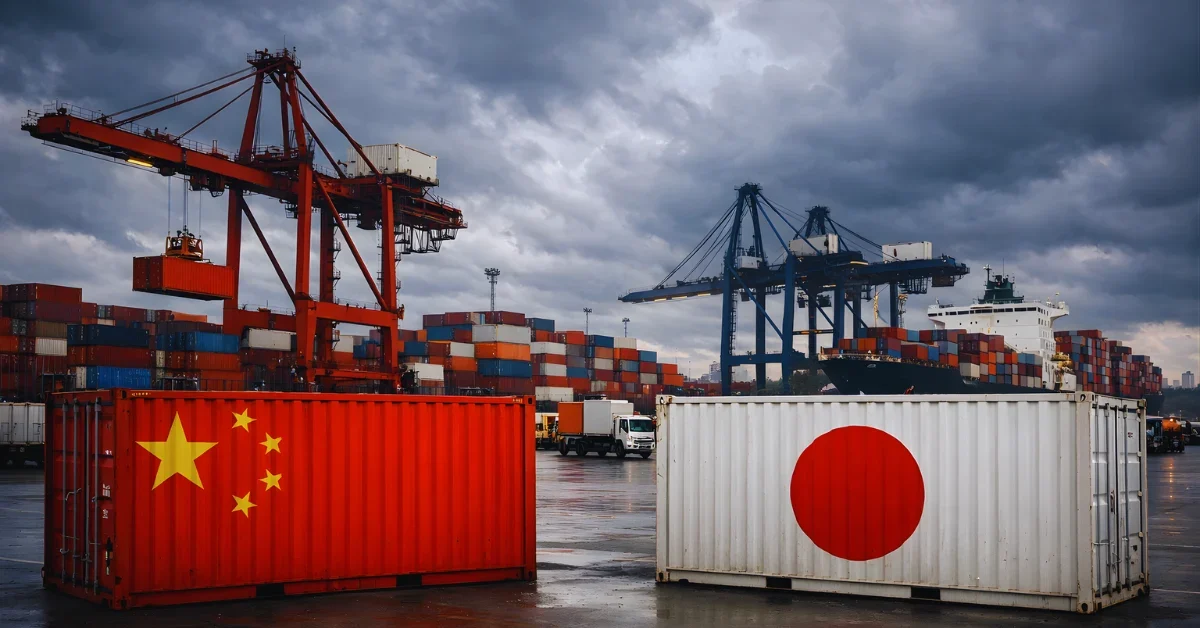
China’s decision to ban exports of dual-use items to Japan has sharply heightened economic and diplomatic tensions between the two nations, threatening key industries and raising wider geopolitical concerns. The dispute stems from comments by Japanese leaders on Taiwan and has already prompted further trade actions, signaling a broader strain in China–Japan relations.
China’s latest export restrictions target items that can serve both civilian and military purposes, and are banned from being sent to Japan if intended for military use. The move elicited strong condemnation from Tokyo, which labeled the ban “absolutely unacceptable and deeply regrettable.” Analysts warn the dispute could extend into critical supply chains such as rare earth minerals and semiconductor materials.
China’s Ban on Dual-Use Items
On January 6, China’s Ministry of Commerce announced a ban on exports of dual-use items to Japan that can contribute to military capabilities, effective immediately. The measure was framed as a response to remarks made by Japanese Prime Minister Sanae Takaichi suggesting that a Chinese attack on Taiwan could represent an existential threat to Japan. Beijing viewed these comments as provocative and cited national security concerns in justifying the export curbs.
Dual-use goods include technologies and materials suitable for both civilian and military applications, such as certain rare earth elements used in drones, microchips, and advanced electronics. China’s expansive export control list covers more than 1,100 dual-use goods and technologies, including medium and heavy rare earths like samarium, dysprosium, and lutetium.
Beijing’s ban bars exports to military users or for any purposes that contribute to Japan’s military strength, and warns that violations by organizations or individuals could incur legal penalties. Japan’s Foreign Ministry lodged a formal protest, urging China to retract the measures and condemning them as outside international norms.
Japan’s Rejection and Economic Risks
Tokyo reacted swiftly to the export ban, with the Japanese government branding the move “absolutely unacceptable” and “deeply regrettable.” Chief Cabinet Secretary Minoru Kihara underscored that measures targeting only Japan deviate from standard international practice. Japan’s stock markets were affected, with key military and heavy industry companies seeing share price declines.
Beyond the immediate ban, markets and policymakers are watching for broader restrictions on rare earth exports, given Japan’s heavy reliance on China for these materials. Japan imports roughly 60 percent of its rare earth needs from China, and tighter controls on these strategic minerals could disrupt manufacturing sectors ranging from electronics to automobiles.
Analysts have noted that a temporary curb similar to past rare earth export restrictions could cost Japanese businesses billions of yen and shave a noticeable percentage off national economic growth. Japan has been diversifying its rare earth supply chains, but remains significantly exposed to Chinese output.
New Trade Action: Anti-Dumping Probe
The dispute escalated further on January 7 when China’s commerce ministry launched an anti-dumping investigation into imports from Japan of dichlorosilane, a key chemical used in semiconductor production. China said domestic producers alleged that imports from Japan rose from 2022 to 2024 while prices declined, hurting local industry performance.
The probe will examine alleged dumping practices from July 1, 2024 to June 30, 2025 and assess potential injury to Chinese producers from early 2022 through mid-2025. A ruling could be issued by January 7, 2027, with a possible six-month extension. Japanese firms named in the complaint include Shin-Etsu Chemical, Air Liquide Japan, and Mitsubishi Chemical Group.
This investigation comes just days after the dual-use export ban and underscores how economic tools are being deployed amid deteriorating diplomatic relations. Beijing’s actions reflect mounting frustrations over Tokyo’s public security statements and are likely to complicate future bilateral trade and technology cooperation.
Broader Implications for East Asia
The trade actions mark one of the sharpest recent escalations between China and Japan, two of Asia’s largest economies. Tensions largely trace back to differing positions on Taiwan and regional security. China considers Taiwan part of its territory and is sensitive to foreign commentary on possible military conflict involving the self-governing island, a stance that Japan and other democracies do not share.
Observers suggest that if China extends restrictions to critical inputs like rare earths more broadly, global supply chains could face disruption given China’s dominant position in processing and exporting these materials. At the same time, Japan may explore countermeasures targeting areas where China depends on Japanese technology.
As the situation unfolds, both governments are under pressure domestically to balance national security interests with economic stability. How Tokyo and Beijing navigate this dispute could influence trade and security dynamics in East Asia for years to come.
