

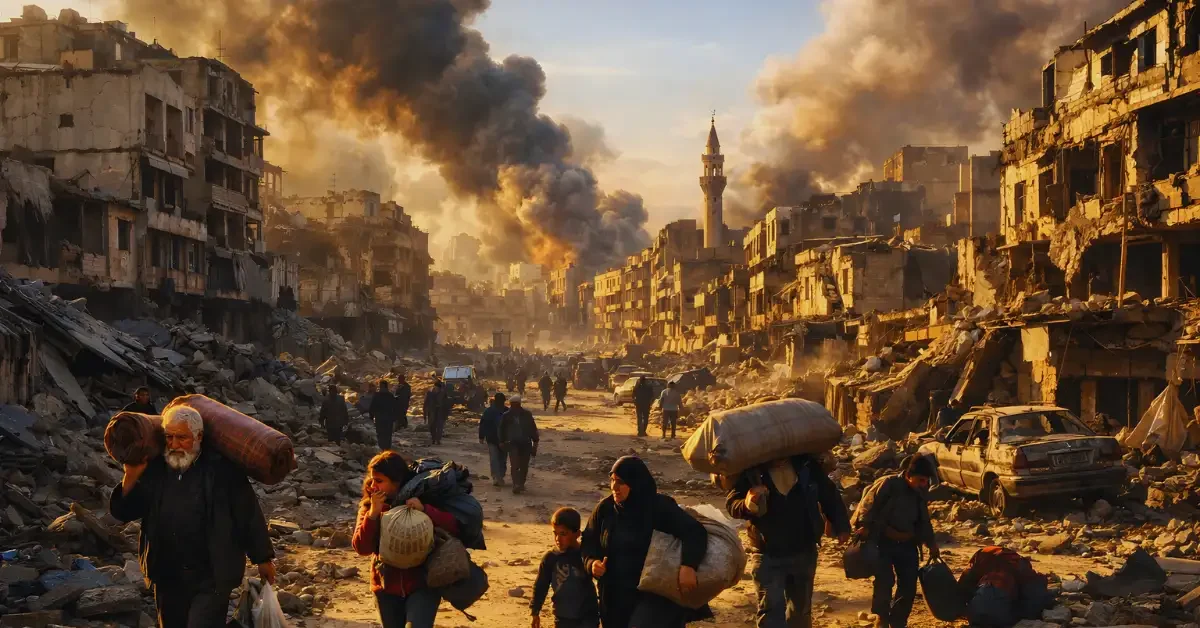
Violence has intensified in Aleppo, Syria, as fighting between the Syrian government and the U.S.-backed Syrian Democratic Forces (SDF) erupts again, forcing residents to flee their homes and deepening the city’s humanitarian crisis. The conflict, centered on predominantly Kurdish neighborhoods, has killed civilians and soldiers, disrupted daily life, and underlined the fragility of peace efforts nearly a year after the Assad government’s fall.
Fierce Fighting and Rising Casualties
Clashes reignited in Aleppo early this week, with violent confrontations leaving multiple people dead and many more wounded. According to state media reports, at least three civilians and one army soldier were killed in renewed hostilities, as the Syrian government and the SDF accused each other of initiating the attacks. The government claimed the SDF “escalated” by striking army positions and residential areas, while the Kurdish-led group denied these allegations, asserting that indiscriminate artillery and missile shelling by factions aligned with the government caused the casualties. Strained relations between the two sides have undermined efforts to integrate the SDF into central government forces, fueling further instability around Aleppo.
Civilians Flee and Daily Life Disrupted
As the violence spread to Aleppo’s Sheikh Maqsoud and Ashrafieh districts, predominantly Kurdish-populated areas, thousands of civilians have fled to safer neighborhoods or taken shelter elsewhere in the city. The clashes have forced the closure of schools, universities, and government departments in parts of Aleppo as insecurity spreads. Transport services, including flights, were suspended as authorities scrambled to manage the worsening situation and ensure civilian safety amid the fighting.
Failed Integration Deal and Lingering Tensions
A key factor complicating the situation is the stalled implementation of a March 2025 agreement aimed at integrating the SDF into the Syrian army by the end of 2025. Both sides have accused each other of delaying or acting in bad faith, leaving a major division in the country’s post-Assad security structure unresolved. The SDF, which gained autonomy and control over significant territory and resources during years of civil war, has been reluctant to relinquish its status, while Damascus has pushed for full reintegration.
International and Local Repercussions
The clashes have raised concerns among regional and international actors. Turkey, which views the Kurdish forces as a terrorist threat because of links to the PKK, has warned of possible broader security implications. Meanwhile, humanitarian agencies and United Nations officials have expressed alarm over the growing civilian toll and displacement, urging all parties to protect noncombatants and pursue political dialogue to prevent further escalation.
As fighting continues, the risk remains that Aleppo’s recent violence could destabilize broader efforts to forge a unified national security framework in post-conflict Syria, prolonging uncertainty for its residents and neighbors alike.
