

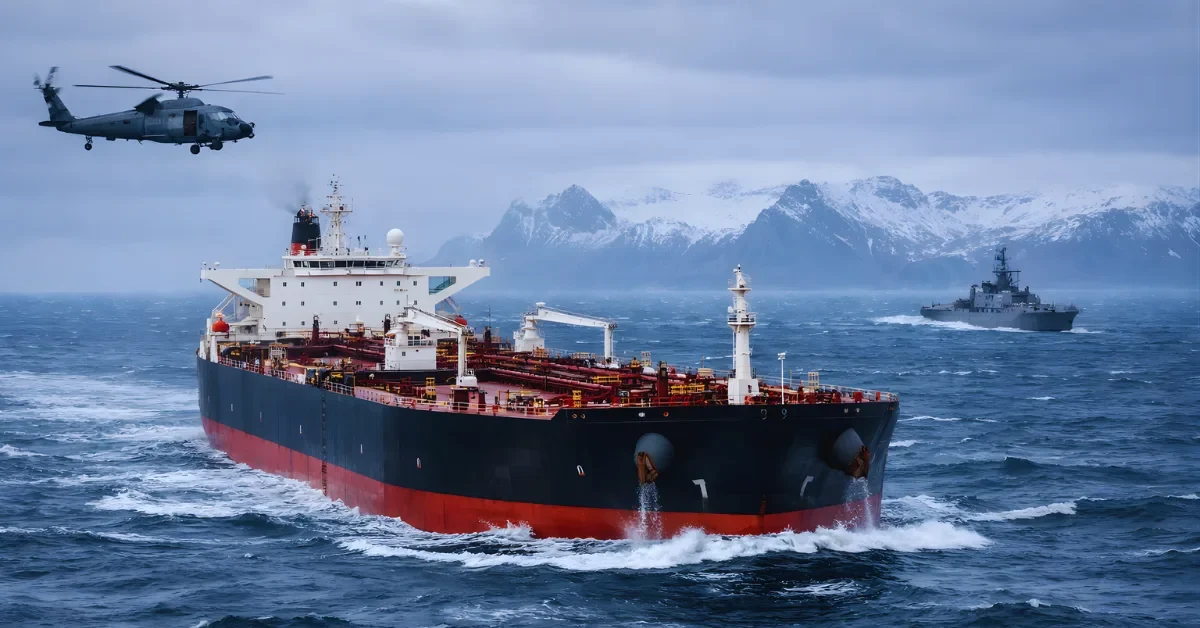
US forces seized the oil tanker Marinera on 7 January off the coast of Iceland after what the US military described as a weeks-long pursuit across the Atlantic. Sky News reported the ship had taken repeated steps to hide or change its identity before the seizure.
The vessel had previously been named Bella 1, according to the US military’s statement cited by Sky News, and it was later tracked using ship and flight data. The Royal Air Force and Royal Navy supported the operation, the UK Ministry of Defence said, including by providing the refuelling ship RFA Tideforce.
A pursuit that ended off Iceland
Sky News’ Data and Forensics team said it tracked Marinera’s movements for more than two weeks leading up to the seizure. The team reported the ship made “multiple efforts to hide its identity” before it was captured on 7 January near Iceland.
Flight-tracking data reviewed by Sky News showed several US aircraft arriving and departing from RAF bases and UK airports in the hours before the ship was seized. Sky News also reported that ship-tracking data and other records suggested the tanker had been trying to evade detection during a voyage that began earlier and stretched across multiple regions.
Tracking data flags identity shifts
Ship-tracking AIS location data placed the tanker about 9 km from the Strait of Hormuz on 3 September, according to data referenced by Sky News from Global Fishing Watch. But Sky News said satellite imagery taken the same day showed the ship more than 700 km away, stationed at Kharg Island, Iran’s primary oil export facility.
Analytics company Kpler told Sky News it assessed the ship loaded crude oil at Kharg Island. Sky News said the mismatch between AIS and satellite imagery suggested the vessel may have been broadcasting a false location signal, a practice known as “spoofing.”
Sky News reported the ship’s signal returned after it left Iranian waters, and that on 13 November it began a journey that later took it into the Suez region. AIS data reviewed by Sky News placed the ship at Egypt’s Suez South anchorage between 23 and 26 November.
Sky News noted it could not confirm whether the ship offloaded oil while in that area, while also stating it could be confident about the vessel’s presence there because ships in the area are required to transmit accurate locations. Sky News reported the tanker later passed through the Strait of Gibraltar on 3 December, another area with mandatory location reporting, before continuing across the Atlantic.
Caribbean sightings and a disputed flag
Sky News reported the ship was last spotted by AIS systems on 17 December in the Caribbean, near Antigua and Barbuda. It also cited reports saying the US Coast Guard attempted to board the tanker on 20 December, saying the United States had a seizure warrant and that the ship was not flying a valid national flag.
Under international law, Sky News said, vessels must be registered under a particular country and rely on that country for protection. Sky News reported the vessel was flying the flag of Guyana, but the US said it was not actually registered there.
Sky News said its analysis found 40 sanctioned tankers were flying the Guyanese flag despite none being registered in Guyana. Sky News also reported that one day after the reported Coast Guard attempt to board Bella 1, the ship made 39 distress calls between 12:26 pm and 5:13 pm.
Those distress calls helped Sky News identify what it described as the ship’s primary position that day, a point just over 500 km from the coast of Antigua and Barbuda. When the ship appeared again on 1 January, Sky News reported it had traveled more than 3,000 km to the North Atlantic, changed its name to Marinera, and adopted a Russian flag.
Seizure details and international reaction
By 7 January, Sky News reported Marinera was passing between Iceland and Scotland. Sky News said reports in The Wall Street Journal claimed the tanker was escorted by a Russian submarine.
Shipping analytics company Windward told Sky News the ship was likely heading to the Russian Arctic port of Murmansk. Sky News reported that at about 11:26 am the vessel made a sudden turn south, and later, around 1:18 pm, was seen heading east toward Scotland using data shared by TankerTrackers.
At 1:43 pm, Sky News reported US European Command announced it had seized the vessel for violations of US sanctions. Mark Cancian, a senior advisor on defence and security at the Center for Strategic and International Studies, told Sky News the helicopters used to board Marinera were short-ranged and said: “Either they came from the US air base on Keflavik, in which case the Icelandic government had to agree, or from a sea platform like the Special Ops mothership.”
After the seizure, Russia’s transport ministry issued a statement saying the action violated maritime law, Sky News reported. The ministry’s statement cited by Sky News said: “In accordance with the 1982 UN Convention on the Law of the Sea, freedom of navigation applies in waters on the high seas, and no state has the right to use force against vessels duly registered in the jurisdictions of other states.”
Sky News also reported Russia’s transport ministry confirmed it had granted the tanker a temporary permit to fly the Russian flag. The seizure has intensified attention on how sanctioned vessels operate across borders and how quickly they can alter names, flags, and tracking patterns.
A second tanker seized the same day
Sky News reported the US announced it seized another tanker, M/T Sophia, shortly after announcing the capture of Marinera. US Southern Command stated the vessel had been “conducting illicit activities” in the Caribbean Sea, Sky News reported.
Sky News said the United States has now seized at least four sanctioned tankers linked to Venezuela, following the capture of vessels Skipper and Centuries in December 2025. Sky News also reported that at least 21 other sanctioned oil tankers changed their flags to Russia in the past month, and said that figure exceeded the number of such flag changes during the whole of 2024.
