

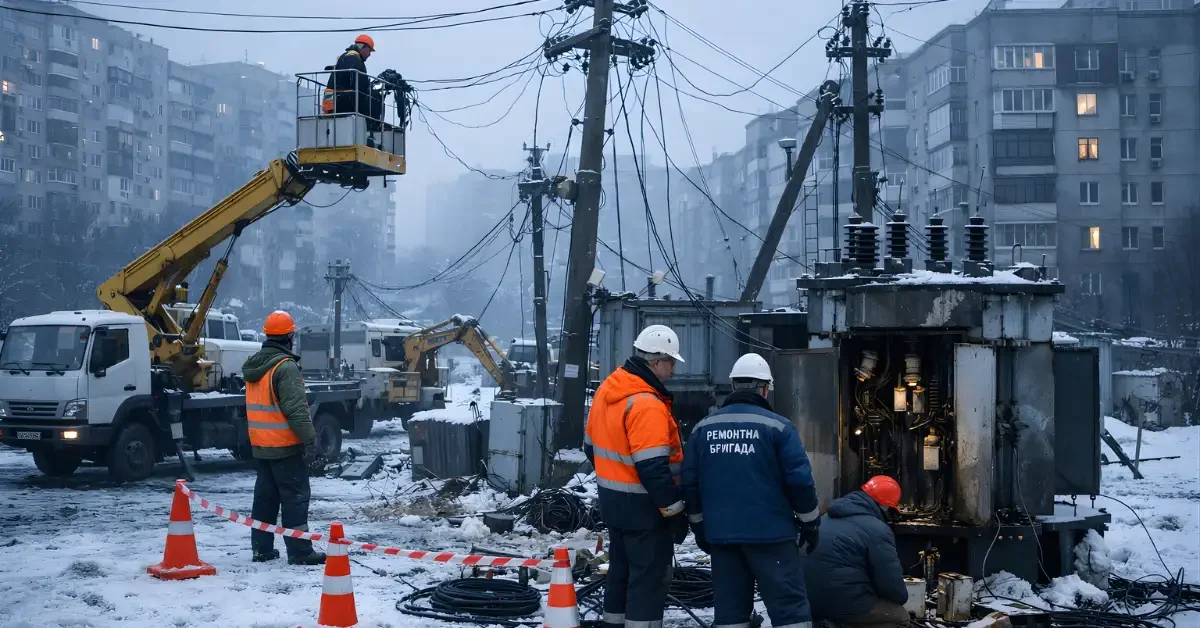
Ukraine’s power grid faced widening disruptions this week after repeated Russian strikes, with officials and energy companies reporting emergency outages and mounting strain on critical infrastructure.
Ukraine’s grid operator Ukrenergo said on Jan. 23 that the country’s energy situation had “significantly” worsened following recent Russian air attacks, triggering emergency power outages in most regions.
Ukrenergo warns of worsening conditions
Ukrenergo said several power generation facilities were undergoing emergency repairs because of the combined impact of the attacks. The operator said equipment was working at the limit of its capabilities and that power units were experiencing heavy overload after earlier damage. Ukrenergo added that it hoped repairs could be completed “in the near future,” allowing a return to planned outage schedules.
Ukraine’s Energy Minister Denys Shmyhal said on Jan. 22 that the country’s power system had endured its most difficult day since a nationwide blackout in November 2022, when Russia began attacking the power grid. Shmyhal said the situation was extremely difficult due to factors tied to Russian shelling, including damage to generation infrastructure and destroyed distribution networks and transformers. He said energy workers were being forced to continue emergency shutdowns and that Ukrenergo was applying special schedules to preserve the integrity of the power system.
Strikes hit multiple regions
On Jan. 19, Ukrainian officials said Russia launched a barrage of drone attacks on energy infrastructure overnight, cutting off power in five regions during freezing weather and higher demand. Ukraine’s air force said Russia launched 145 drones and that air defenses shot down 126 of them. Ukraine’s energy ministry said consumers in the Sumy, Odesa, Dnipropetrovsk, Kharkiv, and Chernihiv regions were experiencing power outages and that emergency repairs were underway depending on security conditions.
In Odesa, the regional governor said energy and gas infrastructure were damaged and that one person was injured. DTEK, Ukraine’s largest private energy provider, said its facility in Odesa was significantly hit, leaving 30,800 households without electricity. In Chernihiv, a local grid operator said five critical energy sites were damaged, affecting tens of thousands of residents.
Kyiv heating and water disruptions
Kyiv also reported major disruptions after combined drone and missile strikes, with officials describing widespread impacts during below-freezing temperatures.
Kyiv Mayor Vitali Klitschko said the attacks cut power and water supplies for many homes and left about 5,000 residential buildings without heating. Energy company DTEK said more than 335,000 Kyiv residents were left without electricity after the overnight strikes.
Kyiv regional governor Mykola Kalashnyk said a 50-year-old man died in the attack, and he added that two fuel stations were damaged. Klitschko said around 80% of the buildings affected were ones where heat supply had been restored after a Jan. 9 attack. Ukraine’s Deputy Foreign Minister Mariana Betsa said “almost half of Kyiv is in blackout right now.”
Other reports also described heating disruptions in Kyiv after overnight strikes. Bloomberg reported that Klitschko said the barrage left more than 5,000 of the city’s high-rise buildings without heating and that Kyiv’s eastern districts were left without water supply. Anadolu Agency reported that Kyiv authorities said 5,635 high-rise buildings lost access to heating, and that the left bank of the city remained without water supply following the attack.
Shmyhal said the most difficult situation was in Kyiv, the Kyiv region, and the Dnipropetrovsk region, according to Anadolu Agency. He said 165 repair crews worked during the day to restore heat to residences in Kyiv, and that work was complicated by security conditions. Shmyhal also said cases of physical aggression against repair crews were unacceptable.
Blackout risk and nuclear links
Reuters also reported concerns about the risk of broader power failures linked to attacks on substations that help deliver nuclear-generated electricity to consumers.
Reuters said Ukraine’s grid relies almost entirely on electricity produced by nuclear power plants and has already lost half of its generating capacity. In a separate Reuters explainer, President Volodymyr Zelenskiy was cited as saying Russia wants to strip Ukraine of energy by targeting substations that deliver nuclear power to consumers, raising the risk of a total blackout.
Reuters reported that Ukraine operates three nuclear power stations, while the Zaporizhzhia nuclear power plant is under Russian control and is inactive. Reuters also reported an estimated generation shortfall of about 10 gigawatts that is mitigated by imports, alongside rolling blackouts in which entire regions can face extended outages. An unnamed industry source cited by Reuters said nuclear generation accounted for up to 80% of Ukraine’s energy consumption, while much of Ukraine’s thermal power generation had been incapacitated by Russian air attacks.
International Atomic Energy Agency chief Rafael Grossi said key Ukrainian power substations had been “affected” by recent Russian missile strikes, Reuters reported. Reuters also cited Kharchenko as saying there had been no attacks on substations at nuclear power plants, but that Russia had targeted substations far from power units at least 60 times during the war. Kharchenko said such damage typically takes a couple of days to repair, though the industry source said nuclear facilities have often had to reduce reactor output because of these strikes.
Peace talks amid strikes
As strikes continued, Ukrainian officials also pointed to the pressure that repeated attacks place on diplomacy.
CityNews reported that a Ukrainian negotiating team arrived in the United States on Saturday, and President Zelenskyy said the delegation’s main task was to convey how relentless Russian strikes are undermining diplomacy. CityNews also reported that Zelenskyy said the delegation would try to finalize documents with U.S. officials for a proposed peace settlement related to postwar security guarantees and economic recovery.
