

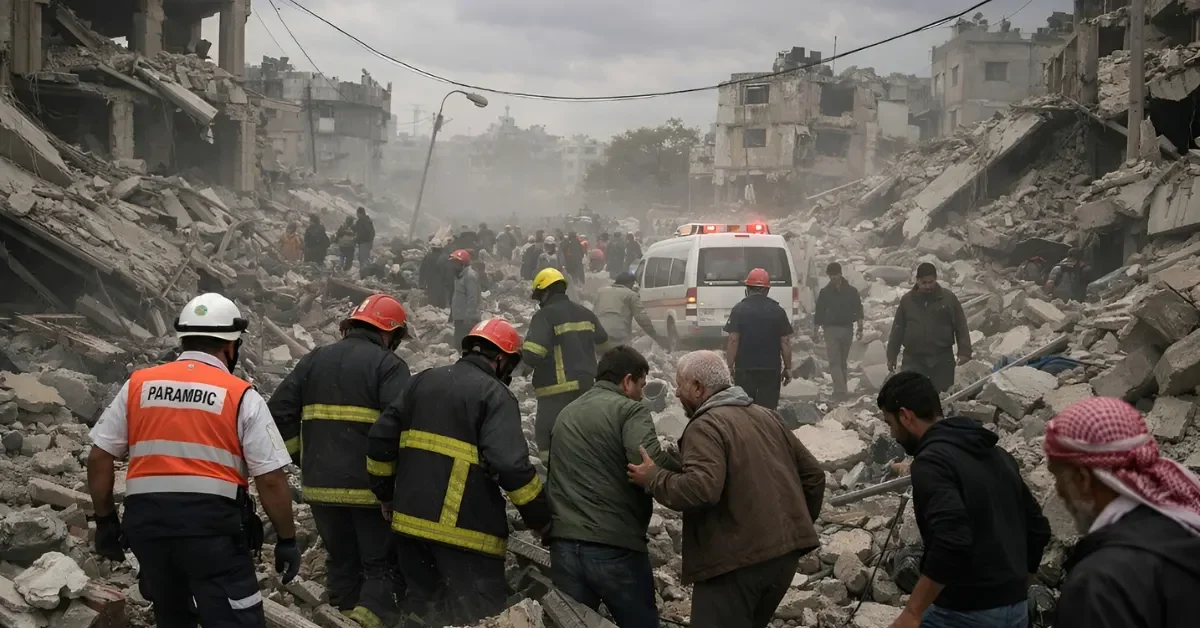
Israeli tank shelling and airstrikes have killed up to 21 Palestinians in Gaza, including several children, following a flare-up of violence on Wednesday. The renewed hostilities have disrupted critical medical evacuations, with Palestinian officials reporting that patient transfers through the Rafah border crossing were abruptly halted.
The strikes, which targeted Gaza City in the north and Khan Younis in the south, came in response to an attack on Israeli forces. According to the Israeli military, tanks fired on Gaza and airstrikes were launched after a gunman opened fire on Israeli soldiers, seriously injuring a reservist. The escalation marks a significant breach in the fragile calm, prompting warnings from Hamas about the potential for further consequences if ceasefire violations continue.
Conflicting Casualty Reports
Reports from the ground indicate a high civilian toll, though sources provide slightly different figures regarding the number of casualties. The Gaza health ministry, which operates under Hamas authority, stated that 21 people were killed and 38 others wounded in the series of strikes. According to this count, the dead included three children and 18 other individuals.
In contrast, other Palestinian officials cited by international news agencies reported a death toll of 18, including four children. This figure was corroborated by reports detailing the aftermath in both Gaza City and Khan Younis. Separately, overnight attacks across Gaza reportedly killed 10 Palestinians, adding to the mounting casualty count reported by local sources over the 24-hour period.
The violence has once again placed civilians in the crosshairs, with families in Khan Younis and Gaza City bearing the brunt of the heavy shelling and aerial bombardment.
Rafah Crossing Dispute Leaves Patients Stranded
The violence has had immediate repercussions for humanitarian operations, specifically the evacuation of critically ill patients. Palestinian health officials reported that Israel halted the passage of patients through the Rafah border crossing into Egypt on Wednesday. This closure came just two days after the crossing had been reopened to allow a “trickle” of Palestinians to leave for medical treatment—the first such movement in months.
The sudden halt left many vulnerable patients in limbo. A spokesperson for the Red Crescent explained that patients had already been transported to a hospital in Khan Younis in preparation for their transfer across the border. However, upon arrival, they were informed that the evacuations had been postponed by Israeli authorities.
Raja’a Abu Teir, a Palestinian patient who was awaiting evacuation, described the confusion and despair at the hospital. “They called the patients and said today there is no travel at all, the crossing is closed,” she said while waiting in an ambulance with other patients who had hoped to receive treatment in Egypt.
Claims of Coordination Failures
While Palestinian officials and patients on the ground reported a closure, Israeli authorities offered a different explanation for the stalled evacuations. COGAT, the Israeli agency responsible for coordinating access to Gaza, denied that the crossing was closed. In a statement issued Wednesday, the agency asserted that the Rafah crossing remained open but that the transfer of patients could not proceed because they had not received the necessary coordination details.
COGAT placed the responsibility on the World Health Organization (WHO), stating that the lack of coordination information from the UN body prevented the facilitation of the crossings. As of late Wednesday, the WHO had not issued an immediate response to requests for comment regarding the stalled evacuations or the specific coordination issues cited by Israel.
Ceasefire Warnings and Political Context
The renewal of hostilities and the closure of the crossing occur against a backdrop of heightened political tension. The reopening of the Rafah crossing earlier in the week had been viewed as a positive step, reportedly part of a broader plan by President Donald Trump’s administration to ease humanitarian conditions in the enclave.
However, the latest violence threatens to unravel these efforts. Following the strikes, Hamas issued a stark warning, stating that there would be “serious consequences” if Israel continued what the group described as ceasefire violations in Gaza. The exchange of fire and subsequent diplomatic fallout underscore the fragility of the current situation, where local incidents can rapidly escalate into broader conflict, instantly freezing humanitarian initiatives and endangering civilian lives.
