

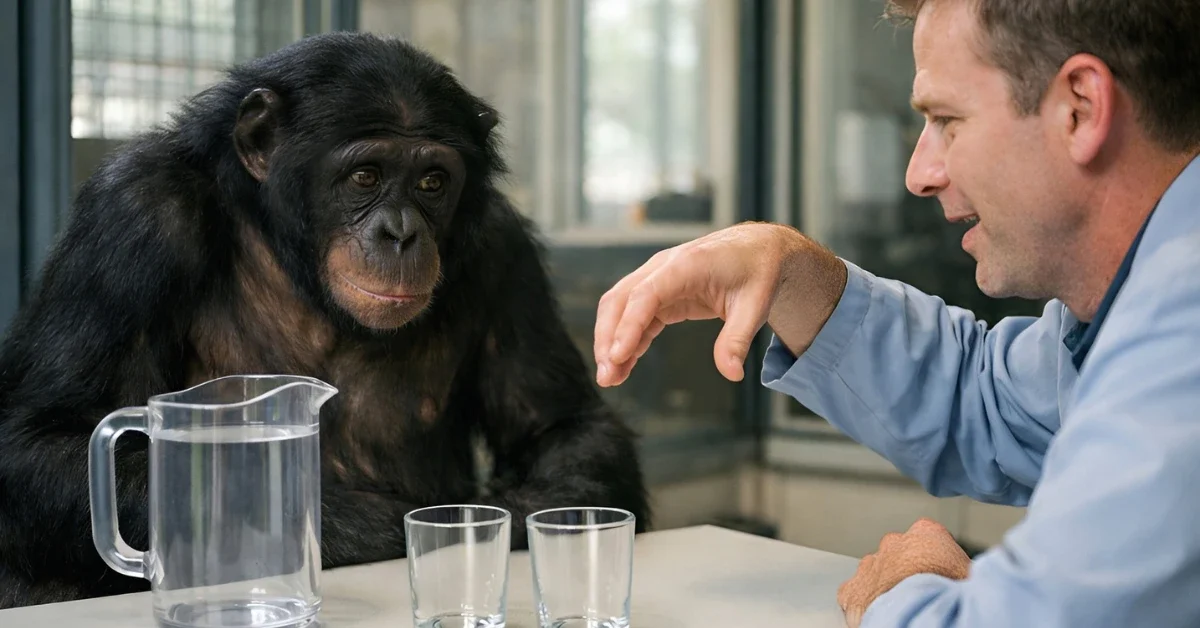
In a groundbreaking discovery that challenges long-held beliefs about what makes humans unique, scientists have confirmed that bonobos are capable of using their imaginations. The revelation comes from a new study published Thursday in the journal Science, detailing a series of experiments where a famous bonobo named Kanzi engaged in “pretend play” during a make-believe tea party. The findings suggest that the cognitive building blocks for imagination may have evolved at least 6 to 9 million years ago, long before humans split from their closest primate relatives.
For decades, the ability to play pretend—such as a child hosting a tea party with empty cups or using a banana as a telephone—was considered a distinctly human trait. While anecdotal reports of great apes playing with imaginary objects have existed for years, this study marks the first time the behavior has been experimentally confirmed in a controlled setting. The results indicate that great apes can not only track imaginary objects in their minds but also distinguish between simulated scenarios and reality.
The Invisible Juice Experiment
To test Kanzi’s capacity for imagination, researchers from Johns Hopkins University and the Ape Cognition and Conservation Initiative designed a series of interactions resembling childhood games. The experiments took place before Kanzi passed away in March 2025 at the age of 44.
In the primary experiment, a researcher sat across from Kanzi with an empty, clear pitcher and two transparent glasses. The researcher then pantomimed the action of pouring “invisible juice” from the pitcher into the glasses. To test Kanzi’s ability to follow the imaginary narrative, the researcher then pretended to pour the contents of one glass back into the pitcher, leaving the other glass “full” of the make-believe liquid.
When asked to identify which glass contained the juice, Kanzi pointed to the correct cup—the one that would have held liquid if the scenario were real. Across 50 different trials, Kanzi successfully identified the “full” cup 34 times, achieving a success rate of 68%. Researchers noted that this performance was significantly above chance, suggesting he was not merely guessing but was actively visualizing the location of the imaginary object. A similar test conducted with “invisible grapes” yielded virtually identical results, with Kanzi correctly tracking the pretend fruit in 69% of the trials.
Distinguishing Fantasy from Reality
One critical question for the research team was whether Kanzi genuinely understood he was playing a game or if he simply believed the cups contained real food due to confusion. To verify this, the team set up a control experiment involving real juice—a treat Kanzi was known to love.
Researchers placed two cups in front of him: one containing actual juice and another that had been “filled” with invisible juice. If Kanzi were confused and believed the pretend juice was real, scientists expected he would choose between the two cups randomly. Instead, Kanzi demonstrated a clear preference, selecting the cup with the real juice in 14 out of 18 trials, or nearly 78% of the time.
Christopher Krupenye, a co-author of the study and professor at Johns Hopkins University, explained that this differentiation is crucial. It proves that Kanzi could hold two distinct concepts in his mind simultaneously: the reality of the empty cup and the imagined layer of “juice” superimposed upon it. This cognitive leap is similar to what developmental psychologists observe in human children around the age of two.
A Legacy of Language and Learning
Kanzi was no ordinary ape. Born in captivity in 1980, he became world-renowned for his linguistic abilities. He learned to communicate with humans using a keyboard of symbols called lexigrams, mastering hundreds of words and understanding spoken English sentences.
His journey into language began accidentally. As an infant, Kanzi would cling to his mother, Matata, while researchers tried to teach her lexigrams. While Matata struggled with the training, Kanzi quietly absorbed the lessons. By the time researchers shifted their focus to him, he had already begun to grasp the system. This unique background may have primed his brain for the abstract thinking required in the tea party study. However, researchers believe the underlying capacity for imagination is likely innate to the species rather than a result of his training alone.
Rethinking Human Uniqueness
The implications of the study extend far beyond a single animal. By demonstrating that bonobos can engage in shared pretense, the findings push back the timeline for the evolution of imagination. If both humans and bonobos possess this trait, it was likely present in the last common ancestor of the two species.
Kristin Andrews, a philosophy professor who specializes in animal cognition, noted that this ability serves a vital evolutionary purpose. Imagination allows a creature to simulate actions in their mind before performing them in the high-stakes environment of the real world. It enables testing potential outcomes without the risk of physical failure.
Experts like Gisela Kaplan from the University of New England also pointed out the striking similarities between Kanzi’s behavior and human child play. Just as children serve tea in tiny cups or offer non-existent cake to dolls, Kanzi was able to participate in a shared social construct of “make-believe.”
While Kanzi did not initiate the pretend play himself—he followed the lead of the human researchers—his participation offers the strongest evidence yet that the spark of imagination is not unique to humanity. It reveals a mind capable of moving beyond the immediate physical world, a trait that may be as ancient as it is profound.
