

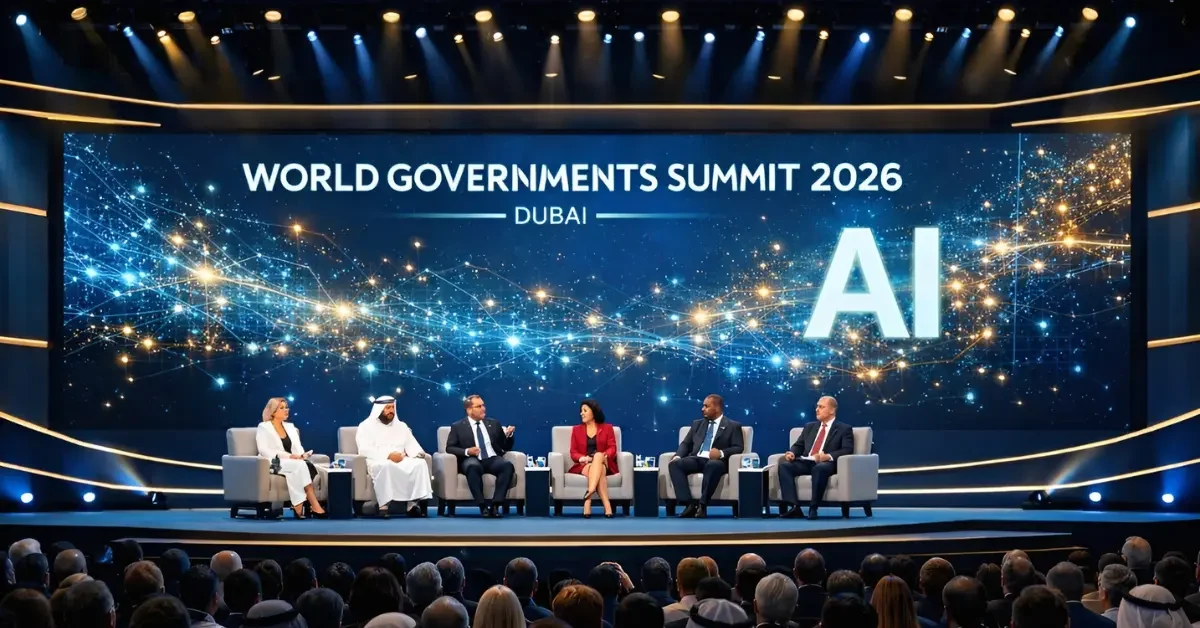
Artificial intelligence (AI) has emerged as the defining force reshaping global governance, economy, and daily life, according to leaders gathered at the World Governments Summit (WGS) 2026. Held in Dubai from February 3 to 5, the summit marked its largest edition to date, hosting more than 6,250 participants, including 40 heads of state and over 500 ministers.
From the halls of Madinat Jumeirah, global decision-makers sent a unified message: AI is no longer just a technological tool but the central pillar of future government policy. Mohammed Al Gergawi, UAE Minister of Cabinet Affairs and WGS Chairman, opened the event by identifying AI as a force fundamentally altering the relationship between states and citizens. He noted that AI governance is a present reality requiring immediate frameworks, not a distant future challenge.
Global Leaders Dismiss “AI Bubble” Fears
A major highlight of the summit was a definitive stance on the financial sustainability of artificial intelligence. In a widely discussed session, Alibaba Group Chairman Joe Tsai rejected concerns about an “AI bubble.” Tsai argued that the current surge in investment is merely the early stage of a technological shift comparable to the dawn of the internet.
Tsai drew parallels to the late 1990s, pointing out that companies viewed as overvalued during the dot-com era, such as Amazon and Google, eventually matured into trillion-dollar enterprises. His comments reinforced a broader sentiment at the summit that the transformative potential of AI justifies the massive capital currently flowing into the sector.
New Era of Infrastructure and Scientific Discovery
The summit served as a launchpad for significant infrastructure and scientific announcements. The Roads and Transport Authority signed a landmark agreement with The Boring Company to construct the “Dubai Loop,” an underground tunnel transit system. The project’s first phase will connect the Dubai International Financial Centre to Dubai Mall, marking The Boring Company’s first expansion outside the United States.
In the scientific arena, the World Laureates Association announced it would move its global headquarters from China to Dubai. Nobel laureate Professor Roger Kornberg also unveiled plans for a new AI agent network designed to connect researchers worldwide, enabling collaborative discovery across borders. Additionally, Oura CEO Tom Hale demonstrated how biometric AI could soon predict health outcomes years in advance, signaling a shift toward more preventive healthcare systems.
Redefining Digital Lifestyles and Governance
Tech leaders emphasized that the digital experience is evolving from simple connectivity to intelligent assistance. Speaking at the summit, Khalifa Al Shamsi of e& International described how telecom companies are transitioning into broad technology platforms. He cited India’s UPI and Brazil’s Pix as examples of how government-backed infrastructure can accelerate digital adoption for underbanked populations.
Panelists like Daniel Gallager of Robinhood and Ashish Koshy of Inception discussed the rise of “AI agents”—systems that perform tasks on behalf of users. Koshy noted that the next phase of digital life will allow people to express intent, such as “renew my permit,” and let intelligent systems navigate the complex steps required to complete the task.
This concept of “agentic AI” was further explored in discussions on public sector trust. Experts suggested that deploying autonomous AI agents could move administrations toward “glass box governance,” where civil servants have absolute visibility into service delivery processes, thereby increasing transparency and efficiency.
Canada and Global Partnerships
International collaboration remained a key focus, with Canada leading a prominent delegation organized by SCALE AI. The mission aimed to translate a 2025 memorandum of understanding between Canada and the UAE into concrete business outcomes.
During the event, Ontario-based company MetaWorldX announced an agreement with Tadoom, a leading IoT firm in Oman. The partnership will focus on developing digital twin solutions for smart cities across the Middle East. Canadian ministers and industry leaders highlighted these agreements as evidence of the growing demand for expertise in responsible, human-centred AI.
