

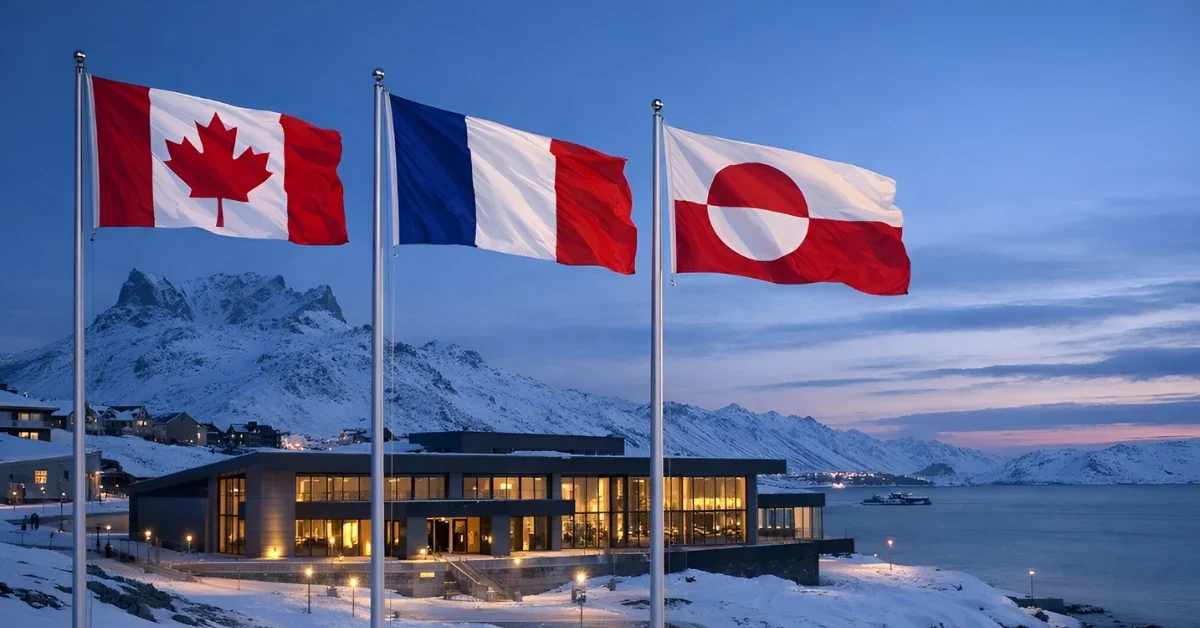
Canada and France have officially opened new diplomatic consulates in Nuuk, Greenland, establishing a stronger presence in the Arctic territory. The move comes as a direct show of support for their NATO ally, Denmark, following renewed pressure from U.S. President Donald Trump regarding American control over the island.
The consulate openings on Friday, February 6, 2026, mark a significant deepening of ties between Nuuk, Ottawa, and Paris. While officials from both nations emphasized friendship and cooperation, the timing of the diplomatic expansion highlights growing concerns among Western allies about Washington’s assertive stance on Arctic security.
Diplomatic Expansion in Nuuk
Ceremonies in Greenland’s capital featured flag-raisings and high-level delegations, underscoring the importance both Canada and France place on their relationship with the semi-autonomous Danish territory. The openings bring the number of diplomatic missions in Nuuk to a new high, joining existing consulates from the United States and Iceland.
Canadian Delegation and Arctic Strategy
Canadian Foreign Minister Anita Anand traveled to Nuuk to preside over the inauguration of the Canadian consulate. She was joined by Governor General Mary Simon, Canada’s first Indigenous governor general, symbolizing the deep cultural connections between Canada’s Inuit population and Greenlanders.
During the event, Anand described the consulate as a testament to Canada’s enduring commitment to the region. She stated that the new mission would allow the country to “stand united with the people of Greenland and Denmark on many issues.” According to Global Affairs Canada, the move is intended to strengthen partnerships with the Kingdom of Denmark while fostering closer collaboration on critical issues such as climate change, economic resilience, and Arctic security.
The establishment of the consulate is a key component of Canada’s Arctic Foreign Policy, which was initially unveiled in December 2024. Canadian Prime Minister Mark Carney has also pledged to bolster the nation’s military and security presence in the far North, further signaling Canada’s intent to protect its sovereignty and interests in the region.
France Becomes First EU Nation with Greenland Consulate
France also cemented its diplomatic footprint on Friday, becoming the first country from the European Union to establish a consulate general in Greenland. Jean-Noël Poirier, a seasoned diplomat with previous experience in Vietnam and Libya, has been appointed as the new consul general.
Speaking at a press briefing in Nuuk, Poirier emphasized that his role focuses on building bridges rather than political posturing. He clarified that his appointment was not meant as a “signal” to the American administration but rather as a gesture of goodwill toward Greenland and Denmark. Poirier noted that his initial priorities would include listening to the needs of the local population and advancing scientific and cultural initiatives.
The French Foreign Ministry released a statement reiterating its “commitment to respecting the territorial integrity of the Kingdom of Denmark.” The plans for the French mission were first announced by President Emmanuel Macron during a visit to the island in June of last year.
Tensions Over U.S. Interest in Greenland
The diplomatic activity in Nuuk unfolds against a backdrop of heightened geopolitical friction. Since returning to the White House, President Donald Trump has renewed his efforts to secure greater U.S. control over Greenland, citing national security concerns and the island’s strategic value.
Tensions escalated recently when the U.S. administration threatened tariffs in an effort to pressure Denmark regarding the territory’s status. However, President Trump dropped the tariff threat following a meeting with NATO Secretary-General Mark Rutte. According to reports, Trump stated that a “framework” for a security deal in the Arctic had been reached, though specific details of the agreement remain undisclosed.
The United States has maintained its own consulate in Nuuk since reopening it in 2020, decades after it was closed in 1953. The Trump administration has argued that Denmark is unable to adequately defend the vast island, a claim that has caused friction within the NATO alliance. A working group involving the U.S., Denmark, and Greenland has been established to discuss Washington’s security concerns.
A Message of Solidarity
While the new consulates are tasked with practical matters like consular services and economic cooperation, they also serve as a political signal. The simultaneous arrival of Canadian and French diplomats offers a visible counterweight to U.S. pressure, reinforcing the sovereignty of the Kingdom of Denmark.
Christophe Parisot, the French Ambassador to Denmark, noted that the consulate represents more than a symbolic act, describing it as a tangible demonstration of the alliance between the three European nations. Similarly, statements from Global Affairs Canada highlighted the “deep ties of friendship” and “centuries of connections” that link the Arctic neighbors.
Despite the geopolitical maneuvering, local and visiting officials maintained a focus on cooperation. According to reports, Foreign Minister Anand met with her Danish counterpart, Lars Løkke Rasmussen, as well as Greenland’s Foreign Minister, Vivian Motzfeldt, to discuss the path forward for Arctic stability.
