

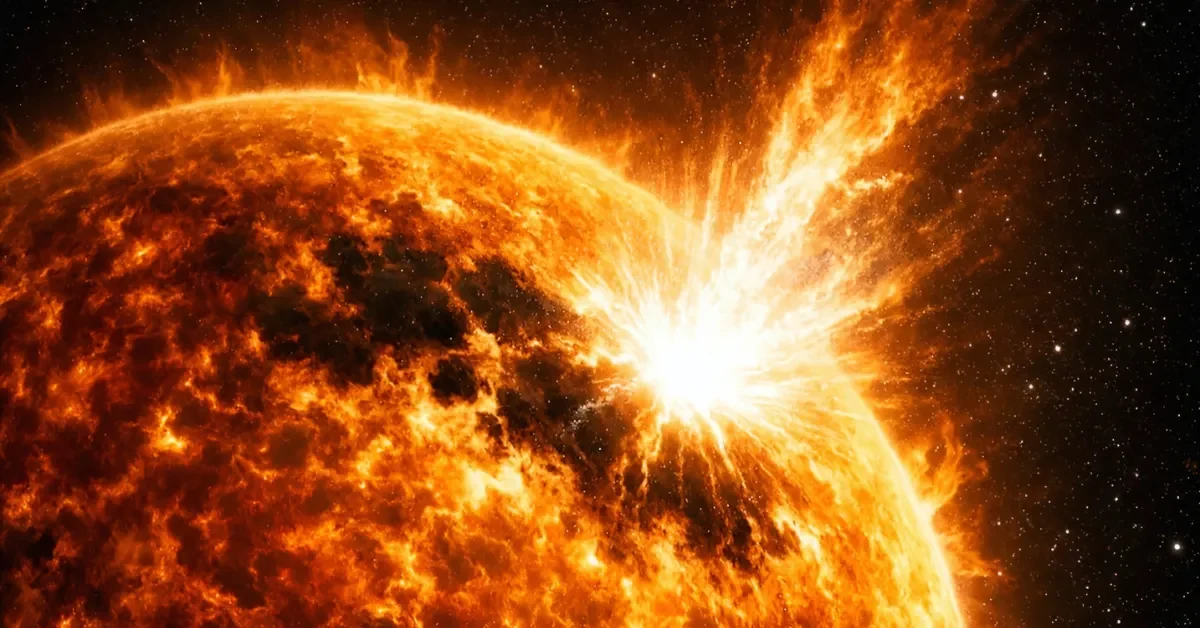
The sun has unleashed an extraordinary barrage of energy toward Earth, marking a significant spike in solar activity that began earlier this month. Space weather agencies have reported a series of powerful eruptions, including a massive X8.1 solar flare and a colossal X4.2 flare. These intense bursts of radiation have already triggered radio blackouts across multiple continents, disrupting communications and putting space agencies on high alert.
Since February 1, the sun has been exceptionally active, emitting a steady stream of strong flares. This recent volatility has drawn the attention of scientists worldwide as a new and volatile sunspot rotates to face our planet. The intensified solar weather has resulted in tangible effects on Earth, specifically targeting high-frequency radio signals used for navigation and communication.
Major Eruptions Rock the Inner Solar System
The most notable event in this recent surge is the detection of an X8.1 solar flare. This flare originated from a highly active area on the sun’s surface identified as Region 4366. The Space Weather Prediction Center (SWPC) under the National Oceanic and Atmospheric Administration (NOAA) confirmed this strong flare, highlighting the sheer intensity of the event.
Just prior to this massive eruption, the sun produced a colossal X4.2 solar flare. This specific blast was powerful enough to cause immediate disruptions here on Earth. Reports confirm that the X4.2 flare knocked out radio signals across large parts of Africa and Europe. The radiation from these flares travels at the speed of light, ionizing the top of Earth’s atmosphere upon arrival and causing a temporary loss of signal for aviators, mariners, and ham radio operators in the sunlit hemisphere.
In addition to the impact on Africa and Europe, scientists have revealed that powerful solar flares were also responsible for radio blackouts observed in the South Pacific. This global range of disruptions underscores the severity of the current solar cycle and the far-reaching influence of our star’s magnetic activity.
Agencies Issue Warnings for Radio Blackouts
The relentless pace of these eruptions has prompted official warnings from major space agencies. The Indian Space Research Organisation (ISRO) has issued specific alerts regarding the potential for strong radio blackouts. With the sun described as “angry” due to its volatile behavior, ISRO warned that India was at risk of experiencing disruptions similar to those seen in other parts of the world.
The concerns raised by ISRO and other agencies focus on the continuous nature of the flares. Since the beginning of February, the sun has been emitting not just the extreme X-class flares, but also numerous M-class flares. While M-class flares are generally smaller than X-class events, a rapid succession of them can still cause significant disturbances to Earth’s ionosphere.
The warnings indicate that the high-frequency radio bands are most vulnerable. These blackouts can last for minutes or even hours depending on the duration and intensity of the flare. As the volatile sunspot regions continue to evolve and rotate, the potential for further communication breakdowns remains a primary concern for monitoring stations.
Understanding the Power of X-Class Flares
To understand the magnitude of these events, it is helpful to look at how scientists classify solar flares. They are categorized by their strength, with X-class flares being the most intense type. The number following the letter provides more specific information about the flare’s strength. An X2 is twice as intense as an X1, and an X8.1 is significantly more powerful than the X4.2 that affected Africa and Europe.
The source of this chaos, Region 4366, is a complex area of magnetic activity on the sun. Sunspots like these are darker, cooler areas on the solar surface where magnetic fields are particularly strong and twisted. When these magnetic lines snap and realign, they release the massive bursts of energy we see as flares.
The current activity suggests that the sun is in a phase of high magnetic tension. The emergence of these volatile regions and the subsequent barrage of flares are characteristic of the sun’s natural 11-year cycle. However, the intensity of an X8.1 flare makes it a standout event, drawing scrutiny from astronomers who are tracking the potential for Coronal Mass Ejections (CMEs) that often accompany such flares.
Monitoring the Volatile Sun
Space weather forecasters are keeping a close watch on the sun as it continues this period of high activity. The sequence of events starting from February 1 shows no immediate signs of stopping. With new volatile sunspots turning toward Earth, the possibility of more flares remains high.
The disruption of communications in Africa, Europe, and the South Pacific serves as a reminder of modern society’s vulnerability to space weather. As agencies like NOAA and ISRO continue to monitor Region 4366 and other active areas, they provide critical data that helps protect satellite operations and power grids on the ground. For now, the world watches as the sun continues its spectacular and disruptive display.
