

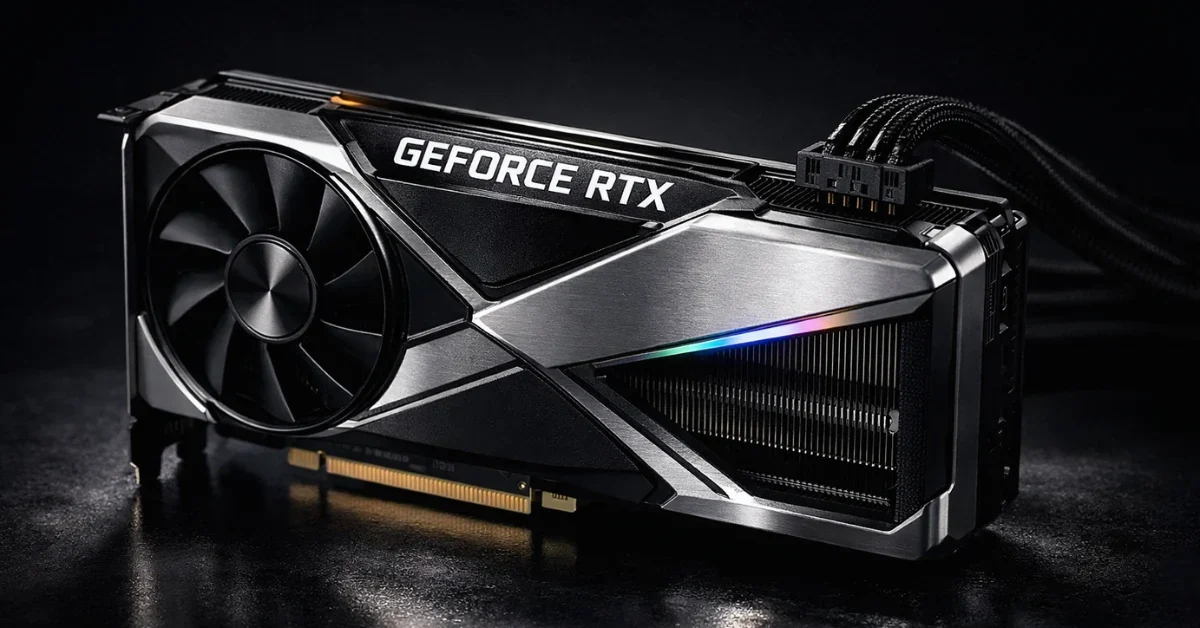
Nvidia appears poised to break with decades of tradition by skipping new gaming graphics card launches for an extended period, with its next-generation RTX 6090 potentially not arriving until 2028. The unprecedented delay stems from a severe memory supply crisis and the company’s strategic pivot toward artificial intelligence chips that deliver significantly higher profit margins.
The gaming GPU market faces a prolonged drought as Nvidia prioritizes memory resources for its booming data center and AI accelerator business. According to industry reports, the company may not release any new gaming GPUs throughout 2026, with the RTX 60 series not entering production until late 2027 or early 2028. This would mark the longest gap between major gaming GPU generations in modern computing history and effectively end the traditional two-year product cycle that gamers have come to expect.
Memory Shortage Drives Strategic Shift
The global memory supply crunch has created intense competition for high-bandwidth memory between gaming GPUs and AI accelerators. Memory manufacturers have already locked up their production capacity, with SK hynix reporting that its HBM is completely sold out through 2026 and Samsung confirming that customers are secured for upcoming output. Micron CEO Sanjay Mehrotra acknowledged that memory markets will likely remain tight past 2026, further constraining availability for consumer products.
Nvidia is actively reducing production of GeForce GPUs to free up capacity for its AI and enterprise segments. From the company’s perspective, this represents sound business strategy rather than operational failure. An AI accelerator generates substantially higher margins than a GeForce card, making the allocation decision straightforward in a resource-constrained environment. Nvidia even acknowledged the memory constraint in a statement to Seeking Alpha, confirming the supply challenge facing consumer products.
AI Business Transforms Company Priorities
Nvidia’s financial transformation explains why gaming has become a secondary concern. The company’s data center revenue reached approximately 51.2 billion dollars out of 57 billion dollars total in the third quarter of fiscal year 2026, representing roughly 90 percent of its business. Gross margins have climbed to 75 percent, up from 72.7 percent the previous year and substantially higher than the 62 percent figure posted in fiscal year 2020. Operating income reached 81.5 billion dollars in fiscal year 2025, representing a 147 percent year-over-year increase.
This dramatic shift reflects how AI has rewired Nvidia’s entire growth engine. The company has evolved from primarily a gaming chip manufacturer into what functions as a full-stack AI platform provider. With data center products now accounting for the majority of growth and maintaining software-like profitability margins, directing scarce memory supplies toward AI products follows basic financial logic.
CES 2026 Signals New Direction
Nvidia’s CES 2026 keynote on January 5 underscored the company’s changing priorities. For the first time in roughly five years, Nvidia stood on the CES stage without announcing a new GPU or teasing the next RTX generation. Instead, the company showcased the Vera Rubin platform and launched its flagship NVL72 AI supercomputer, both scheduled for production in the second half of 2026.
Vera Rubin represents a fundamental departure from conventional GPU releases. Nvidia describes it as a rack-scale computing platform built from multiple classes of silicon designed, validated, and deployed together. Each rack integrates 72 Rubin GPUs and 36 Vera CPUs into a single logical system. According to Nvidia, each Rubin GPU can deliver up to 50 PFLOPS of NVFP4 compute for AI inference using low-precision formats, roughly five times the throughput of its Blackwell predecessor in similar inference workloads.
Gaming Market Faces Extended Wait
The delayed roadmap has significant implications for PC gaming. The GeForce RTX 50 series remains Nvidia’s current flagship offering, with the RTX 5090 carrying a manufacturer’s suggested retail price starting at 1,999 dollars. However, third-party trackers show listings reaching as high as 4,438 dollars on Amazon, reflecting market scarcity and demand. Reports indicate that Nvidia may also completely cancel the planned Blackwell refresh, which would have included models such as the RTX 5080 Super or 5070 Super intended to bridge the gap until the next generation.
The situation leaves gamers with limited options, as AMD is not expected to launch real next-generation products in 2026 and 2027 either. AMD’s upcoming RDNA-5 architecture remains distant, and the company has warned that its Gaming segment faces headwinds, forecasting a double-digit sales decline in 2026. The absence of competitive pressure from both major manufacturers means existing products must last longer, prices remain elevated, and technological progress reaches consumers more slowly.
From Nvidia’s operational standpoint, the postponement aligns with its public strategy and market positioning. The company is no longer selling accelerators individually but instead delivering entire AI systems to hyperscalers and AI labs that deploy hardware in standardized blocks measured in racks or data halls. This system-centric approach shortens deployment timelines for major customers and reduces integration work, even if it means leaving traditional GPU announcements off the agenda.
