

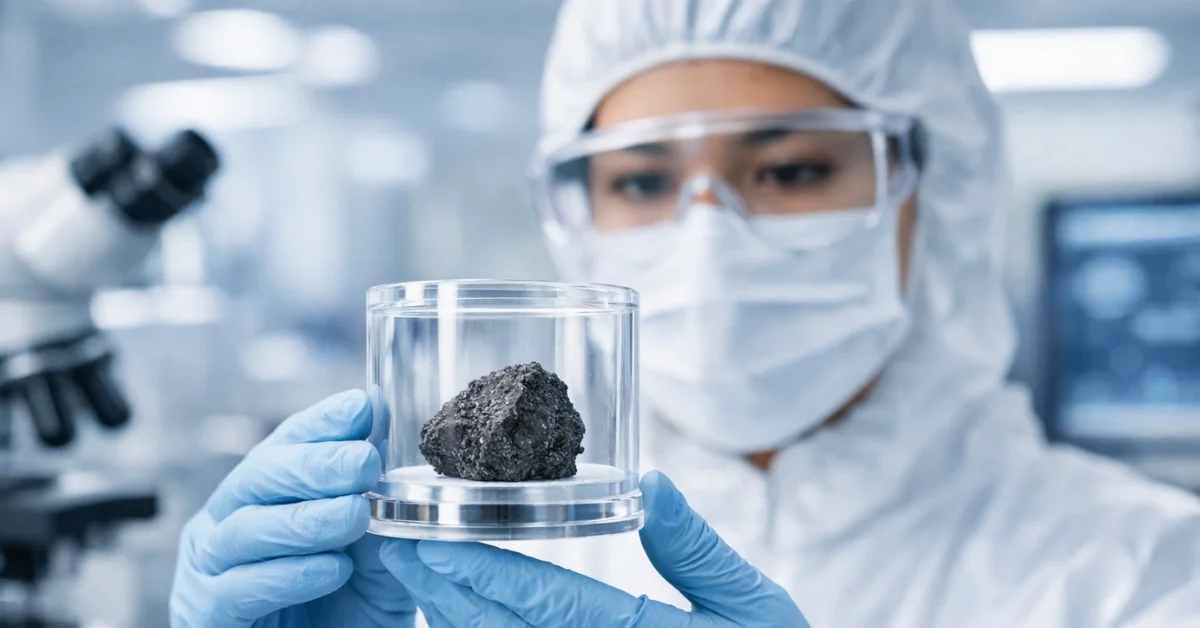
Recent analysis of rare lunar rocks collected by China’s Chang’e-6 mission indicates that a colossal ancient collision reshaped the Moon far more deeply than previously understood. By examining samples from the Moon’s far side, researchers discovered unusual chemical fingerprints that suggest extreme heat and significant material loss caused by a massive impact billions of years ago. These findings provide a new perspective on how large-scale cosmic accidents can permanently alter the internal chemistry and volcanic history of a planetary body.
The study centered on basalt samples retrieved from the South Pole-Aitken (SPA) Basin, which is the oldest and largest known impact crater in the solar system. Measuring approximately 2,500 kilometers in diameter, this massive structure is located on the lunar far side and has long been a subject of scientific curiosity. The rocks returned by the mission stood out because they possess a potassium isotopic makeup that is significantly heavier than any lunar materials previously collected during the Apollo missions or found in meteorites.
Chemical Evidence of a Massive Collision
A research team led by the Chinese Academy of Sciences investigated these unique chemical signatures to understand the Moon’s early development. Their results, published in the Proceedings of the National Academy of Sciences (PNAS), link the heavy potassium isotopes directly to the intense impact that created the SPA Basin. During this high-temperature and high-pressure event, lighter isotopes of potassium were lost through evaporation, leaving behind the heavier material found in the recent samples.
This massive loss of volatile elements suggests the collision was powerful enough to penetrate deep into the lunar crust and potentially the mantle. Computer simulations used in the study supported this theory, showing that the impact generated enough heat to drive convection within the Moon’s interior. This internal movement likely carried the chemical changes deep below the surface, permanently altering the composition of the lunar layers.
Solving the Mystery of Lunar Asymmetry
The discovery also sheds light on a long-standing mystery regarding why the near and far sides of the Moon look so different. The near side is famous for its vast volcanic plains, while the far side is rugged and lacks similar evidence of widespread volcanic activity. Researchers now believe that the depletion of volatile elements during the SPA impact may have suppressed magma production on the far side. By reducing the materials necessary for volcanic eruptions, the ancient collision helped create the lopsided geological appearance we see today.
Beyond volcanic activity, the mission has allowed scientists to refine their understanding of the Moon’s timeline. By mapping crater densities around the landing site and comparing them with data from previous missions like Apollo and Chang’e-5, experts have confirmed that the rate of meteorite impacts has been essentially consistent across the entire Moon. This finding challenges earlier theories that one side might have acted as a shield for the other, providing a reliable basis for a unified global lunar chronology.
