

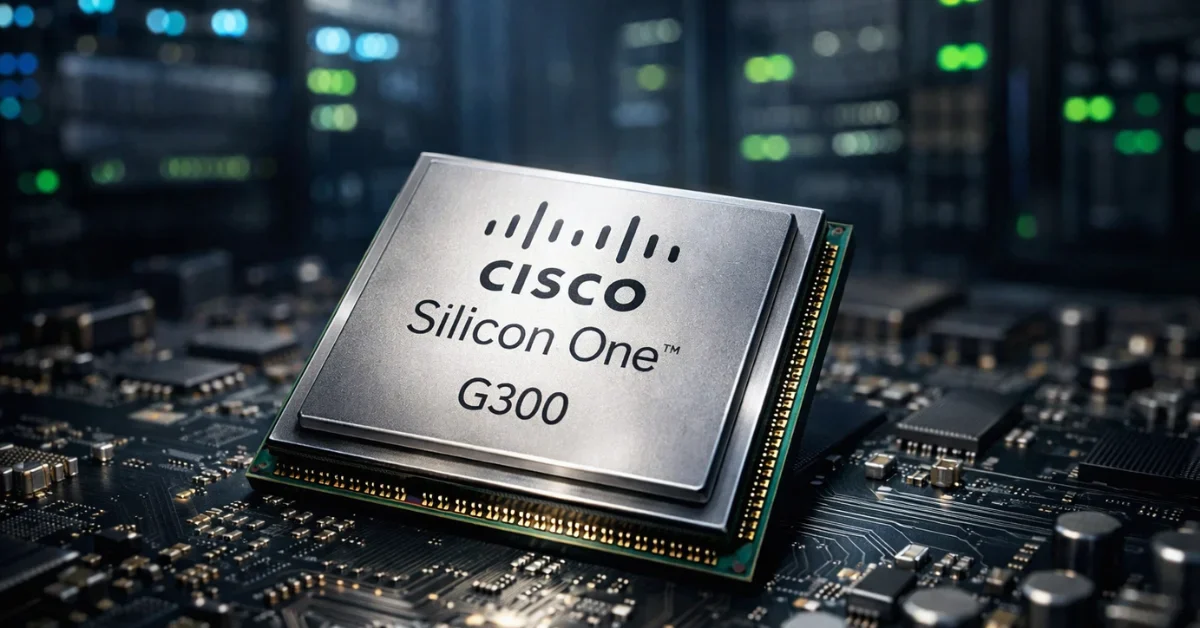
Cisco Systems has introduced a groundbreaking high-speed networking chip designed to accelerate data flow within massive artificial intelligence data centers. The new Cisco Silicon One G300 is a high-performance switching silicon that delivers a staggering 102.4 terabits per second of bandwidth, positioning the company as a formidable competitor to industry giants Broadcom and Nvidia. This release marks a significant milestone in the global AI infrastructure market, which is currently valued at approximately $600 billion as enterprises and hyperscalers rush to build more complex AI models.
The Cisco Silicon One G300 is specifically engineered for what the company describes as the agentic era of artificial intelligence. By doubling the switching bandwidth of previous generations, the chip allows data center operators to build massive AI clusters using significantly fewer switches, which simplifies the physical infrastructure and reduces overall complexity. This innovation addresses a critical bottleneck in the industry, where the ability to connect thousands of processors efficiently has become essential for scaling next-generation AI workloads.
Unprecedented Speed and Network Utilization
The primary advantage of the Cisco Silicon One G300 is its ability to maximize the productivity of expensive graphic processing units. According to company data, the new chip can improve GPU utilization by 33 percent compared to non-optimized network configurations. This efficiency translates directly into a 28 percent reduction in job completion times for AI training and inference tasks. In a data center environment, these improvements allow for more AI tokens to be generated per GPU-hour, significantly enhancing the profitability and performance expectations of high-end computing facilities.
Cisco achieved these performance gains through a suite of features called Intelligent Collective Networking. This technology combines an industry-leading fully shared packet buffer with proactive network telemetry and path-based load balancing. These “shock absorber” capabilities are designed to prevent network bottlenecks during sudden spikes in data traffic, which are common in AI training. By automatically rerouting data around link failures and preventing packet drops that could otherwise stall massive computing jobs, the G300 ensures reliable data delivery even across clusters spanning hundreds of thousands of links.
Advanced Manufacturing and Liquid Cooling
The Silicon One G300 is manufactured using the advanced 3-nanometer process technology from Taiwan Semiconductor Manufacturing Co. This cutting-edge fabrication allows Cisco to pack more performance into a smaller, more power-efficient footprint. In addition to the silicon itself, Cisco announced new systems in its Nexus 9000 and Cisco 8000 product lines that are powered by the G300. These systems are designed to meet the extreme thermal demands of modern data centers, offering both traditional air-cooled configurations and fully liquid-cooled designs.
The transition to liquid cooling represents a major shift in how networking hardware is managed. Cisco’s liquid-cooled switching systems can improve energy efficiency by nearly 70 percent compared to older generations. By using direct-to-chip liquid cooling with modular cooling manifolds and advanced leak detection, Cisco can deliver the same amount of bandwidth in a single system that previously required six air-cooled units. Company representatives noted that as future generations of GPUs move toward mandatory liquid cooling, the networking infrastructure must evolve in parallel to maintain stability and density without the noise or energy waste of traditional fans.
Versatile Software and Open Ecosystems
Beyond the hardware specifications, Cisco is focusing on simplifying network management through integrated software tools. The new G300-powered hardware will integrate with a unified platform that combines the Nexus Dashboard and Nexus Hyperfabric. This allows organizations to manage both on-premises and cloud-managed devices through a single interface. A key feature of this integration is the ability to handle large volumes of network data more efficiently, specifically addressing the cost and complexity of ingesting data into platforms like Splunk.
Cisco is also maintaining its commitment to open networking standards to give customers more flexibility. While the new Nexus switches primarily run the Linux-based NX-OS software, the 8000 series models also support alternative operating systems, including the open-source Sonic platform. This dual-track approach ensures that the new hardware can fit into diverse data center environments, whether they rely on Cisco’s proprietary ecosystem or prefer open-source management tools.
Market Impact and Future Availability
The launch of the Silicon One G300 places Cisco squarely in a race for dominance in the data center switch market, which analysts predict will exceed $100 billion annually. As the AI ecosystem expands beyond the largest hyperscalers to broader enterprise markets, the demand for energy-efficient and high-performance networking is expected to surge. By providing hardware that scales to 1.6T speeds and beyond, Cisco aims to own a larger share of the back-end scale-out networks that power the global AI boom.
Industry analysts suggest that the G300 represents a transformational leap that will reshape the economics of AI data centers. The new systems and optics are scheduled to begin shipping this year, with the Silicon One G300 chip itself expected to be available for general sale in the second half of 2026. As the fourth year of exponential AI growth continues, these innovations provide the foundation for the next wave of agentic AI workloads and real-time computing.
