

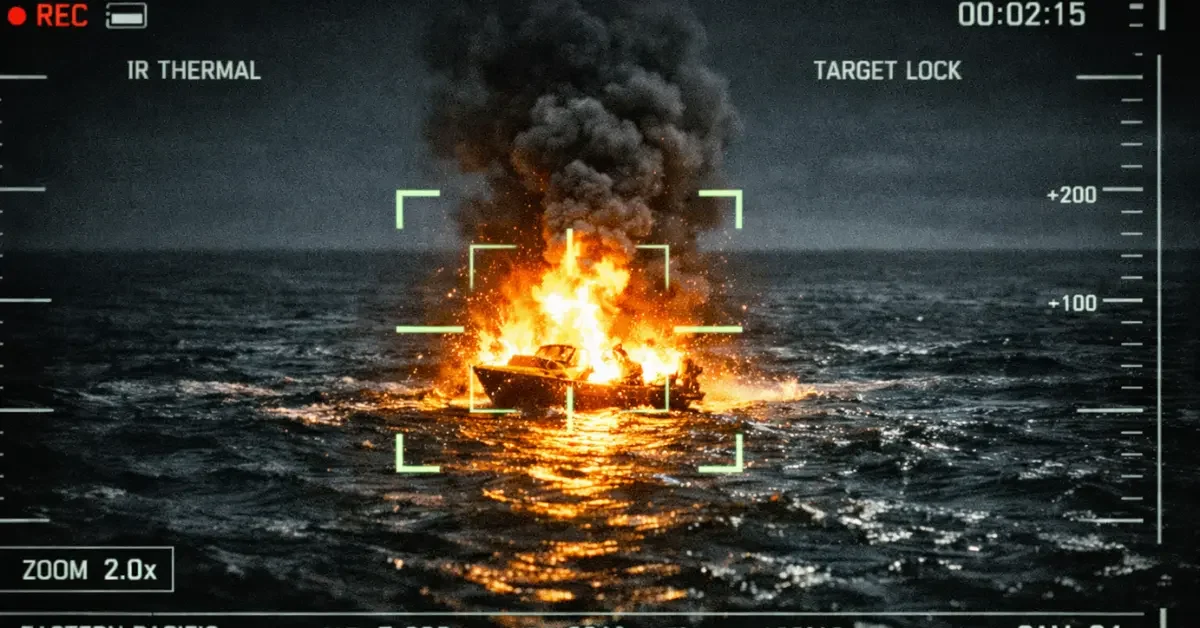
The United States military conducted a lethal kinetic strike against an alleged drug-trafficking vessel in the Eastern Pacific on Monday, resulting in the deaths of two individuals and leaving one survivor. The operation, which took place in international waters, was carried out under the authority of U.S. Southern Command (SOUTHCOM) as part of an ongoing campaign against transnational narcotics networks. This latest engagement marks the third recorded strike of its kind in 2026, as the Trump administration continues to escalate maritime enforcement operations.
At the direction of General Francis L. Donovan, the commander of SOUTHCOM, Joint Task Force Southern Spear executed the strike on February 9. Military officials reported that intelligence confirmed the targeted vessel was transiting through established narco-trafficking routes and was actively engaged in smuggling operations at the time of the attack. The individuals killed in the strike have been described by the military as narco-terrorists linked to designated terrorist organizations, though specific group names were not released in the initial reports.
Search and Rescue Efforts for Sole Survivor
Immediately following the kinetic engagement, SOUTHCOM alerted the U.S. Coast Guard to activate search and rescue protocols for the single survivor of the blast. A spokesperson for the Coast Guard confirmed that the Maritime Rescue Coordination Center in Ecuador has taken the lead in the search efforts. While the United States is providing technical assistance to the Ecuadorian authorities, the current condition and location of the survivor remain unknown.
This incident is the second time this year that a survivor has been reported following a lethal strike in the Pacific. A similar operation conducted on January 23 also resulted in two deaths and one survivor, highlighting a pattern in the kinetic tactics currently employed by Joint Task Force Southern Spear. In both cases, the military has moved quickly to transition from combat engagement to rescue assistance once the immediate threat was neutralized.
Escalation of Operation Southern Spear
The Monday strike is part of a broader mission known as Operation Southern Spear, which was launched last September to disrupt maritime drug trafficking. Since the operation began, the Trump administration has intensified its use of lethal force against suspected smuggling vessels, leading to at least 121 deaths. President Trump, who was reelected in 2024 and inaugurated for his second term in January 2025, has advocated for a more aggressive military posture against cartels.
Under the leadership of Secretary of War Pete Hegseth, the Department of War has categorized those targeted in these strikes as “unlawful combatants.” This classification allows the military to conduct lethal operations without traditional judicial oversight, a policy based on a classified determination from the Justice Department. While the administration maintains that these actions are necessary to protect national security, the frequency of the strikes has grown, with two significant operations occurring in February alone.
Questions Over Evidence and Legality
Despite the military’s claims of confirmed intelligence, the administration has not publicly released specific evidence linking the deceased individuals to narco-terrorist organizations. Critics and international observers have noted that no illicit substances have been recovered or documented in the immediate aftermath of these high-seas attacks. This lack of transparency has led to increased scrutiny from members of Congress regarding the legal justification for using lethal force in international waters.
Several military attorneys and legal experts have raised concerns that the strikes may lack a firm foundation in international law. While SOUTHCOM maintains that the vessels are operated by designated terrorist organizations, the refusal to provide evidence has fueled a debate over the administration’s “kinetic” approach to drug interdiction. Earlier strikes, including the very first attack in September, were also met with skepticism after reports suggested that crew members might not have been involved in the activities alleged by the military.
As the search for the survivor continues in the Eastern Pacific, the political debate in Washington is expected to intensify. The Trump administration has signaled no intention of slowing down Operation Southern Spear, asserting that the lethal strikes are a vital component of its strategy to dismantle the financial and logistical networks of global drug cartels. For now, the Eastern Pacific remains a central front in this expanded maritime conflict, with more strikes likely as the administration pursues its aggressive security agenda.
