

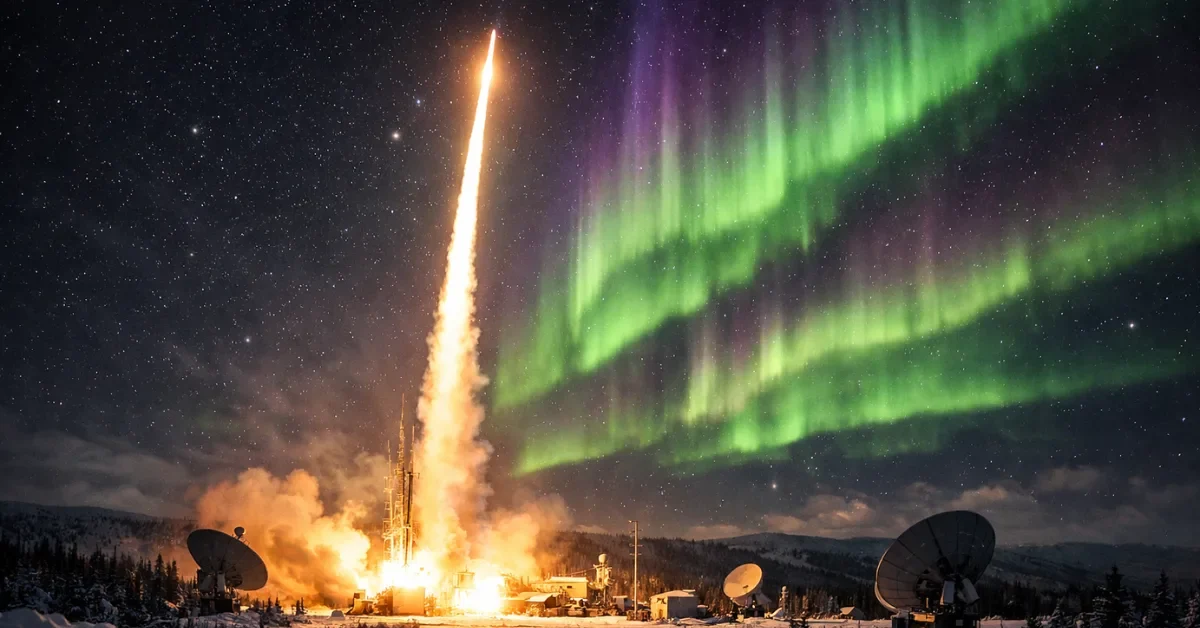
NASA scientists successfully launched a series of sounding rockets from the Poker Flat Research Range in Alaska this week, marking a major milestone in the study of the northern lights. These missions, which occurred on February 9 and 10, 2026, utilized a groundbreaking “CT scan” technique to examine the complex electrical currents that power auroras. By flying directly through the shimmering lights, researchers captured three-dimensional data that could transform our understanding of how space energy interacts with Earth’s atmosphere.
The primary goal of the NASA auroral CT scan project is to map the invisible electrical circuitry that underlies the aurora borealis. While most people view the northern lights as a beautiful visual display, scientists see them as a massive electrical circuit. This circuit involves a constant flow of electrons moving between space and our planet. Understanding how this electricity moves is critical for predicting how the upper atmosphere heats up and how it might affect satellites orbiting Earth.
Mapping the Sky With a Three-Dimensional Scan
The core of this research is the Geophysical Non-Equilibrium Ionospheric System Science mission, commonly known as GNEISS. This mission employed a unique strategy by launching two rockets back-to-back on February 10. The rockets took flight only thirty seconds apart, at 1:19:00 a.m. and 1:19:30 a.m. local time. They reached altitudes of approximately 198.3 miles and 198.8 miles, flying side-by-side to capture different “slices” of the same aurora.
To achieve the “CT scan” effect, each rocket ejected four smaller subpayloads once they were inside the aurora. These subpayloads acted as independent sensors, measuring conditions at distinct locations simultaneously. As the rockets and subpayloads traveled through the sky, they sent radio signals to receivers stationed on the ground. The surrounding plasma, which is the charged gas that makes up the aurora, altered these radio waves as they passed through.
This process is remarkably similar to a medical CT scan used in hospitals. Just as different body tissues change the path of X-ray beams to create a picture of a patient’s internal organs, the plasma in the atmosphere changes the radio signals from the rockets. By analyzing these changes, the GNEISS team can determine the density of the plasma and identify exactly where electricity is flowing. This provides a detailed, three-dimensional view of the electrical environment that would be impossible to see from the ground alone.
Decoding the Electrical Circuit of the Northern Lights
NASA scientists often compare the electricity of an aurora to a household lightbulb. In this analogy, the beams of electrons coming from space are like the power cord that brings electricity to the bulb. However, a circuit must be a complete loop to function. While the incoming electrons are well-organized, the electrons that have already sparked the light of the aurora become chaotic and scattered. They must find a winding path back through the atmosphere to complete the circuit.
Dr. Kristina Lynch, the principal investigator for the GNEISS mission and a professor at Dartmouth College, explained that the team is focused on more than just the rocket’s flight path. They want to see how the electrical current spreads downward and eventually returns to space. Currently, the paths these returning currents take are difficult to track because they are influenced by winds, pressure changes, and shifting magnetic fields. By using the NASA auroral CT scan technique, researchers can finally see the “return cord” of the circuit.
Investigating the Mystery of Black Auroras
The GNEISS mission was not the only research effort taking place this week. On February 9, NASA launched the Black and Diffuse Auroral Science Surveyor. This rocket reached a peak altitude of about 224 miles and was designed to study “black auroras,” which are unusual dark spots or gaps found inside the glowing northern lights. Scientists suspect these dark patches occur in locations where the electrical currents suddenly reverse their direction.
Marilia Samara, the principal investigator for the Black and Diffuse mission, reported that all instruments and technology demonstrations on the rocket performed as expected. This launch was a significant success, especially after a previous attempt in 2025 was grounded due to poor weather and unfavorable science conditions. The high-quality data returned from this mission will complement the findings from GNEISS to provide a more complete picture of auroral behavior.
Why This Science Matters for Earth and Space
Studying the northern lights is about more than just satisfying scientific curiosity. The electrical currents associated with auroras play a major role in how energy from space is distributed throughout Earth’s upper atmosphere. When these currents spread out, they cause the atmosphere to heat up. This heating can stir up high-altitude winds and create turbulence.
For the modern world, this has practical consequences. Satellites orbiting the planet can be affected by these atmospheric changes, sometimes moving through air that is more turbulent than expected. By learning to “read” the aurora through missions like GNEISS, scientists can better predict these environmental shifts. These rocket-based measurements are also being coordinated with NASA’s EZIE satellite mission, which has been observing auroral currents from above since its launch in March 2025.
By combining top-down views from satellites with the internal “CT scan” data from sounding rockets, NASA is creating the most detailed map of the northern lights ever produced. These short, targeted flights allow researchers to place instruments exactly where the action is, turning brief flashes of light into deep scientific insights about the world above us.
