

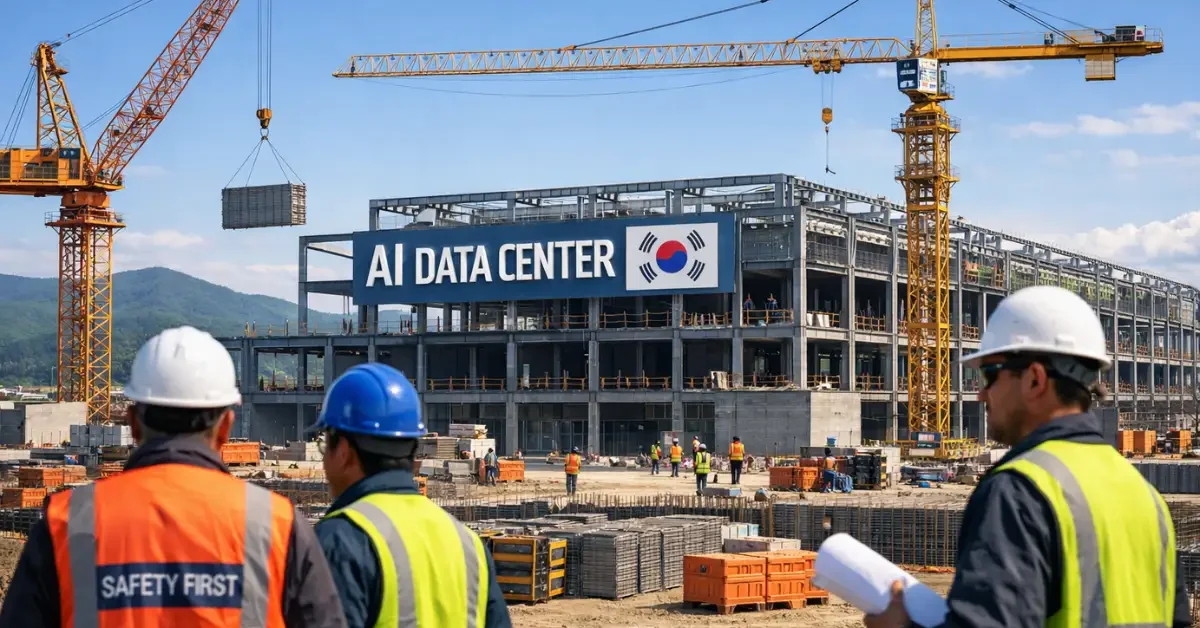
OpenAI, Samsung Electronics, and SK are set to begin construction on artificial intelligence data centers in South Korea next month. Science and ICT Minister Yoo Sang-im announced the timeline during a parliamentary hearing on Monday, confirming that groundwork will commence in March 2026. The collaboration represents a significant step in strengthening South Korea’s position as a global AI hub and securing critical infrastructure for advanced computing.
The partnership brings together OpenAI’s software expertise with South Korea’s semiconductor manufacturing power. Samsung Electronics and SK Hynix, the world’s leading memory chip producers, will supply high-bandwidth memory essential for training large-scale AI models. This vertical integration aims to create a stable supply chain for the components needed to support artificial intelligence development on a massive scale.
Two Data Centers Planned Across South Korea
The project involves building two separate facilities in different regions of the country. OpenAI will partner with Samsung Electronics to construct one data center in Pohang, located in North Gyeongsang Province. A second facility will be developed in South Jeolla Province through collaboration with SK Telecom and SK Hynix.
Each data center is expected to start with an initial power capacity of 20 megawatts. The government has strategically chosen locations outside the capital region to promote balanced economic development across the nation. Officials believe these facilities will stimulate local innovation ecosystems and improve access to AI technology for businesses and public institutions throughout the country.
Samsung SDS to Manage Operations and Services
Samsung SDS will take on a central role in designing, developing, and operating the new data centers. The company has signed a letter of intent outlining its responsibilities, which include providing consulting services to help Korean businesses integrate OpenAI’s technology into their operations. This support structure is designed to lower barriers for domestic companies seeking to adopt generative AI solutions.
The collaboration extends to exploring innovative infrastructure concepts as well. Samsung C&T and Samsung Heavy Industries are investigating the feasibility of floating data centers, which could offer improved cooling efficiency and reduced environmental impact compared to traditional land-based facilities. These alternative designs reflect the partnership’s commitment to sustainable and cutting-edge infrastructure development.
Part of OpenAI’s Global Stargate Initiative
The South Korean project fits within OpenAI’s broader Stargate initiative, a $500 billion global effort to build 20 AI-focused data centers by 2029. The initiative involves partnerships with major technology and telecommunications companies worldwide, including SoftBank and Oracle. By participating in this international network, Samsung and SK are positioning themselves as core players in the evolving AI supply chain.
South Korean President Lee Jae-myung has expressed strong government support for the initiative. During meetings with OpenAI CEO Sam Altman, the president indicated willingness to ease regulations, including rules around financial-industrial separation, to facilitate larger investments in semiconductors and AI infrastructure. This regulatory flexibility is seen as crucial for helping South Korea achieve its goal of becoming one of the top three global AI leaders.
High-Bandwidth Memory and AI Chip Supply
Samsung Electronics and SK Hynix will supply the high-bandwidth memory chips that power advanced AI systems. These components are critical for processing the enormous datasets required to train models like ChatGPT and other generative AI applications. By securing a direct partnership with OpenAI, both companies gain a reliable customer for their most advanced memory products.
The alliance ensures that OpenAI has consistent access to the hardware needed for its ambitious expansion plans. Industry observers note that this arrangement benefits both sides, providing stability for chip manufacturers while giving OpenAI the supply chain security necessary for rapid scaling. The collaboration also strengthens South Korea’s influence in the global technology sector.
Energy Efficiency and Future Technology Integration
The new facilities are expected to incorporate advanced cooling systems and may eventually transition to renewable energy sources. These measures aim to reduce the substantial costs associated with training large AI models, which require continuous operation of thousands of processors. SK Telecom has indicated plans to integrate its Titan supercomputer, equipped with high-performance GPUs, to support model training and deployment alongside the new centers.
Industry experts anticipate that the March start date will accelerate domestic AI development throughout South Korea. Local firms will gain easier access to the computing infrastructure needed for high-performance applications, potentially sparking a wave of innovation in sectors ranging from healthcare to finance. With construction set to begin in just weeks, South Korea is moving rapidly to cement its role in the global artificial intelligence race.
