

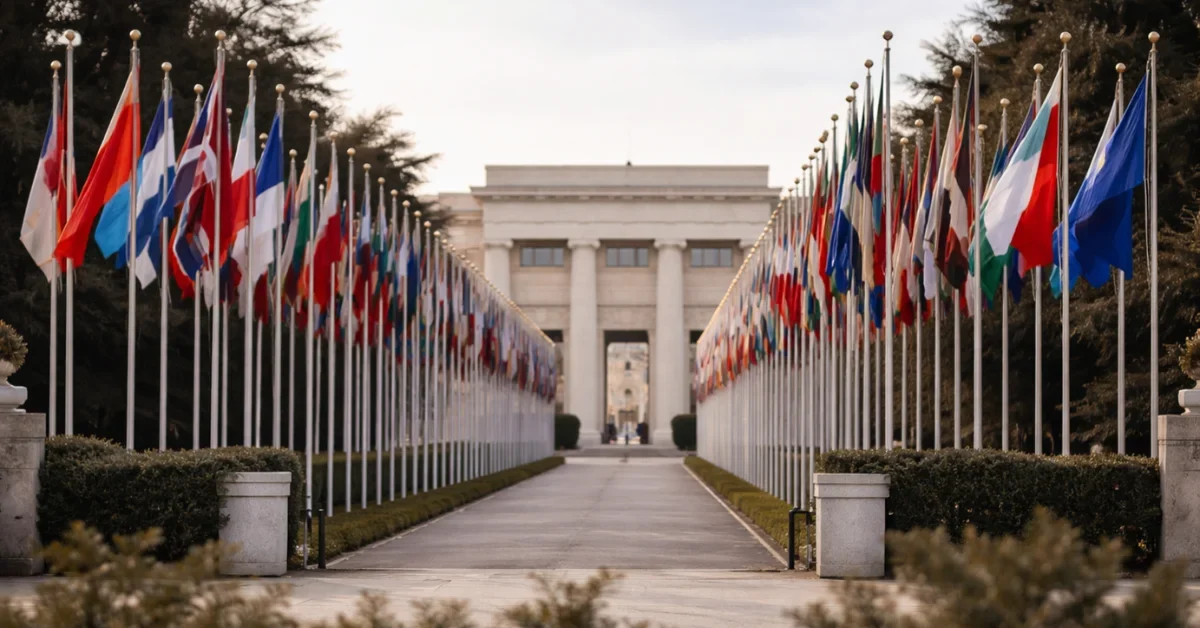
Geneva is set to host two separate diplomatic tracks next week, with a second round of U.S.-Iran nuclear talks expected on Tuesday and a new round of trilateral Russia-U.S.-Ukraine talks scheduled for Feb. 17–18. The meetings come as broader debates about the war in Ukraine and transatlantic security also dominate discussions among global leaders gathered at the Munich Security Conference.
The U.S.-Iran discussions are expected to focus on nuclear issues and are aimed at shaping an agreement that would help avoid conflict, according to a U.S. official and other sources cited by Axios. Separately, the Kremlin has said the next round of Ukraine settlement talks will again take place in Geneva in a trilateral format involving Russia, the United States, and Ukraine.
U.S.-Iran nuclear talks expected Tuesday
Axios reported that the United States and Iran are anticipated to hold a second round of talks on nuclear issues in Geneva next Tuesday. Axios said the talks are intended to help craft an agreement that would avert conflict.
According to Axios, the American delegation is expected to include President Donald Trump’s senior advisor Jared Kushner and White House representative Steve Witkoff. Axios also reported that Iran’s side is expected to be led by Foreign Minister Abbas Araghchi. Axios said Oman’s Foreign Minister Badr al-Busaidi, described as a channel between the two sides, is also likely to be present.
In comments described by Axios, Trump said he prefers a diplomatic solution and wants to reach a deal with Iran, while also pointing to a major U.S. military buildup in the Gulf that includes the deployment of an additional aircraft carrier strike group. Axios quoted Trump as saying, “Either we will finalize a deal or we will have to take drastic measures like we did previously,” during an interview with the outlet. Axios also reported that Trump told journalists any agreement must require zero uranium enrichment in Iran, and that he said Iran is interested in talks but has not shown willingness to take concrete steps on its nuclear program. When asked about regime change in Iran, Axios reported Trump responded that it “appears to be the best outcome that could occur.”
Axios further reported that earlier in the week, Witkoff communicated with Oman’s foreign minister and conveyed messages related to the nuclear discussions for him to pass to Iranian representatives. Axios said the Omani foreign minister drafted a document based on that exchange and presented it to Ali Larijani, identified as the secretary of Iran’s Supreme National Security Council, during a visit to Muscat last Tuesday. Axios reported Larijani later confirmed on Iranian state television that he had received a document containing U.S. messages.
Russia-Ukraine talks set for Feb. 17–18
The next round of talks on a Ukraine settlement will be held in Geneva on Feb. 17–18 in a trilateral Russian-U.S.-Ukrainian format, Kremlin spokesman Dmitry Peskov said, according to Interfax. Peskov said Russia’s delegation will be led this time by presidential aide Vladimir Medinsky.
Interfax reported that the previous round of security consultations involving Russia, the United States, and Ukraine took place in Abu Dhabi on Feb. 4–5. Interfax said that earlier round was led on the Russian side by Igor Kostyukov, identified as the head of the Russian General Staff’s Main Intelligence Directorate.
Bloomberg also reported that Russia and Ukraine said a new round of U.S.-led talks will take place in Geneva next week. Bloomberg reported Peskov said Medinsky will lead Moscow’s delegation at the negotiations planned for Feb. 17 and 18. Al Jazeera likewise reported that Russia and Ukraine are set to hold another round of talks in Geneva next week.
Munich conference highlights wider security strain
At the Munich Security Conference, Euronews reported that discussions over global security, the war in Ukraine, and the future of transatlantic relations are central themes this year. Euronews reported French President Emmanuel Macron called for Europe to show an “unwavering commitment” to defend its interests, including continuing support for Ukraine, while also referring to “unjustified tariffs” and “unjustified claims on European territory” in a reference Euronews described as tied to Trump’s claims about Greenland.
Euronews also reported Macron warned that any future peace should not mean giving in to Russian demands and said a priority is ensuring Ukraine can continue to resist. The same Euronews live coverage said Germany’s Friedrich Merz defended the value of the transatlantic alliance and described NATO as “an alliance of values,” pointing to freedom, democracy, and human rights. Euronews further reported Sweden’s Ulf Kristersson said Europe needs a “strategic and mental shift” to do more on its own and with other partners, while also arguing that the transatlantic relationship should not be abandoned.
As the diplomatic calendar shifts to Geneva, the parallel tracks—one centered on Iran’s nuclear program and another on the war in Ukraine—underline how Switzerland remains a key venue for high-stakes international talks.
