
By using this site, you agree to our Privacy Policy and Terms of Use.
Accept
VellaTimesVellaTimesVellaTimes
  • News
    NewsShow More
    Scientist in a laboratory using a fluorescence microscope while a screen shows glowing particles in a sample.
    Microplastics glow: New method tracks them in the body
    February 14, 2026
    Wide, dusk exterior view of the Pentagon with a subtle digital network overlay in the sky, styled like a professional news header image.
    Pentagon used Claude AI in Venezuela raid: WSJ report
    February 14, 2026
    Wide shot of the Palais des Nations area in Geneva with international flags outside in winter daylight.
    Geneva talks set for US-Iran nuclear, Ukraine talks
    February 14, 2026
    A bottle of fish oil supplement capsules on a laboratory bench with several golden softgels next to it.
    Fish oil supplements may backfire without ALOX15
    February 14, 2026
    A modern developer desk with a laptop showing a code editor and terminal in a softly lit office setting.
    GPT-5.3 Codex launches as faster agentic coding model
    February 14, 2026
  • Technology
    TechnologyShow More
    Wide, dusk exterior view of the Pentagon with a subtle digital network overlay in the sky, styled like a professional news header image.
    Pentagon used Claude AI in Venezuela raid: WSJ report
    February 14, 2026
    A smartphone displaying a Grok-labeled AI chatbot interface on a desk in a modern office setting, photographed in a wide, news-style shot.
    Grok US market share jumps amid sexualized images backlash
    February 14, 2026
    A smartphone displaying a generic AI assistant screen with Lunar New Year decorations, including red lanterns, in the background.
    China AI models surge as Lunar New Year race heats up
    February 14, 2026
    A wide, daylight exterior view of an EU institutional building with EU flags, with a subtle cybersecurity-themed visual overlay on the glass facade.
    Google Wiz acquisition cleared by EU antitrust review
    February 13, 2026
    A close-up of a smartphone displaying the WhatsApp icon with an access-blocked indicator, with a blurred city street scene in the background.
    Russia blocks WhatsApp as Kremlin promotes state-backed Max
    February 13, 2026
  • AI
    AIShow More
    A modern developer desk with a laptop showing a code editor and terminal in a softly lit office setting.
    GPT-5.3 Codex launches as faster agentic coding model
    February 14, 2026
    A developer sits at a desk in a modern office, looking at a monitor displaying an AI coding assistant interface with multiple agent panels.
    Claude Opus 4.6 upgrade adds agent teams, 1M context
    February 14, 2026
    A wide view down a modern data center aisle with server racks lit in blue tones and a blurred stock market ticker display in the background.
    Big Tech AI spending hits $650bn as fears rise
    February 13, 2026
    A laptop and monitor on an office desk display an AI video generation interface labeled “Seedance 2.0” with a prompt box and a short editing timeline.
    ByteDance Seedance 2.0 sparks viral AI video debate
    February 13, 2026
    A news-style image of server racks and a computer screen with abstract AI graphics, suggesting competition in artificial intelligence technology.
    OpenAI DeepSeek distillation accusation draws scrutiny
    February 13, 2026
  • Science
    ScienceShow More
    Scientist in a laboratory using a fluorescence microscope while a screen shows glowing particles in a sample.
    Microplastics glow: New method tracks them in the body
    February 14, 2026
    A bottle of fish oil supplement capsules on a laboratory bench with several golden softgels next to it.
    Fish oil supplements may backfire without ALOX15
    February 14, 2026
    Researcher fits a noninvasive brain stimulation electrode cap on a participant in a neuroscience lab.
    Gamma brain stimulation may reduce selfish choices in study
    February 14, 2026
    Clinician holding an injection pen above a desk with a printed obesity treatment guideline document in a clinical office setting.
    WHO GLP-1 obesity guideline sets use, flags limits
    February 13, 2026
    Two researchers in a laboratory examine neural stem cell samples beside a microscope on a lab bench.
    DMTF1 protein may rejuvenate aging brain stem cells
    February 13, 2026
  • World
    WorldShow More
    Wide shot of the Palais des Nations area in Geneva with international flags outside in winter daylight.
    Geneva talks set for US-Iran nuclear, Ukraine talks
    February 14, 2026
    Three diplomats speak at podiums during a press conference in Nuuk, Greenland, with microphones and flags in the background.
    Greenland US diplomatic talks deepen as Arctic security focus grows
    February 14, 2026
    A U.S. aircraft carrier sails at sea with escort warships visible nearby under a cloudy sky.
    Second aircraft carrier heads to Middle East amid Iran standoff
    February 14, 2026
    A wide news-style view of an official area in Muscat, Oman, with diplomatic vehicles and security in the distance under neutral lighting.
    US-Iran nuclear talks in Oman end as tensions rise
    February 13, 2026
    A news-style image of President Donald Trump speaking at a podium with blurred US and Chinese flags in the background.
    Trump-Xi meeting: Trump says he will visit China in April
    February 13, 2026
  • Bookmarks
Search
Category
  • News
  • Technology
  • AI
  • Science
  • World
Company
  • About Us
  • Contact Us
  • Fact Checking Policy
  • Terms & Conditions
  • Privacy Policy
  • Copyright Policy
Resources
  • Home
  • Web Stories
  • Bookmarks
  • Interests
  • Disclaimer
  • Sitemap
© 2022 VellaTimes • All Rights Reserved.
Reading: AI-generated evidence in court: New rules, new risks
Share
Notification Show More
Font ResizerAa
VellaTimesVellaTimes
Font ResizerAa
  • News
  • Technology
  • AI
  • Science
  • World
Search
  • Explore
    • News
    • Technology
    • AI
    • Science
    • World
  • Useful Links
    • About Us
    • Contact Us
    • Fact Checking Policy
    • Terms & Conditions
    • Privacy Policy
    • Copyright Policy
  • Home
  • Web Stories
  • Bookmarks
  • Interests
  • Disclaimer
  • Sitemap
© 2022 VellaTimes • All Rights Reserved.
News

AI-generated evidence in court: New rules, new risks

Sameer Katoch
Last updated: 14/02/2026
Sameer Katoch
Share
7 Min Read
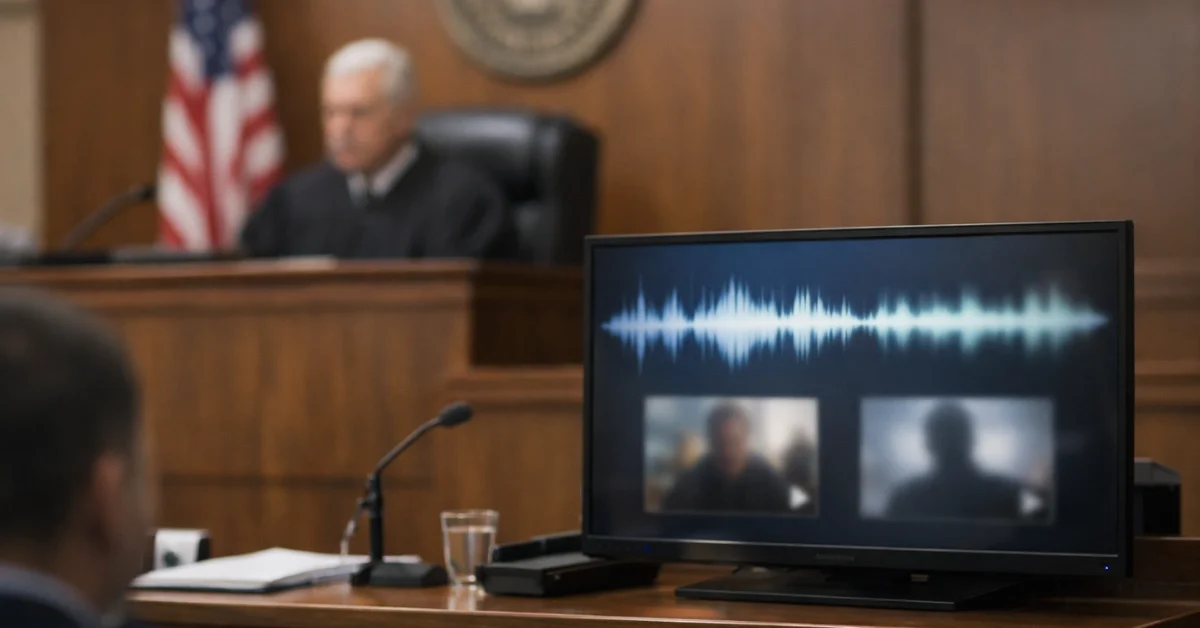
A modern courtroom with the judge’s bench and a monitor showing blurred icons for audio and video evidence, suggesting a dispute over AI-generated media.

Courts are facing a growing challenge as AI-generated images, audio, and video—often described as deepfakes—become easier to create and harder to verify. Judges and legal experts are warning that the justice system is not yet equipped to handle a surge of disputes over whether digital evidence is authentic or manipulated.

Contents
Judges sanction AI mistakes in filingsFederal courts weigh new evidence rulesWhy deepfakes worry investigators and juriesWhat lawyers and the public can do now

In the U.S., the issue is showing up in multiple ways: experts say even everyday evidence such as phone recordings, security footage, and photos can be questioned, while judges are also penalizing lawyers for filing AI-produced legal claims that turned out to be wrong. At the same time, federal rulemakers are working on proposed approaches that could shape how AI-generated or machine-made evidence is treated in court.

Judges sanction AI mistakes in filings

A Kansas federal judge fined several attorneys a combined $12,000 after court filings in a patent case included quotations and case citations that did not exist and were generated by artificial intelligence. The ruling said that although one lawyer used AI and inserted the inaccurate material, the other lawyers who signed the filings were also responsible for failing to properly review them.

The sanctioned attorneys represented Lexos Media IP in a patent infringement case against online retailer Overstock.com, according to the ruling. The judge, U.S. District Judge Julie Robinson in Kansas City, wrote that lawyers should understand the risks of using unverified generative AI for legal research and the ethical duty to ensure filings are accurate.

The decision described the spread of AI-related errors in legal filings as a growing problem, pointing to the risk that generative AI can produce false information—often called “hallucinations.” The ruling also noted that the court had ordered attorneys in the case to explain why sanctions should not be imposed after problems were found in multiple documents, including citations and quotations that did not exist.

Federal courts weigh new evidence rules

A federal judicial committee agreed to move forward with developing a rule to address evidence produced by machine learning and to begin work on guidance related to claims that audio or video evidence might be a deepfake. The decision came during a meeting of the U.S. Judicial Conference’s Committee on Rules in New York, Reuters reported.

The committee’s discussion reflected a broader push by courts to respond to generative AI tools that can generate text, images, and video. Reuters reported that Chief Justice John Roberts, in an annual report issued Dec. 31, said AI could bring benefits to litigants and judges while emphasizing the need for the judiciary to consider appropriate uses of the technology.

The proposed approach discussed by the committee would focus on the reliability of methods used by computer technologies to produce predictions or inferences from existing data. Reuters reported that one idea under consideration would require some machine-generated evidence to meet standards similar to the reliability rules that govern expert testimony under Rule 702 of the Federal Rules of Evidence.

Committee members also discussed whether courts could face a wave of claims that audio or video evidence is fake, with U.S. Circuit Judge Richard Sullivan expressing doubt that a “tsunami” of such challenges is coming. Still, Reuters reported that members agreed it could be useful to consider drafting a possible rule so the judiciary is not caught unprepared if deepfakes become a major courtroom issue.

Why deepfakes worry investigators and juries

Digital forensics experts told Axios that as deepfakes become more common, traditional media evidence—photos, videos, and audio—can no longer be assumed reliable in the way many people expect. Axios reported that the court system is struggling to adapt, in part because there are not enough forensic analysts available to authenticate evidence that may have been altered by AI.

Axios described how AI-generated evidence could be used in different types of disputes, including a divorce case where a photo background is changed to make a situation look dangerous, or a homicide case where a deepfake video appears to place someone at a crime scene. Axios also reported an example of a fabricated audio clip that led to a wrongful termination claim in Baltimore County.

Experts told Axios that as AI improves, it may become increasingly difficult—possibly even impossible—to prove that a piece of media was altered. Axios reported that courts may need to rely more on digital forensics professionals to identify signs of manipulation, but even expert explanations may not always persuade a jury beyond a reasonable doubt.

What lawyers and the public can do now

One concern raised to Axios is that verification tools for AI manipulation can function like “black boxes,” making it harder to explain how a conclusion was reached and leaving room for disagreement about what the tools show. Axios reported that investigators are trying different methods to assess authenticity, including analyzing supporting details and artifacts tied to the original material.

Axios also reported advice to keep original files—such as voicemails, texts, and photos—because metadata and other supporting artifacts can be important when authenticity is questioned. As judges, rulemakers, and investigators confront the same core problem—trust in digital evidence—the debate is likely to intensify over how courts should screen AI-generated evidence and how lawyers should use AI tools responsibly.

TAGGED: AI-generated evidence, court evidence, deepfakes, digital forensics, Generative AI, Julie Robinson, legal ethics, Rule 702
Share This Article
Facebook Twitter Whatsapp Whatsapp Telegram Copy Link
By Sameer Katoch
As the Founder of VellaTimes and an avid traveler, I'm passionate about the daily news events happening globally. With over five years of experience in the writing field, I am committed to delivering top-notch news that satisfies your daily news intake.
Leave a comment

Leave a Reply Cancel reply

Your email address will not be published. Required fields are marked *


Most Read

Microsoft Launches Publisher Content Marketplace to Simplify AI Licensing

February 4, 2026

Morocco Fossils Reveal Key Clues to Human Ancestor

February 8, 2026

Pseudo leukotrienes: Scientists rethink asthma trigger

January 28, 2026

Venezuela frees Americans detained as prisoner releases widen

January 14, 2026

US Suspends Somalia Aid Over Alleged Seizure of Food Assistance

January 8, 2026

EU IRGC terrorist designation triggers sanctions, travel bans

January 30, 2026

Related News

Scientist in a laboratory using a fluorescence microscope while a screen shows glowing particles in a sample.
News

Microplastics glow: New method tracks them in the body

Nisha Pradhan Nisha Pradhan February 14, 2026
Wide, dusk exterior view of the Pentagon with a subtle digital network overlay in the sky, styled like a professional news header image.
News

Pentagon used Claude AI in Venezuela raid: WSJ report

Rakesh Paul Rakesh Paul February 14, 2026
Wide shot of the Palais des Nations area in Geneva with international flags outside in winter daylight.
News

Geneva talks set for US-Iran nuclear, Ukraine talks

Editorial Staff Editorial Staff February 14, 2026

About Us

VellaTimesVellaTimesVellaTimes

VellaTimes is a leading news portal that covers the latest trending news in technology, lifestyle, entertainment, automobiles, travel, and sports.

Explore

  • News
  • Technology
  • AI
  • Science
  • World

Useful Links

  • About Us
  • Contact Us
  • Fact Checking Policy
  • Terms & Conditions
  • Privacy Policy
  • Copyright Policy

Subscribe Us

Subscribe to our newsletter for the Latest News and Top Stories!

© 2022 VellaTimes • All Rights Reserved.
  • Home
  • Web Stories
  • Bookmarks
  • Interests
  • Disclaimer
  • Sitemap
adbanner
AdBlocker Detected
Our site is an advertising supported site. Please whitelist us to support our work.
Okay, I'll Whitelist