

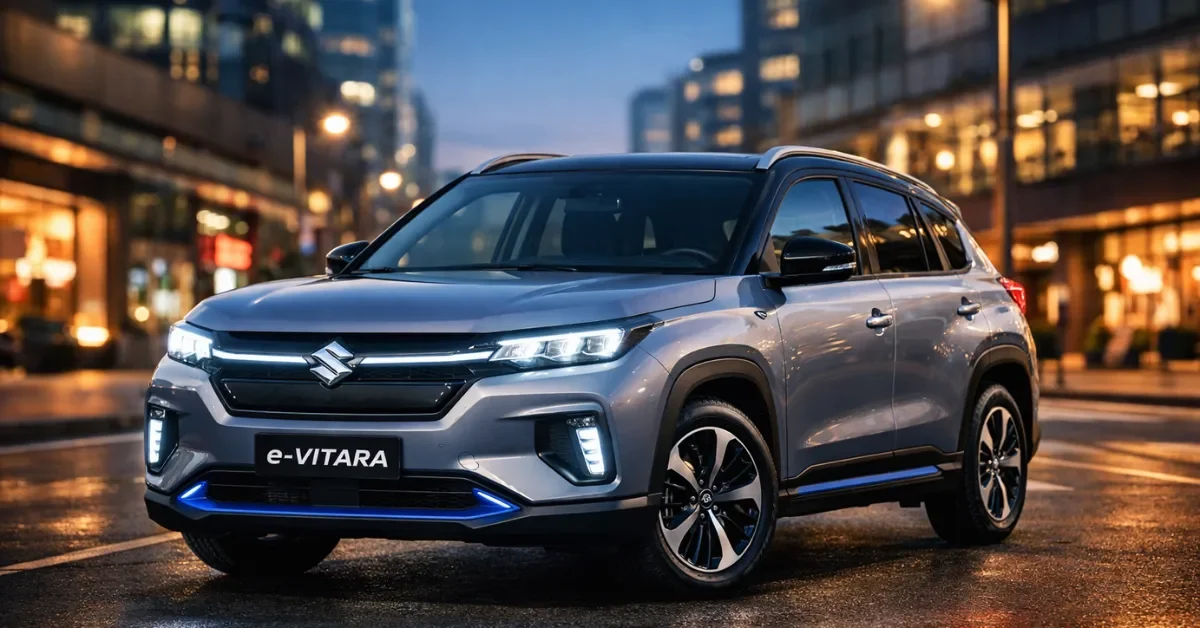
Maruti Suzuki India Limited has officially launched its first electric vehicle, the e-Vitara, marking a major milestone in the country’s automotive sector. The company has introduced the electric SUV with a starting price of Rs 10.99 lakh (ex-showroom), a competitive entry point made possible through a new Battery-as-a-Service (BaaS) ownership model. This strategic pricing aims to make electric mobility more accessible by separating the cost of the battery from the vehicle.
The launch on Tuesday represents the automaker’s formal entry into the electric vehicle market. Under the unique BaaS program, customers can purchase the vehicle at a lower upfront cost while paying for the battery usage separately. According to the pricing structure announced, the battery rental fee has been set at Rs 3.99 per kilometer. This approach is designed to lower the initial acquisition cost for buyers, addressing one of the primary barriers to EV adoption in India.
Pricing and Battery-as-a-Service Model
The headline price of Rs 10.99 lakh applies to the base model and is exclusive of the battery pack. Customers opting for this scheme will pay the additional rental charge for every kilometer driven. The BaaS model allows the manufacturer to price the e-Vitara significantly lower than traditional electric vehicles where the battery cost is included in the showroom price.
Reports indicate that the vehicle is available with two battery pack options: a 49kWh unit and a larger 61kWh unit. The starting price of Rs 10.99 lakh specifically corresponds to the 49kWh battery pack variant. By removing the battery cost from the initial purchase, Maruti Suzuki aims to offer a value proposition that reduces the total cost of ownership. The rental scheme is described as an “introductory offer” valid for a specific period, providing early adopters with a cost-effective way to transition to electric mobility.
Specifications and Charging Infrastructure
The e-Vitara is built to offer substantial range and convenience for daily commuting and highway driving. The electric SUV claims a driving range of up to 543 kilometers on a single charge, depending on the variant and battery pack selected. The vehicle is offered in multiple trims, including Delta, Zeta, and Alpha. The Delta trim is paired exclusively with the 49kWh battery, while the higher-end Zeta and Alpha trims are available with the larger 61kWh battery pack.
To support customers, Maruti Suzuki is providing a complimentary 7.4 kW AC Wall Box Charger with every e-Vitara, which includes free installation. The company has also emphasized the ease of charging with specific timelines released during the launch. Using the 7.4 kW AC charger, the 49kWh battery can be charged from 10 percent to 80 percent in approximately 6.5 hours. The larger 61kWh battery takes about 9 hours for the same level of charge. For those requiring quicker turnarounds, the vehicle supports DC fast charging, which can replenish the battery from 10 percent to 80 percent in just 45 minutes using a charger with support for speeds up to 70kW.
Market Impact and Customer Support
The launch has had an immediate impact on the financial markets, with Maruti Suzuki’s shares rising by 1 percent following the announcement. This positive market reaction reflects investor confidence in the company’s strategy to tackle the competitive EV landscape with an innovative pricing model. The carmaker has stated that its EV strategy is focused on making the e-Vitara a primary choice for customers.
To ensure a seamless ownership experience, the company has established a robust support network. Senior leadership at Maruti Suzuki noted that the e-Vitara is backed by over 1,500 EV-ready service centers across the country. Additionally, specially trained relationship managers and dedicated charging managers have been deployed to assist buyers. Bookings for the e-Vitara are currently open, with a booking amount set at Rs 21,000. Deliveries have already commenced, signaling the company’s readiness to meet demand immediately upon launch.
