

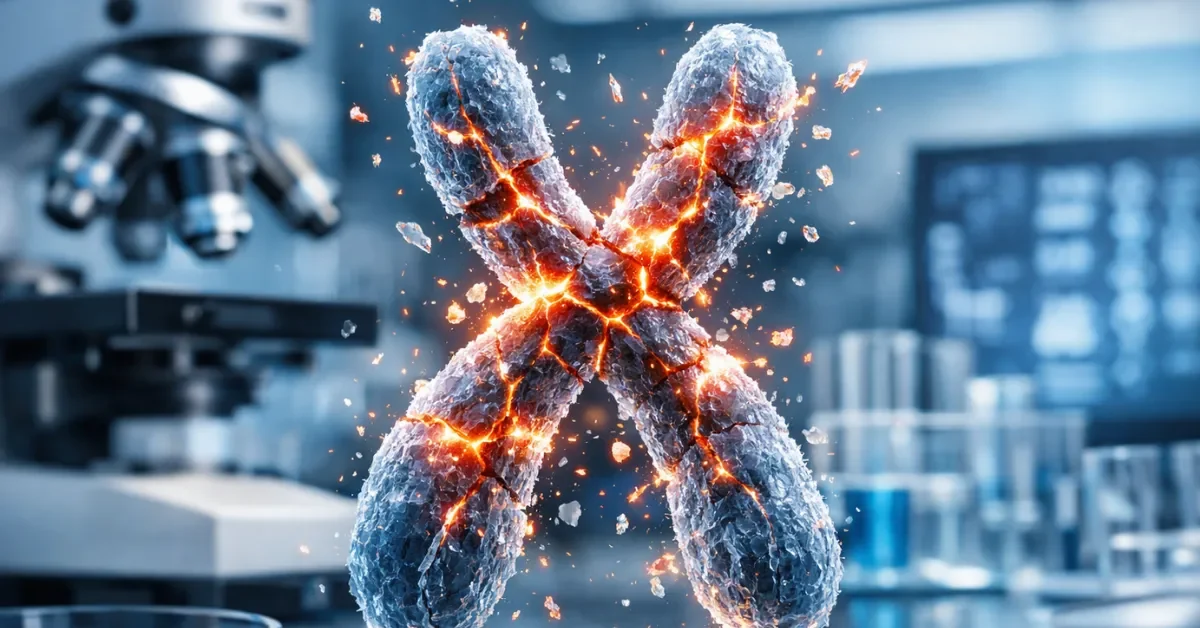
Scientists at the University of California San Diego have solved a longstanding mystery in cancer biology by identifying the specific enzyme responsible for a catastrophic genetic event that accelerates tumor growth . The discovery, published in the journal Science, reveals how cancer cells rapidly mutate to survive therapies and offers a new pathway to target treatment-resistant cancer .
For more than a decade, researchers have known that an explosive evolutionary process called chromothripsis drives some of the most aggressive cancers . However, the exact molecular trigger that sets this chaotic chain reaction in motion remained undiscovered until now .
The Mechanics of Chromosome Shattering
Cancer cells typically evolve at a slow pace, accumulating genetic mutations one by one . Chromothripsis, however, operates on a completely different scale . During this process, an entire chromosome shatters into fragments and then stitches itself back together in a random, scrambled order .
Instead of generating gradual changes, a single catastrophic episode of chromothripsis can create dozens or even hundreds of genomic alterations at once . This chaotic reshuffling frequently amplifies cancer-promoting genes and deletes crucial tumor suppressors, allowing cancer cells to rapidly evolve and develop resistance to medical treatments .
This devastating genetic phenomenon is surprisingly common . Researchers estimate that approximately one in four human cancers shows evidence of chromothripsis . The rates are even higher in certain highly aggressive tumors . For instance, virtually all osteosarcomas—a severe type of bone cancer—display evidence of this chromosomal shattering, and many brain cancers show unusually elevated levels as well .
Identifying the N4BP2 Enzyme
Chromothripsis begins with an error during cell division . This mistake traps an individual chromosome inside a tiny, fragile cellular compartment known as a micronucleus . When this fragile structure eventually bursts, the chromosome inside is left completely exposed and vulnerable to nucleases, which are enzymes capable of cutting DNA strands .
Because scientists did not know which specific nuclease was responsible for the destruction, they could not develop treatments to stop it . To find the answer, the research team used an advanced imaging-based screening technique to observe human cancer cells in real time . They systematically tested all known and predicted human nucleases to see how they behaved .
The analysis revealed one clear culprit: an enzyme called N4BP2 . This specific enzyme is uniquely capable of entering a ruptured micronucleus and slicing the exposed DNA into fragments .
To prove that N4BP2 directly causes the genetic chaos, researchers eliminated the enzyme from brain cancer cells . Removing it sharply reduced the frequency of chromosome shattering . Conversely, when the scientists forced the N4BP2 enzyme into the nucleus of otherwise healthy cells, intact chromosomes began to break apart .
Dr. Ksenia Krupina, the study’s first author and a postdoctoral fellow at UC San Diego, noted that these experiments prove the enzyme is not just correlated with the shattering process, but is entirely sufficient to cause it .
The Link to Extrachromosomal DNA
To understand the broader impact of this enzyme, the research team analyzed over 10,000 human cancer genomes across multiple tumor types . Their analysis showed that cancers with high levels of N4BP2 expression exhibited significantly more structural rearrangements and patterns resembling chromothripsis .
Crucially, these highly active tumors also contained elevated amounts of extrachromosomal DNA, or ecDNA . These circular DNA fragments carry powerful cancer-promoting genes and are strongly linked to aggressive tumor growth and therapy evasion . Tumors rich in ecDNA are notoriously difficult to treat, leading organizations like the National Cancer Institute and Cancer Research UK to name ecDNA one of the Cancer Grand Challenges .
The new findings demonstrate that ecDNA is not an isolated issue . Instead, it is a direct downstream consequence of the initial chromosome shattering caused by N4BP2 . By placing this newly discovered enzyme at the starting point of the chain reaction, researchers now have a clearer understanding of how genome instability unfolds .
New Strategies for Cancer Treatment
Identifying the initial molecular spark of this chaotic process provides researchers with a brand new entry point for medical intervention . Dr. Don Cleveland, the study’s senior author and a professor at the UC San Diego School of Medicine, explained that targeting N4BP2 or its activated pathways could ultimately limit the genomic chaos that allows tumors to adapt and recur .
The research marks the beginning of a larger effort to disrupt cancer evolution at its source . Dr. Krupina will continue this work when she joins the University of Iowa Health Care Holden Comprehensive Cancer Center in February 2026 as an assistant professor . Her new laboratory will focus on defining the precise regulation of N4BP2 activity, identifying other factors involved in chromosome shattering, and exploring how these biological processes drive aggressiveness across different types of cancer .
