

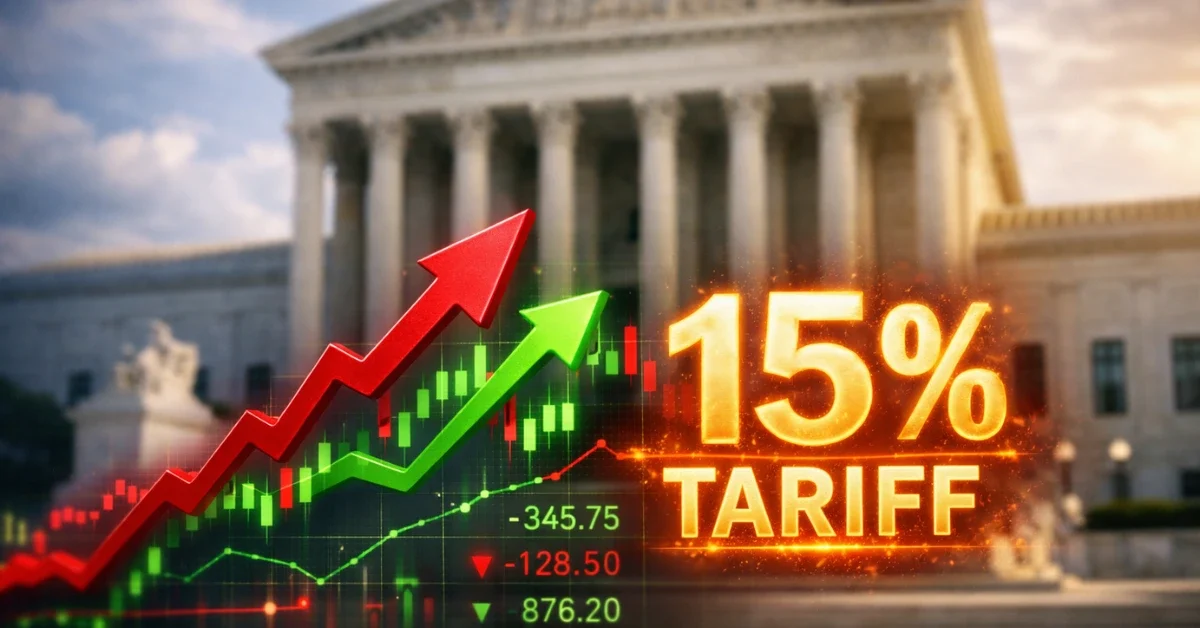
The U.S. Supreme Court struck down a significant portion of President Donald Trump’s sweeping global tariffs on Friday, prompting the administration to enact new import levies immediately. The landmark Supreme Court tariff ruling has triggered rapid market reactions, sending the U.S. dollar lower and causing oil prices to slide amid renewed uncertainty over global economic growth.
In a 6-3 decision, the justices ruled that Trump overstepped his authority by implementing the extensive tariffs under the 1977 International Emergency Economic Powers Act, a law designated for national emergencies. Chief Justice John Roberts authored the majority opinion, noting that the administration “points to no statute” where Congress indicated the language in the act could be applied to tariffs. The court concluded that the taxing authority resides with Congress. Justices Clarence Thomas, Samuel Alito, and Brett Kavanaugh issued dissenting opinions.
A Divisive Judicial Decision
President Trump vehemently criticized the ruling. During a news conference and in social media posts, he labeled the decision a “disgrace” to the country. Trump characterized the majority justices as “fools and lapdogs,” “very unpatriotic,” “disloyal to the Constitution,” and an “embarrassment to their families,” insinuating they were influenced by foreign interests.
Despite the court’s decision, the ruling does not restrict the president from imposing tariffs through alternative legal frameworks. On Saturday, Trump announced a new global tariff under Section 122 of the Trade Act of 1974. Initially set at 10%, he quickly raised the blanket levy to 15%, the maximum rate permissible under the law. These new tariffs are restricted to a duration of 150 days unless Congress extends them. No president has previously utilized Section 122, and its application may invite additional legal disputes. The White House indicated that the new tariffs would include exemptions for specific items such as essential minerals, metals, and energy products.
Alternative Legal Frameworks and Trade Pacts
The administration also asserted that countries must uphold existing trade agreements, even if they entail higher rates than the new universal tariff. According to an administration representative, exports from nations like Malaysia and Cambodia will continue to incur their negotiated rates of 19%. Indonesia’s chief negotiator also confirmed that their 19% trade deal remains intact.
Discrepancies Over Billions in Refunds
Meanwhile, businesses and foreign governments are exploring avenues to reclaim funds already collected by the U.S. government, though experts caution that receiving refunds may take years. Sources conflict regarding the total amount at stake. According to Al Jazeera, the U.S. has accrued an estimated $133 billion from the tariffs. However, Reuters reports that the government might need to repay approximately $170 billion in revenue, a scenario that could increase the fiscal deficit by half a percentage point to 6.6% of gross domestic product.
Global Market and Currency Reactions
Financial markets experienced immediate turbulence following the judicial intervention. While stock markets broadly surged after the court’s decision, the U.S. dollar dipped on Monday as traders interpreted the ruling as supportive for non-U.S. global growth. Sim Moh Siong, a currency strategist at OCBC Bank in Singapore, noted that the decision diminishes the dollar’s strength because it potentially benefits economic expansion outside the United States. In early trading, the Australian dollar surpassed 71 cents, and the New Zealand dollar hovered just below 60 cents. Gold saw increased demand as a safe-haven asset, rising 0.2% to $2,500 per ounce, while silver climbed 2% to $28.62.
Commodities and International Trade Impacts
Commodity markets also reacted to the sudden policy shift. Oil prices slipped on Monday as the 15% tariff hike raised jitters over world economic growth and fuel consumption. Brent crude futures slid 45 cents, or 0.63%, to $71.31 a barrel, while U.S. crude futures fell 50 cents, or 0.75%, to $65.98 a barrel. This decline offset the rising risk of a military conflict between the U.S. and Iran, which had pushed prices up more than 5% the previous week. In related energy sector news, South African petrochemical company Sasol reported a 34% drop in half-year profit. The company’s headline earnings per share fell to 9.32 rand from 14.13 rand for the six months ending December 2025, primarily due to lower global oil and chemical prices.
The ongoing unpredictability regarding trade policy has already disrupted international diplomacy. India delayed plans to send a trade delegation to Washington this week due to the tariff uncertainty following the judgment. The delegation was scheduled to depart on Sunday to finalize an interim trade deal that would reduce U.S. tariffs on Indian goods to 18%, while India committed to purchasing $500 billion worth of U.S. items over five years. Despite the diplomatic delay, Indian shares were set to open higher, with Nifty futures indicating a positive start above the previous close of 25,571.25 points, buoyed by the prospect of reduced global trade barriers.
