

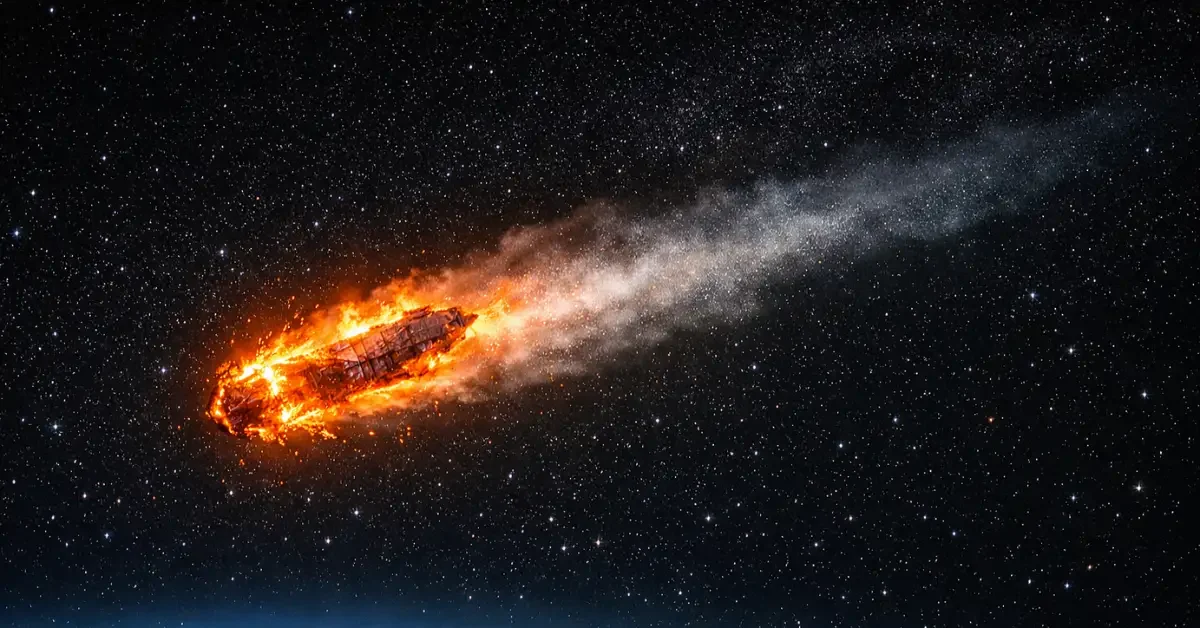
For the first time, researchers have directly measured upper atmospheric pollution caused by a re-entering spacecraft. Scientists tracked a massive plume of lithium back to the uncontrolled re-entry of a discarded Falcon 9 rocket upper stage. This groundbreaking discovery highlights growing environmental concerns regarding SpaceX rocket pollution as the number of commercial satellite launches continues to surge worldwide.
The historic measurement occurred after the rocket created a brilliant fireball over Europe. Using sensitive laser technology, an international research team successfully quantified the chemical footprint left behind in a region of the atmosphere that is notoriously difficult to examine. Published in the journal Communications Earth & Environment, the findings demonstrate that space debris leaves a detectable chemical fingerprint high above the planet.
Experts warn this event is a harbinger of future atmospheric challenges. As space companies plan to launch massive satellite megaconstellations, the volume of metal burning up in our skies will drastically increase.
Tracing the Lithium Plume
The event traces back to February 19, 2025, when a Falcon 9 upper stage tumbled back to Earth. As the machinery burned up during its uncontrolled descent over the Atlantic Ocean, west of Ireland, it created a spectacular visual display witnessed by stargazers from the United Kingdom to Poland.
Shortly after 00:20 UTC on February 20, scientists at the Leibniz Institute of Atmospheric Physics in northern Germany detected a chemical anomaly. The research team, led by Robin Wing and Gerd Baumgarten, utilized a remote sensing instrument known as LIDAR. This technology gauges atmospheric conditions by shooting rapid laser pulses into the sky and analyzing the rebounding light.
The instruments recorded a sudden spike in lithium atoms. The lithium plume stretched between 94 and 97 kilometers above sea level, lingering in the instruments’ view for 27 minutes before data recording stopped. At its peak, the lithium concentration in this layer was 10 times higher than normal baseline levels.
By using atmospheric trajectory and wind modeling, the researchers definitively linked this metallic cloud to the SpaceX rocket’s path. The elevated levels of lithium—a metal widely used in satellite batteries and spacecraft casings—were distinctly different from the natural traces left by burning meteors.
The “Ignorosphere” and Unknown Climate Impacts
The pollution was detected in an atmospheric zone spanning the mesosphere and lower thermosphere. Scientists sometimes refer to this 50-to-100-kilometer stretch as the “ignorosphere” because it is exceptionally challenging to study. It is too high for weather balloons and research aircraft, yet too low for orbiting satellites to monitor effectively.
While the immediate impacts of this specific lithium cloud remain uncertain, researchers are deeply concerned about the broader consequences. The upper atmosphere plays a critical role in global weather patterns, GPS and radio communications, and housing the protective ozone layer.
According to the study’s authors, a relatively small amount of material at extreme altitudes can have a disproportionate effect. “What we do know is that one ton of emissions at 75 kilometers is equivalent to 100,000 tons at the surface,” the research team noted.
Previous research suggests that soot from rocket launches could warm the upper atmosphere, while aluminum and chlorine emissions from re-entering debris might slow the recovery of the ozone layer. This protective barrier is vital for shielding life on Earth from harmful ultraviolet radiation.
A Rapidly Escalating Problem
The successful measurement of this pollution arrives at a critical turning point for the space industry. A few years ago, only a few thousand satellites orbited the planet. Today, there are approximately 14,000 active satellites in orbit.
The sheer volume of planned launches is staggering. SpaceX recently applied to launch up to one million additional satellites to power data centers in space, while China requested authorization to deploy around 200,000. Every satellite and rocket stage will eventually fall back to Earth. Current estimates project that by 2030, several tonnes of spacecraft material will incinerate in the upper atmosphere every single day.
Despite this rapid industrialization of space, there is currently no regulatory framework governing these emissions. Eloise Marais, a professor of atmospheric chemistry at University College London who was not involved in the study, emphasized the urgent need for oversight.
“There is currently no suitable regulation targeting pollution input into the upper layers of the atmosphere,” Marais stated. She added that while these regions feel distant, pollutants there could carry consequential impacts for life on the ground if they alter the climate or diminish the ozone layer.
The new findings provide the first proof that space industry pollution can be reliably measured and traced back to specific re-entry events. Scientists argue this capability is an essential first step toward holding companies accountable and establishing international monitoring networks before the emerging threat escalates further.
