

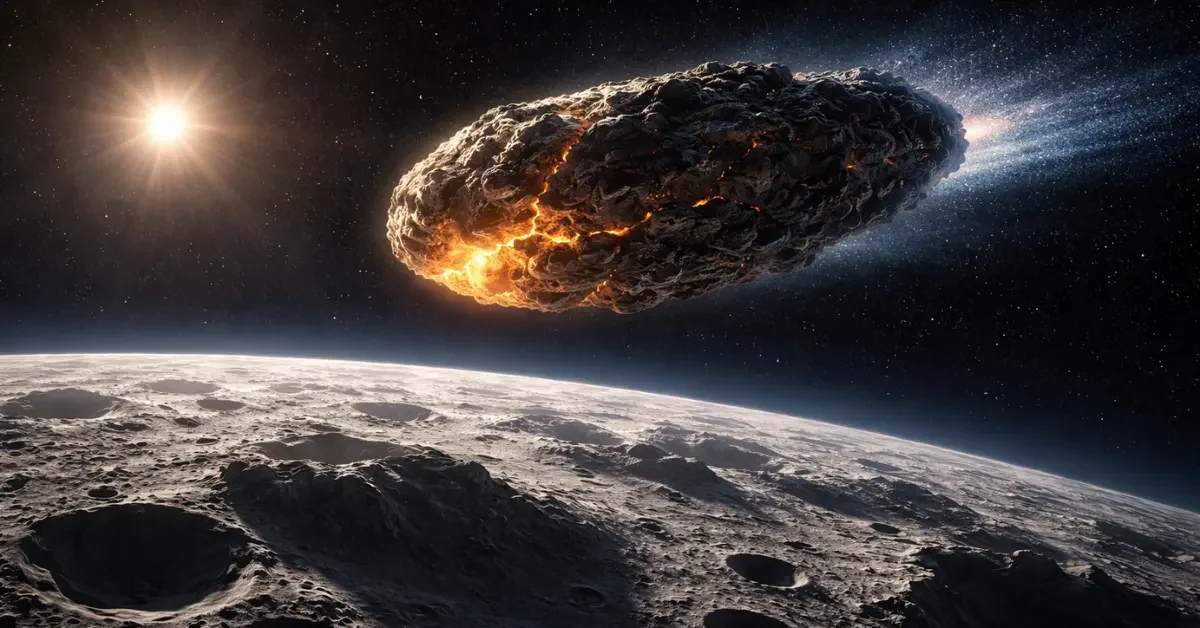
The near-Earth object known as Asteroid 2024 YR4 will not crash into the moon on December 22, 2032. After astronomers initially calculated a 4.3 percent chance of a lunar collision, new data gathered by NASA’s James Webb Space Telescope has completely ruled out an impact. Instead of striking the lunar surface, the asteroid will safely cruise past the moon at an altitude of 13,200 miles (21,200 kilometers).
Earlier this year, Asteroid 2024 YR4 commanded international attention due to a potential impact threat to Earth. While the risk of an Earth impact in 2032 was lowered to near-zero by late February, its highly uncertain orbit meant the moon remained a possible target. Astronomers initially believed they would need to wait until 2028 to observe the space rock again and clarify its exact trajectory. Fortunately, a brief observing window in February allowed the powerful space telescope to measure its path and officially eliminate the danger to both Earth and the moon.
Tracking the Asteroid Against Distant Stars
Locating such a small, distant target was a major astronomical challenge. Asteroid 2024 YR4 is one of the faintest targets the James Webb Space Telescope has ever observed. Between February 18 and February 26, scientists carefully aimed the telescope’s Near-Infrared Camera (NIRCam) at the asteroid as it traveled across a backdrop of faint stars. Because the European Space Agency’s Gaia mission had already mapped these background stars with extreme precision, astronomers could use their fixed positions to accurately refine the asteroid’s orbit.
Researchers at the Johns Hopkins University Applied Physics Laboratory (JHUAPL) worked alongside telescope engineers, the European Space Agency’s Near-Earth Object Coordination Centre, and NASA’s Center for Near-Earth Object Studies to execute the demanding task. The NIRCam instrument has a narrow field of view of just 2.2 square arcminutes, making the precise tracking a significant achievement for planetary defense.
Measuring a 15-Story Space Rock in Infrared
Beyond mapping its path through the solar system, the observations allowed scientists to figure out the exact size and makeup of Asteroid 2024 YR4. By using both NIRCam and the Mid-Infrared Instrument (MIRI), astronomers analyzed the sunlight reflecting off the rock and the heat radiating directly from it. While reflected light alone makes it difficult to gauge an asteroid’s size, measuring the heat gives a much more accurate dimension.
Andy Rivkin, the principal investigator of the telescope program used for the study, explained that combining these instruments revealed both the object’s dimensions and its surface composition. The asteroid measures roughly 200 feet (60 meters) across, making it about the height of a 15-story building. This makes it the smallest object the mission has targeted to date, and one of the smallest space rocks to ever have its size directly measured.
The infrared data also revealed highly unusual thermal properties. The rock heats up and cools down completely differently than larger asteroids, acting strangely based on its current distance from the sun. Scientists believe this happens because the object spins very fast and lacks fine-grained sand on its exterior. Instead, its surface is likely dominated by rocks that are fist-sized or even larger.
What a Lunar Impact Would Have Looked Like
If the 2032 lunar impact had occurred, the event would have been visually spectacular and highly destructive. The collision would have unleashed energy equal to six million tons of TNT, creating an explosion rivaling a large nuclear detonation. If it had struck the near side of the moon, observers on Earth would have witnessed a brilliant flash of light as the asteroid carved out a brand-new crater measuring 0.62 miles (1 kilometer) wide.
While most of the impact debris would have rained back down onto the lunar surface, millions of pounds of dust and rock could have escaped the moon’s gravity. Some of this material would have eventually fallen toward Earth, potentially sparking a unique meteor shower lasting several days. More concerningly, the lingering debris would have created a long-term hazard for satellites operating in Earth’s orbit.
Today, researchers are using this successful tracking effort to prepare for future hazards. The international community, including orbit calculators and the International Asteroid Warning Network, expects to find more potential impactors in the coming years as more sensitive asteroid search programs begin operation. Practicing these observation techniques on Asteroid 2024 YR4 ensures scientists are ready to act quickly if a more dangerous space rock heads our way.
