

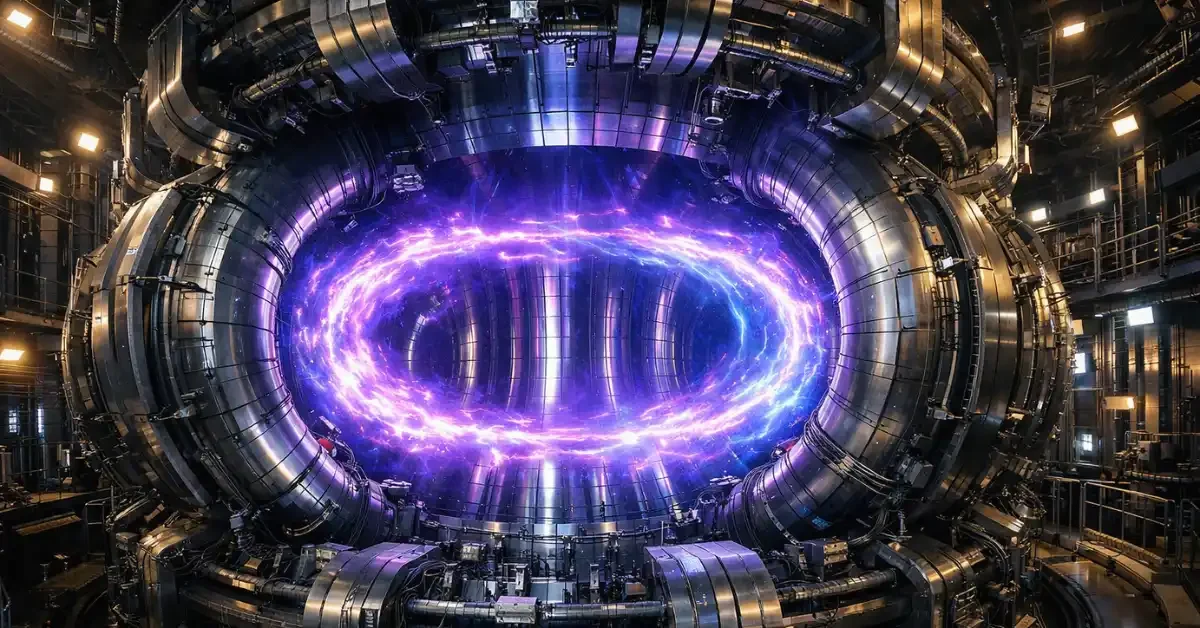
Recent nuclear fusion breakthroughs are pushing humanity closer to harnessing the near-limitless clean energy that powers the stars. For decades, the immense temperatures and complex engineering required to sustain fusion made commercial viability seem impossible. However, new achievements—including a record-shattering plasma density experiment in China and a strategic push for advanced diagnostics in the United States—are fundamentally changing the timeline for commercial nuclear fusion.
As technical hurdles fall, financial backing is skyrocketing. Between 2021 and 2025, private investment in the fusion sector surged to nearly $9 billion, driven largely by major technology companies like Google, Microsoft, Amazon, and Meta seeking sustainable power for artificial intelligence data centers. With international collaborations expanding and new material sciences emerging, these nuclear fusion breakthroughs indicate that a commercial power plant may be closer than previously imagined.
Shattering the Greenwald Density Limit
A critical obstacle to sustained fusion has long been the Greenwald limit, a theoretical boundary dictating how dense plasma can become before it destabilizes and kills the reaction. Because higher density allows more atoms to collide and lowers the energy required for ignition, breaking this barrier is essential for efficient power generation.
On January 1, 2026, researchers announced in the journal Science Advances that China’s Experimental Advanced Superconducting Tokamak successfully maintained stable plasma at 1.3 to 1.65 times beyond the Greenwald limit. By carefully controlling the initial fuel gas pressure and utilizing a technique called electron cyclotron resonance heating, scientists guided the plasma into a density-free regime. This approach optimized the interactions between the plasma and the reactor walls, allowing density to rise steadily without triggering disruptions.
This achievement confirms the plasma-wall self-organization theory, which suggests that a careful balance of physical interactions can stabilize the fuel. While experimental reactors in the United States, such as the DIII-D National Fusion Facility and a device at the University of Wisconsin–Madison, previously breached this density limit in 2022 and 2024 respectively, the Chinese results provide a highly scalable pathway for next-generation fusion devices.
Expanding Diagnostic Technologies
To operate these highly complex reactors safely, scientists need advanced sensors to monitor extreme temperatures and ultra-quick physical processes. A March 2026 report sponsored by the U.S. Department of Energy emphasizes the critical need for diagnostic innovation to accelerate the development of commercial power plants.
Compiled by 70 researchers and led by experts from the Princeton Plasma Physics Laboratory and the University of Rochester, the report outlines key strategies for advancing measurement technologies. Priority recommendations include developing sensors that can withstand the intense radiation of future pilot plants, utilizing artificial intelligence to streamline design modeling, and establishing a national diagnostic network called CalibrationNetUS.
By improving how scientists measure and calibrate plasma fuel conditions, the fusion sector can transfer essential operational expertise from public research facilities to private energy companies, speeding up the commercialization process.
Solving Extreme Material Challenges
Even with stable plasma and precise diagnostics, physical reactor components face punishing conditions. Commercial nuclear fusion requires exotic materials capable of withstanding blistering heat and intense neutron flux over long periods.
To tackle this material science bottleneck, the Massachusetts Institute of Technology launched the Laboratory for Materials in Nuclear Technologies in June 2025. This specialized facility focuses on discovering and testing cost-effective materials specifically designed to handle the extreme environments inside commercial fusion power plants.
Global Collaboration and the Path Forward
These combined scientific leaps feed directly into humanity’s most ambitious energy project: the International Thermonuclear Experimental Reactor. Currently under construction in southern France by a coalition of 35 countries, this massive 23,000-tonne machine recently received its final central solenoid module—the world’s most powerful magnet—in September.
The international reactor is designed to prove that a fusion device can generate more energy than it consumes, an essential milestone before commercial grids can adopt the technology. The project is expected to begin full-scale fusion reactions in 2039.
Supported by dynamic artificial intelligence models that can manage magnetic fields and predict safe zones within the intense heat, researchers are tackling the remaining technical barriers from all sides. While challenges remain before nuclear fusion completely replaces fossil fuels, the rapid acceleration of investment, international cooperation, and scientific milestones proves that the foundation for a limitless clean energy future is already being built.
