

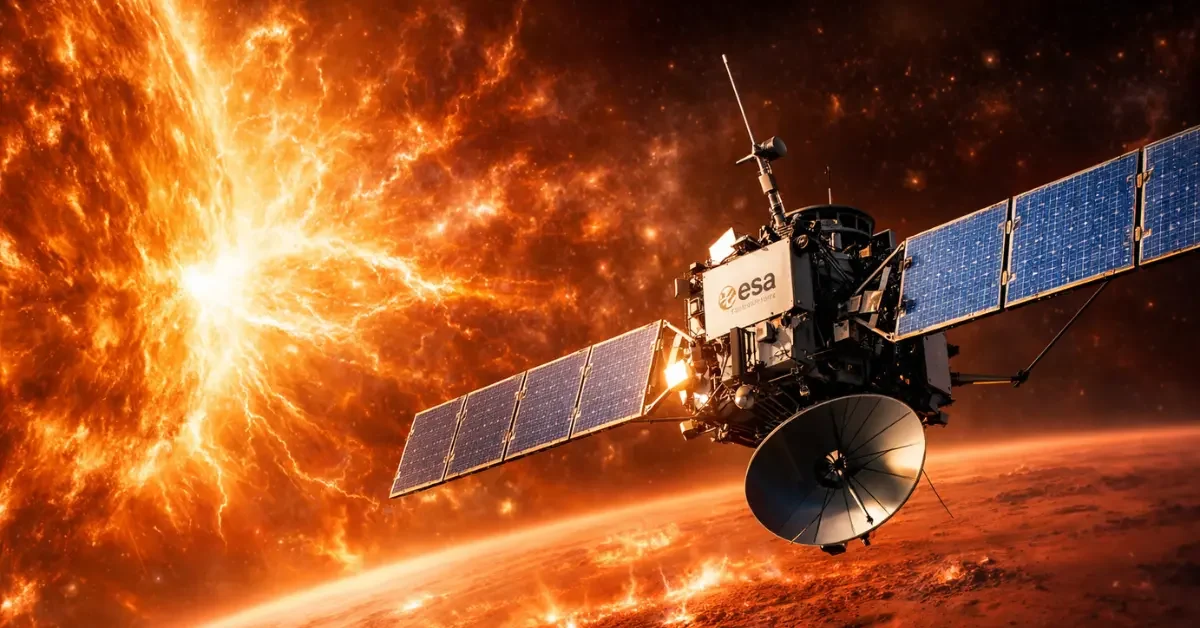
A historic solar superstorm that recently struck Earth also slammed into the Red Planet, delivering an unprecedented wave of radiation. In May 2024, the Sun erupted with powerful solar flares and coronal mass ejections. While Earth experienced spectacular auroras, a solar superstorm on Mars caused complete chaos in the planet’s upper atmosphere and temporarily disrupted orbiting spacecraft.
The immense surge of solar energy flooded the Martian atmosphere with charged particles. According to a new study published in the journal Nature Communications, this solar superstorm on Mars produced the largest atmospheric response to space weather ever recorded on the planet. Two European Space Agency spacecraft, the Mars Express and the ExoMars Trace Gas Orbiter, were perfectly positioned to observe the onslaught.
Unprecedented Radiation and Spacecraft Glitches
The violent storm originated from an active sunspot region known as AR3664. Large clusters of sunspots are notorious for producing explosive solar phenomena. When this region erupted, it unleashed a combination of extreme space weather events, sending fast-moving magnetized plasma rocketing through the solar system.
Capturing data during such an intense event came with significant risks. The severe space weather caused temporary computer errors on both orbiters. Energetic solar particles are highly unpredictable and easily interfere with sensitive electronics. Fortunately, engineers designed these spacecraft with harsh space environments in mind. Equipped with radiation-resistant components and automated systems to fix errors, both orbiters recovered quickly.
The ExoMars Trace Gas Orbiter carries a dedicated radiation monitor that revealed the true intensity of the bombardment. In a span of just 64 hours, the spacecraft absorbed a massive radiation dose equivalent to 200 normal days in orbit.
An Atmosphere Flooded With Electrons
The storm consisted of three distinct phases: a rapid flare of radiation, a sudden burst of high-energy charged particles, and a massive coronal mass ejection. As this material hit the Martian upper atmosphere, it collided violently with neutral atoms, stripping away their outer electrons.
This violent process filled the region with a record-breaking number of free electrons. Scientists observed that the lower layer of the Martian ionosphere expanded dramatically, swelling to nearly three times its typical size.
The atmospheric changes were staggering. The electron density increased by 45 percent at an altitude of 68 miles, or 110 kilometers. Higher up, at 81 miles or 130 kilometers above the surface, the electron count skyrocketed by 278 percent. Researchers noted this is the highest concentration of electrons ever measured in these specific atmospheric layers.
Measuring the Storm With Radio Occultation
To measure these shifts, researchers utilized a pioneering technique known as radio occultation. This required precise teamwork between the two spacecraft. The Mars Express beamed a continuous radio signal toward the ExoMars Trace Gas Orbiter at the exact moment the receiving spacecraft began to disappear behind the Martian horizon.
As the radio signal traveled through the heavily charged atmosphere, the dense layers of newly freed electrons caused the signal to bend. By carefully analyzing how the radio waves changed, scientists could calculate the exact density of the charged particles. Data collected by NASA’s MAVEN spacecraft independently confirmed these electron spikes.
The research team, led by European Space Agency scientists Jacob Parrott and Colin Wilson, benefited from fortunate timing. The orbiters conducted this complex maneuver just 10 minutes after a massive solar flare struck the planet. Because the agency only schedules these observations twice a week, catching the immediate aftermath was a lucky coincidence.
Earth vs. Mars: The Shielding Difference
This extreme event highlighted the stark differences between Earth and its planetary neighbor. When the same storm hit Earth, the direct impact on our atmosphere was much more muted. Earth possesses a strong magnetosphere. This natural magnetic shield successfully deflects a large portion of dangerous solar particles away from the planet.
Mars, however, lacks a global magnetic field. Without a protective magnetosphere, the planet is entirely exposed to the harsh realities of space weather. The intense solar storm hit the Martian atmosphere directly, causing the extreme reactions observed by the orbiters.
Why Monitoring Space Weather Matters
Understanding how a solar superstorm on Mars affects the planet is crucial. Researchers believe a continuous onslaught of solar wind over billions of years is the primary reason Mars lost its ancient water and thick atmosphere, slowly transforming into an arid desert.
These findings also have major implications for the future of space exploration. When the Martian upper atmosphere becomes packed with electrons, it can block the radio and radar signals scientists rely on to study the surface. As space agencies plan complex robotic and human missions to the Red Planet, predicting severe space weather will be essential for keeping equipment and future astronauts safe.
