

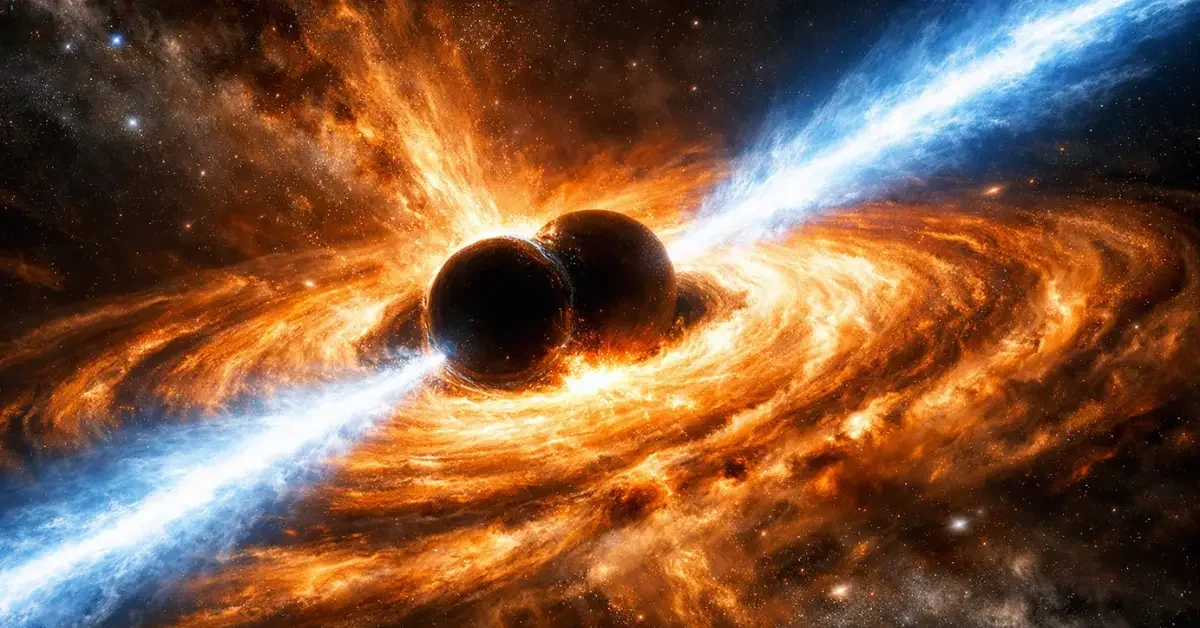
Recent observations have unveiled a groundbreaking cosmic event that challenges traditional astronomical theories. The massive black hole merger designated as LVK S241125n, which involves objects with a combined mass exceeding 100 solar masses, has produced unexpected electromagnetic emissions. Located approximately 4.2 billion light-years away from Earth, this 100-solar-mass black hole merger ripples spacetime while simultaneously generating a brilliant flash of light. Historically, scientists believed that black hole collisions occurred in desolate, empty environments and were entirely invisible to conventional telescopes. However, this new discovery suggests that under specific, extreme conditions, a black hole merger can briefly but spectacularly illuminate the surrounding universe.
The initial signal reached Earth on November 25, 2024, when the LIGO and Virgo gravitational-wave observatories detected the distinct spacetime ripples of the S241125n event. A mere 11 seconds after this gravitational wave detection, NASA’s Swift observatory identified a short gamma-ray burst radiating from the exact same region of the sky. Shortly after this prompt emission, China’s Einstein Probe satellite detected a lingering X-ray afterglow in the vicinity. Researchers published their joint analysis in The Astrophysical Journal, calculating that the probability of these signals aligning purely by chance is deliberately conservative, with a false-alarm rate of only one event in 30 years.
A Violent Collision in an Active Galactic Nucleus
To explain how a supposedly dark event could emit intense radiation, researchers point to the turbulent environment of an active galactic nucleus. At the center of active galaxies, supermassive black holes are surrounded by massive, dense, and rapidly rotating disks of gas and dust. Within these chaotic accretion disks, smaller black holes can become trapped, orbiting through the thick gas. Over time, some of these stellar-mass black holes form binary pairs and eventually merge.
If the black holes involved in S241125n collided within such an active galactic nucleus disk, the dynamics would be vastly different from a collision in the vacuum of empty space. According to the proposed astrophysical model, the actual merging process released gravitational waves unevenly, which generated a massive asymmetric force. This lopsided emission delivered a powerful recoil kick to the newly formed, merged black hole, propelling it at high speeds through the surrounding dense disk material.
As this kicked black hole plowed through the magnetized gas of the accretion disk, it began to consume the material in its path at an astonishing rate. The consumption reached hyper-Eddington accretion levels, which vastly exceed the normal physical limits at which a black hole can steadily absorb matter. This intense, rapid feeding frenzy transformed the black hole into a voracious cosmic engine. The rotational energy of the spinning black hole then powered twin relativistic jets, launching radiation and subatomic particles outward at velocities approaching the speed of light.
Unusual Spectral Signatures and Shock Breakouts
The interaction between these relativistic jets and the dense gas of the active galactic nucleus disk explains the unique electromagnetic signature observed by the Swift observatory. When the jets punched through the surrounding material, they triggered a “shock breakout.” This breakout produced a Comptonized, or thermalized, gamma-ray spectrum that matched the actual data captured by space telescopes.
Interestingly, the luminosity and energy of S241125n are consistent with typical short gamma-ray bursts, which normally originate from colliding neutron stars. However, the spectral characteristics of this black hole merger are distinctly different. The prompt emission of the burst featured a photon index of -2.2 within the 15 to 350 keV energy range. This indicates a significantly softer spectrum with lower photon energy, compared to the standard photon index of -1 to -1.5 typically seen in standard short gamma-ray bursts.
Expanding the Frontiers of Multi-Messenger Astronomy
This extraordinary event represents a monumental achievement for multi-messenger astronomy, a field that combines different types of cosmic signals to build a comprehensive picture of the universe. Gravitational-wave detectors successfully captured the “sound” of the spacetime ripples, while orbiting X-ray and gamma-ray telescopes recorded the explosive “flash.” Together, these distinct instruments tell a far more complete story than any single observatory could achieve alone.
As the global astronomical community continues to scrutinize the S241125n data, researchers are already planning their next steps. Scientists advocate for deep-field observations of the cosmic region to pinpoint the exact host galaxy, which is expected to be a distant galaxy harboring a bright active galactic nucleus. Furthermore, astronomers suggest looking for residual orbital eccentricity in the gravitational-wave signal, which would serve as a telltale imprint of the dynamic disk environment. If fully confirmed, this historic detection will permanently alter our understanding of black hole environments and the extreme mechanisms powering high-energy cosmic phenomena.
