

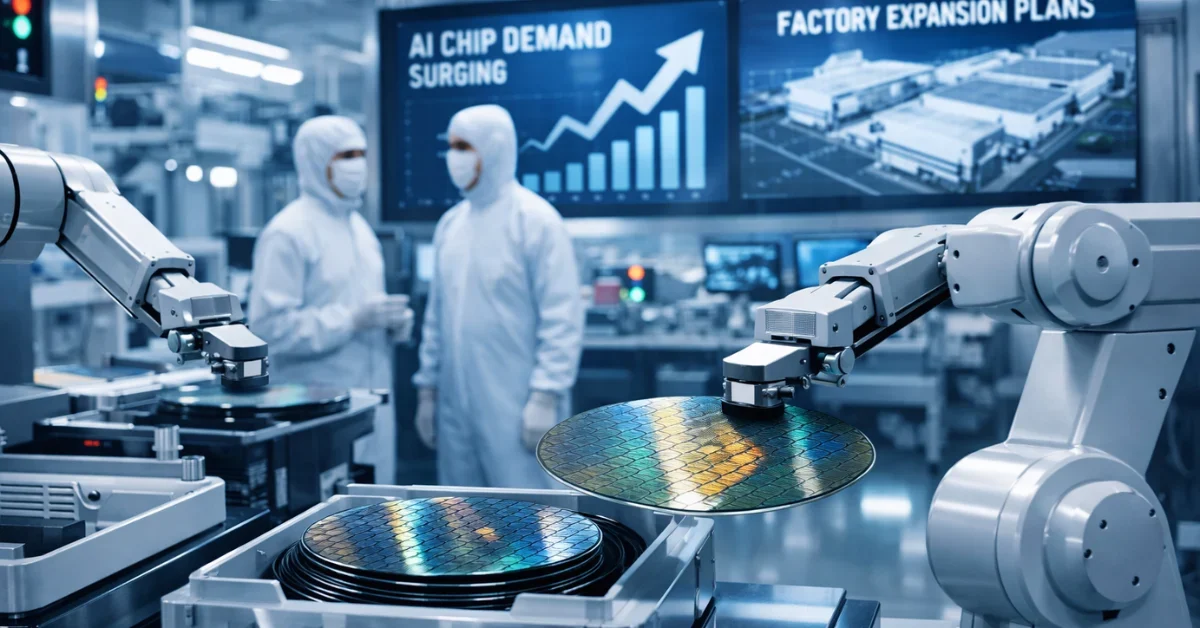
The semiconductor industry is moving into 2026 with two strong forces at once: a fresh wave of factory spending tied to AI demand and a growing warning that those investments could become risky if demand weakens. TSMC’s latest outlook points to another big jump in capital spending, while India is pushing ahead with a larger semiconductor buildout under the India Semiconductor Mission.
That tension is becoming one of the biggest stories in chipmaking this year. Industry signals tracked in early 2026 show momentum in AI cloud infrastructure, silicon photonics, edge AI, memory research, quantum computing, and industrial policy, even as supply-chain limits and utilization risks remain in focus.
TSMC warning sharpens focus
The clearest warning has come from TSMC, whose management said the company is treating its 2026 investment plans carefully because mistakes at this scale could be damaging. According to one analysis published Tuesday, advanced nodes are expected to take 70 percent to 80 percent of TSMC’s planned 2026 spending, increasing the financial pressure around every expansion decision.
TSMC booked US$122.42 billion in revenue in 2025, with AI and high-performance computing contributing about 58 percent, and the company has guided for nearly 30 percent revenue growth in 2026. The same source said TSMC’s 2025 capital spending rose 33 percent year over year to NT$1,272.41 billion, or about US$41 billion, and the midpoint of its 2026 plan implies another 30 percent increase.
Those numbers help explain why semiconductor capex risk is now drawing more attention from investors, equipment suppliers, and manufacturing partners. The analysis said Wall Street is also watching TSMC’s 41.7 percent operating margin, its projected 2026 capex-to-revenue ratio of roughly 44 percent, and its NT$811 billion net cash position at the end of 2025.
India accelerates its chip push
At the same time, India is expanding its own semiconductor manufacturing base with central and state support. India Briefing reported that, as of March 2026, 10 semiconductor units had been approved under the Semicon India Programme, including two fabrication plants and eight assembly, testing, marking, and packaging facilities, with one unit already in commercial production and three running pilot lines.
The same report said the programme has attracted investment commitments of about INR 1.6 trillion, or US$17.31 billion. It also said the Union Budget for 2026-27 announced ISM 2.0, which is expected to strengthen semiconductor equipment and materials manufacturing, expand full-stack design capabilities, develop domestic intellectual property, and improve supply-chain resilience.
India’s policy structure is designed to lower the cost of entry for major projects. Under the country’s modified schemes, approved semiconductor fabs, display fabs, and compound semiconductor or ATMP and OSAT facilities can receive fiscal support of up to 50 percent of eligible project cost or capital expenditure, while the Design Linked Incentive scheme supports chip design work and commercialization.
The market opportunity is also one reason global investors continue to watch India closely. India Briefing said the domestic semiconductor market was valued at about US$38 billion in 2023 and is projected to reach around US$109 billion by 2030, driven by demand from smartphones, automotive electronics, industrial automation, and data centers.
New projects add to pressure
Fresh project announcements are also adding to the sense that the industry is racing to secure future chip supply. Tom’s Hardware reported that Elon Musk said his Terafab Project would launch on March 21, 2026, after earlier saying existing foundries could not meet his companies’ demand for high-performance AI processors.
That report said the long-term goal is tied to supply needs at Tesla, SpaceX, and xAI. It also said Musk had previously suggested his companies could need 100 billion to 200 billion AI chips per year, though he added that they would continue to rely on external foundry partners if those suppliers could expand fast enough to meet the required timeframe.
Industry growth meets bottlenecks
A broader industry roundup from The Semiconductor Newsletter shows that the 2026 story is not just about more logic chips or more memory. The publication said this year’s momentum is also concentrating in optical interconnects, specialty materials, quantum architectures, and critical supply issues such as helium instability, which it described as a growing manufacturing constraint.
Taken together, these developments show an industry trying to build for long-term AI demand while staying alert to the risk of overcapacity, slower utilization, and cost pressure. With TSMC raising the warning flag, India scaling incentives, and new ventures like Terafab entering the picture, semiconductor capex risk is emerging as one of the central themes of 2026.
