

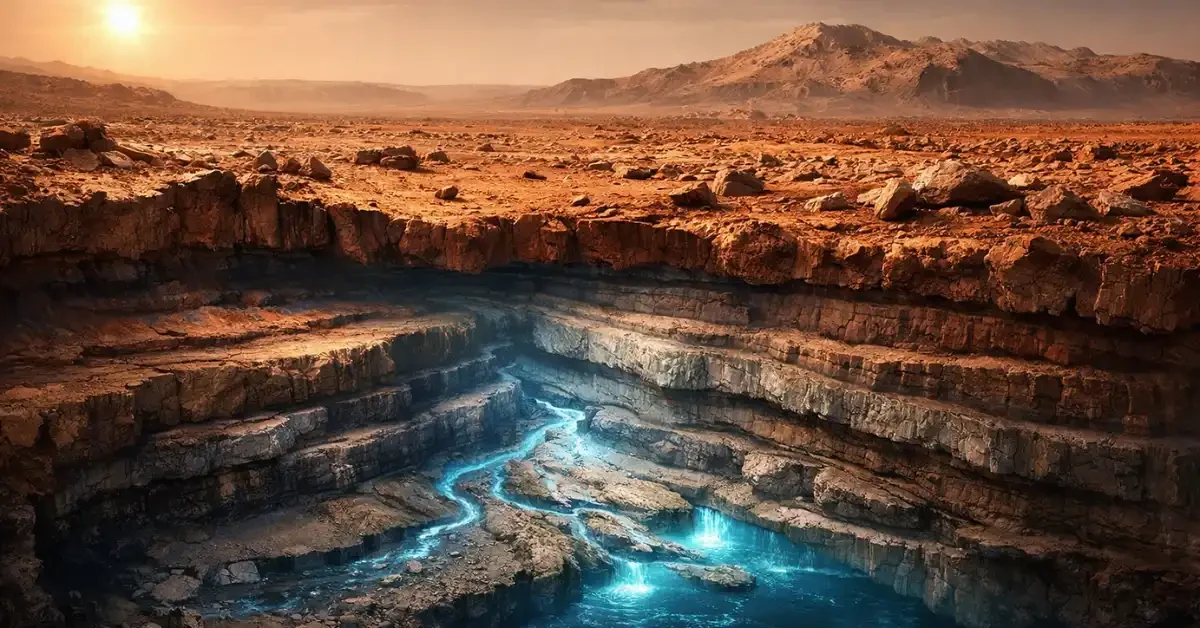
NASA’s Perseverance rover has uncovered evidence of an ancient buried river delta on Mars. Using advanced ground-penetrating radar, scientists detected vast geological structures under Jezero Crater that point to a water-rich environment from the planet’s earliest days. This newly discovered river system is estimated to be between 3.7 billion and 4.2 billion years old, shifting our understanding of how long liquid water actively flowed across the Martian landscape.
The discovery provides some of the oldest evidence yet that the Red Planet once hosted dynamic aquatic environments. By revealing a subsurface deltaic landscape that predates the previously known surface features, the findings extend the window of potential habitability. Researchers believe this extended history of flowing water significantly boosts the chances of finding preserved biosignatures, which are chemical or physical indicators of past microbial life.
Probing the Subsurface of Jezero Crater
Since landing in February 2021, the Perseverance rover has been traversing Jezero Crater, a 45-kilometer-wide basin in the Martian northern hemisphere formed by an asteroid impact nearly 4 billion years ago. Scientists specifically targeted this region because its orbital imagery suggested a history of flowing water. To look beyond the dusty red surface, the rover relies on the Radar Imager for Mars’ Subsurface Experiment, commonly known as RIMFAX.
Between September 2023 and February 2024, Perseverance spent approximately 250 Martian days collecting the deepest radar data ever gathered in the crater. Over the course of 78 traverses covering a distance of 6.1 kilometers, the RIMFAX instrument transmitted radar waves deep into the ground. The signals that bounced back allowed researchers to construct a detailed three-dimensional map of the layers of rock and sediment hiding below.
The radar penetrated to depths exceeding 35 meters, peering nearly twice as deep as any previous study in the area. The research team focused their efforts on the Margin unit, an area packed with carbonate and olivine minerals. On Earth, carbonates typically form in stable, watery environments like shallow seas or lakebeds. As the rover continued its drive across the Margin unit, the radar signals revealed complex, sloping layers of sediment known as clinoforms.
Geological Clues of a Dynamic River System
The structures detected underground are characteristic of a delta, which forms when a flowing river empties into a larger, standing body of water and leaves behind deposits of sand and mud. Alongside the sloping clinoforms, the ground-penetrating radar identified lobe and channel structures, scours, backseats, and buried boulders. These formations are typical indicators of a dynamic river system.
According to Emily Cardarelli, a geomicrobiologist at the University of California, Los Angeles, the data revealed an unexpected level of transparency in certain underground units starting around the Sol 909 radargram. By the time the rover recorded the Sol 1052 radargram, the team observed complex geological features at depths they had not previously encountered. While the radar only probes tens of meters down at any specific location, combining the measurements from the entire traverse suggests that the Margin unit could have an actual vertical extent of 85 to 90 meters.
A Longer Window for Potential Martian Life
The newly mapped subsurface delta is distinct from the visible, fan-shaped expanse of sediment on the crater floor known as the Western Delta. While the surface-level Western Delta is estimated to be 3.5 billion to 3.7 billion years old, the buried layers are significantly older. Because Mars itself formed roughly 4.5 billion years ago, this hidden delta dates back to the planet’s Noachian to early Hesperian period.
This age difference indicates that Mars experienced multiple phases of water flowing over and shaping its landscape, rather than just a single brief period of moisture. The extended timeframe provides a much larger window of opportunity for microbial life to have emerged and thrived. The deep, fine-scale internal structures of the buried delta could act as a time capsule, preserving the mineral compositions and geochemical conditions of these ancient aqueous events.
The findings, published in the journal Science Advances, join a growing body of evidence supporting a wet Martian history. Beyond Jezero Crater, multiple exploration zones and orbital images continue to reveal ancient crater lakes and dried channels. Last year, Chinese scientists analyzing data from the Zhurong rover also detected radar signals in the northern plains beneath sandy surfaces, revealing structures that resemble the shores of an ancient ocean. Together, these discoveries highlight the complex evolutionary history of the rocky world and offer renewed hope for finding signs of ancient life preserved in the Martian crust.
