

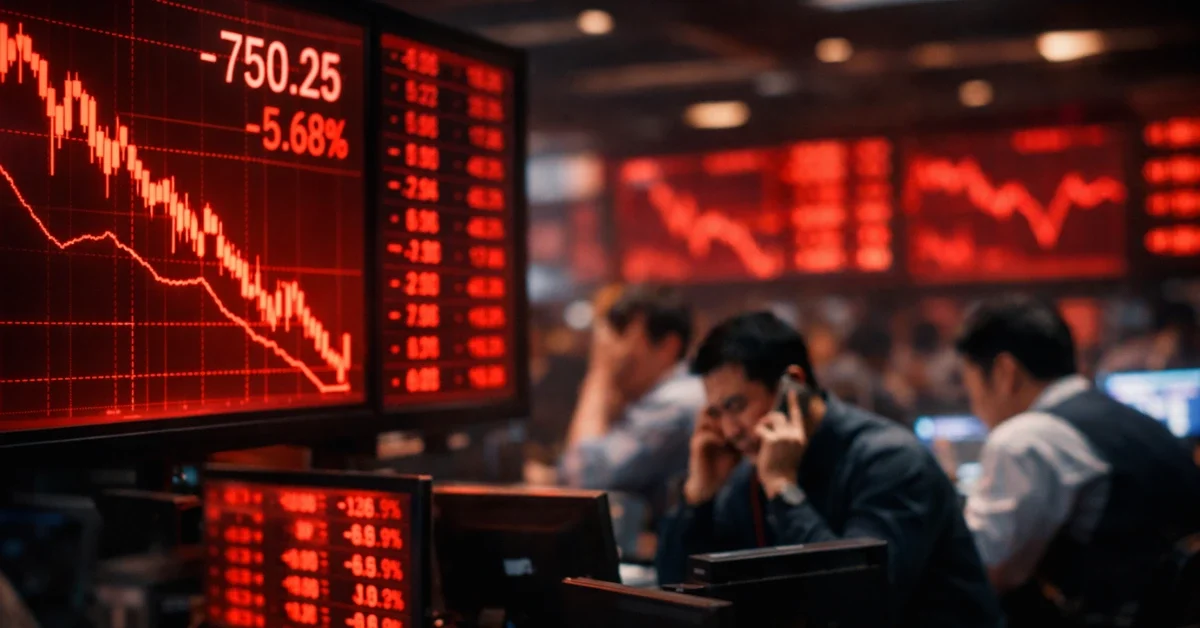
Market participants are moving away from bonds and inflation-sensitive investments while preparing for extended energy supply interruptions. Consequently, Asian markets tumble to their lowest levels in months.
Following significant Friday drops on Wall Street, major exchanges across Sydney, Tokyo, Shanghai, and Seoul posted broad losses on Monday. The widespread selling pressure dragged the MSCI global stock index to a four-month low, its weakest standing since November. The U.S. dollar appeared ready for a rebound as the geopolitical crisis reduced risk appetite and drove demand toward safer assets.
Escalating Threats in the Middle East
The financial downturn follows a weekend of heightened geopolitical threats. On Saturday evening, U.S. President Donald Trump gave Tehran a 48-hour ultimatum. He declared that the United States would destroy vital Iranian energy facilities if the country refused to reopen the Strait of Hormuz for shipping.
Iranian officials responded by promising to strike key regional infrastructure, including energy sites, if attacked. The confrontation follows earlier U.S. and Israeli bombing campaigns in Iran, which included a targeted strike that killed Ayatollah Ali Khamenei, the nation’s supreme leader. While early market consensus suggested the economic fallout from the Middle Eastern intervention would pass quickly, the hostilities are now entering their fourth week.
According to a senior market analyst at City Index in Brisbane, the recent ultimatum disrupted the market’s earlier stability. “Trump’s latest deadline has jolted markets from their previous calm and serves as a stark reminder that situations can escalate rapidly, sometimes triggered by a simple social media post,” the analyst noted.
Regional Impact: Japan and South Korea Lead Losses
Japan and South Korea suffered the steepest regional equity drops. These two nations, alongside India, rely heavily on imported fuel, making their economies especially susceptible to international energy disruptions.
Japanese equities faced severe selling pressure as traders returned from a Friday public holiday. The Nikkei 225 fell by up to 3.4% during morning trading sessions, while the Topix index declined by as much as 3.5%.
Meanwhile, South Korea’s Kospi index plunged almost 5%. Alongside war anxieties, Seoul’s markets faced domestic monetary fears following the nomination of economist Shin Hyun-song to lead the Bank of Korea. ING analysts characterized the appointment as hawkish, warning that the central bank might pursue interest rate hikes later in the year.
Oil Prices Surge as Energy Supplies Face Risk
The military standoff has severely disrupted international energy markets. Crude oil values have climbed past $100 per barrel, and natural gas prices in Europe have doubled. Analysts point to oil costs as the most visible metric of the crisis unfolding near the Strait of Hormuz.
A head of equities at RBC Capital Markets in Sydney highlighted the fragility of recent stock gains. “There has been a significant lack of conviction regarding valuation in this market rally,” the expert stated, adding that “we are witnessing a rapid exit from the market.” The analyst warned that while businesses and countries possess fuel stockpiles for now, these reserves will eventually deplete if the conflict continues.
Financial experts caution that a prolonged war could drive oil beyond $170 per barrel, potentially sparking a worldwide recession. Projections from Barclays suggest that if crude averages $100 throughout 2026, global economic expansion could shrink by 0.2 percentage points, pushing inflation up to 3.8%.
Widespread Economic Fears and Inflation Concerns
The extended fighting threatens to trigger another massive wave of consumer price hikes. Major financial institutions, including the European Central Bank, the Bank of England, and the Federal Reserve, have issued warnings that the war could significantly stifle growth and elevate inflation.
A chief investment strategist based in Singapore observed that traders no longer view the conflict as a fleeting issue. “The market is beginning to perceive this as more than just a temporary geopolitical incident,” the strategist explained. With European and Treasury bond yields climbing, investors are reconsidering inflation trajectories and scaling back hopes for interest rate cuts, raising fears of long-term stagflation.
Current economic conditions differ sharply from the 2022 energy shocks, which were buffered by strong post-pandemic consumer demand. Today, household budgets have little room to absorb higher living costs, and corporate job cuts were already underway in multiple nations before the Middle Eastern violence erupted.
A sustained equity sell-off could expose hidden weaknesses within the broader financial system. Analysts are increasingly concerned about transparency in private credit markets and the risk of a collapsing artificial intelligence technology bubble. The simultaneous drop in gold and stock prices signals a massive rush toward cash, which experts describe as a direct punishment for earlier market complacency.
