

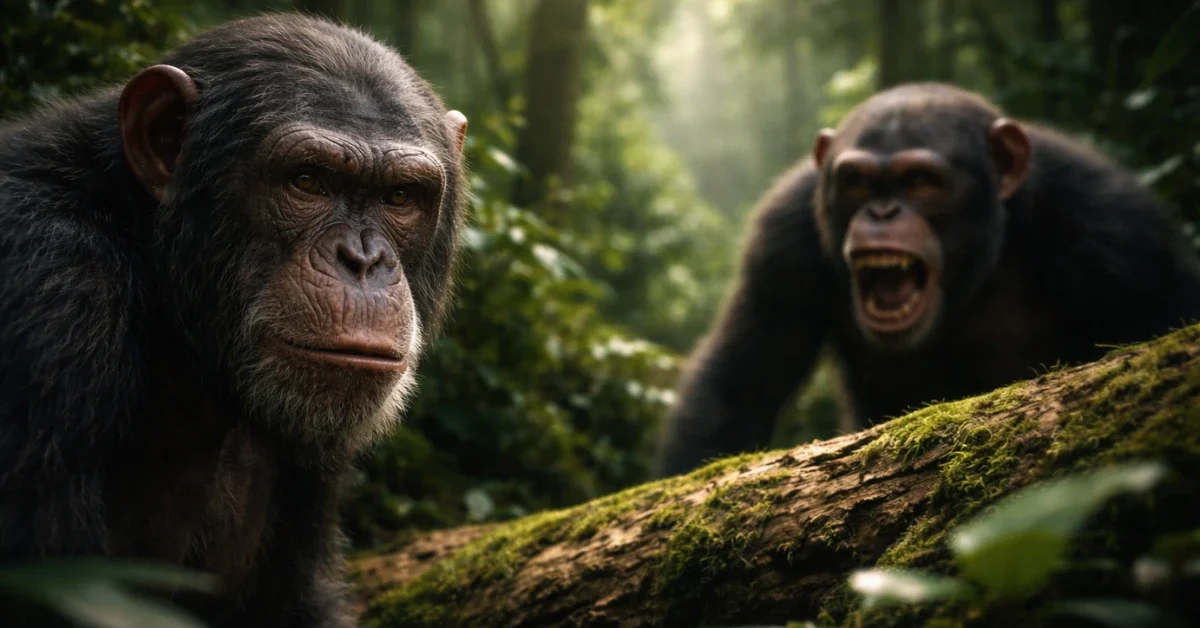
In a discovery that challenges our understanding of primate behavior, the largest known community of wild chimpanzees has permanently fractured into two rival factions, igniting a prolonged and deadly conflict. This unprecedented Uganda chimpanzee civil war, detailed in a study published in the journal Science, marks the first clearly documented permanent fission of a wild chimpanzee group. Researchers have observed former allies engaging in sustained, lethal violence, providing a rare glimpse into the mechanics of societal breakdown among our closest evolutionary relatives.
The conflict involves the Ngogo chimpanzees, a population living in Kibale National Park that previously gained fame in the Netflix series “Chimp Empire.” For nearly three decades, researchers monitored this cohesive community. However, over several years, the once-unified group of approximately 200 animals split into two distinct factions. As the groups divided, social ties dissolved, and the chimpanzees embarked on a lethal campaign against former friends.
The Roots of the Ngogo Chimpanzee Split
Chimpanzees typically operate in a fission-fusion dynamic, meaning individuals regularly separate into temporary subgroups before reuniting. For the first two decades of observation, the Ngogo community followed this cooperative pattern. However, subtle shifts began between 1998 and 2014, as certain subgroups formed more rigid cliques.
The turning point arrived in 2014 and 2015. In 2014, five adult males and one adult female died. Researchers suspect these individuals functioned as crucial social bridges holding the community together. The following year brought a change in the alpha male hierarchy. Simultaneously, scientists witnessed polarization, with members of what would become the Western and Central clusters actively avoiding each other.
The situation worsened when a respiratory epidemic killed 25 chimpanzees in 2017. By 2018, the community’s last social ties disintegrated, and the population ruptured into two distinct, territorial groups. The Western group consisted of 83 chimpanzees, while the Central group contained 107.
Escalation into Lethal Violence
The permanent division quickly gave way to extreme aggression during territorial border patrols. According to Aaron Sandel, an anthropologist at the University of Texas at Austin and the study’s lead author, chimpanzees from one group began actively attacking and killing members of the other faction.
Between 2018 and 2024, researchers documented a series of lethal raids, confirming seven attacks on adult males and 17 on infants. Observers noted that infanticide became a regular occurrence starting in 2021. The actual death toll is likely higher, as many chimpanzees disappeared without a clear cause. The violence has not subsided, with researchers reporting further attacks continuing through 2025 and 2026.
Before the split, the Ngogo chimpanzees were already known as one of the most aggressive communities studied. Zoologist Liran Samuni noted that between 1998 and 2008, the Ngogo chimpanzees killed at least 21 individuals from neighboring groups to expand their territory. However, turning that level of lethal violence inward against familiar group members is highly unusual.
A Rare Scientific Phenomenon
Permanent fissions in chimpanzees are extraordinarily rare. Genetic evidence suggests such splits occur only about once every 500 years. The only other suspected case was reported by primatologist Jane Goodall in the 1970s at Gombe, Tanzania. In that instance, a large group split, leading to a four-year period of fatal attacks. However, the Gombe case remained debated because researchers provided the animals with food. The Ngogo chimpanzees were never provisioned, making this the most natural documentation of a community collapse.
Insights into the Human Condition
While researchers often use the term “civil war,” they remain cautious about the label. Sandel emphasizes that chimpanzees do not have nations, but the phrase effectively communicates the concept of war against familiar individuals rather than strangers. James Brooks, an evolutionary anthropologist, agrees the term helps capture the essence of the division.
This devastating Uganda chimpanzee civil war offers profound insights into collective violence. The study challenges the hypothesis that human warfare is primarily driven by cultural markers like religion or ideology. Instead, it suggests that relational dynamics alone can trigger lethal polarization.
Despite the grim findings, Brooks cautions against assuming violence is an inevitable biological destiny. He points out that bonobos, which share a similarly close evolutionary relationship with humans, form stable groups and do not engage in lethal collective conflicts, emphasizing that our evolutionary past does not rigidly dictate our future.
