

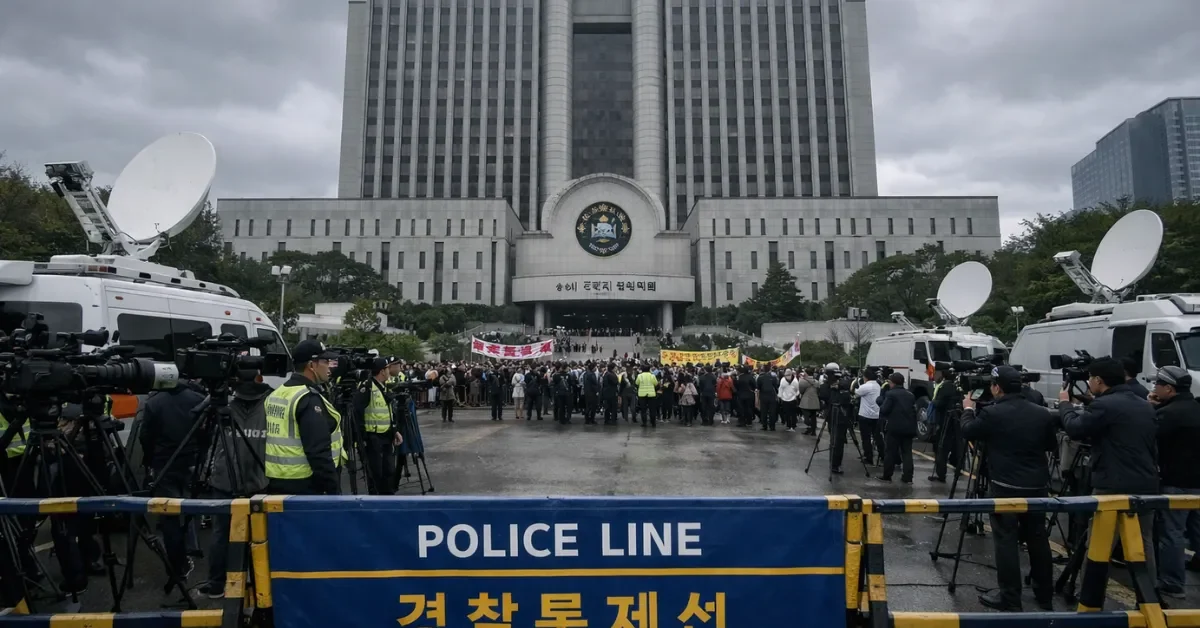
A South Korean court has sentenced former President Yoon Suk Yeol to life in prison for his role in a failed attempt to impose martial law. The Seoul Central District Court delivered the verdict on Thursday, convicting Yoon of insurrection following his brief but chaotic declaration of martial law in December 2024. The ruling marks a historic downfall for the conservative leader, who becomes the first former South Korean president to be convicted of insurrection since the country’s transition to democracy.
The three-judge panel found that Yoon’s declaration of martial law on December 3, 2024, amounted to an insurrection because it utilized military forces to unconstitutionally suspend the powers of the parliament and judiciary. The court stated that Yoon had no legal grounds for the move and that his actions threatened the constitutional order. Prosecutors had initially sought the death penalty, arguing that Yoon’s actions constituted a grave attack on democracy, but the court opted for a life sentence, citing the fact that the martial law decree was rescinded within hours and resulted in no direct casualties.
Verdict and Courtroom Reaction
During the televised sentencing, Yoon stood silently as the judges read the verdict. The court rejected his defense that the martial law declaration was a necessary act of governance to protect the country from “anti-state forces.” Instead, the judges ruled that his mobilization of troops to block the National Assembly and control media outlets was a clear violation of the constitution.
The court also handed down prison sentences to several of Yoon’s former top aides and military officials involved in the martial law decree. Kim Yong-hyun, the former defense minister, was sentenced to life in prison for playing a key role in executing Yoon’s orders. Other military commanders and senior officials received sentences ranging from several years to life imprisonment for their participation in the deployment of troops to the parliament building.
Public and Political Aftermath
The sentencing has drawn mixed reactions across South Korea. Outside the courthouse, groups of protesters and supporters gathered, reflecting the deep political divisions that have persisted since Yoon’s impeachment and removal from office. Supporters of the former president rallied, claiming the trial was politically motivated, while opponents celebrated the verdict as a victory for the rule of law and democratic resilience.
The ruling Democratic Party, which holds a majority in the National Assembly, welcomed the decision, stating that it sends a stern warning that no leader is above the law. Conversely, members of Yoon’s former party expressed regret over the harsh sentence but urged the public to respect the judicial process. Security remains tight around the court and key government buildings as authorities monitor for potential unrest following the high-profile judgment.
Background of the Martial Law Decree
The charges against Yoon stem from the events of late 2024, when he unexpectedly declared martial law during a late-night televised address. He claimed the measure was necessary to eradicate “pro-North Korean” elements within the opposition. Within hours, special forces troops attempted to enter the National Assembly, but lawmakers managed to vote unanimously to overturn the decree. Yoon was forced to lift the order early the next morning, leading to widespread protests, his subsequent impeachment by parliament, and removal from office by the Constitutional Court in 2025.
This conviction adds Yoon to a list of South Korean presidents who have faced imprisonment after leaving office, though his case is unique due to the specific charge of insurrection related to a martial law declaration while in power. Yoon has the right to appeal the verdict, and his legal team is expected to challenge the ruling in higher courts.
