

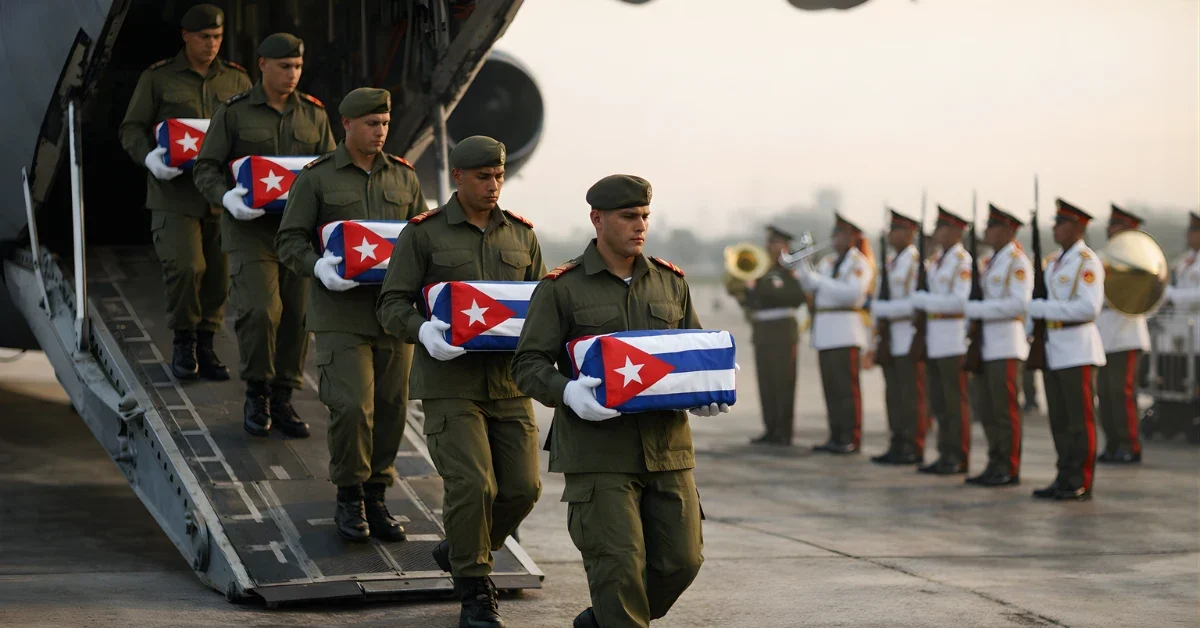
Cuba has brought home the remains of 32 Cuban officers killed during a U.S. strike in Venezuela, with a military ceremony in Havana and public tributes planned in the capital. The repatriations come as tensions rise between Cuba and the United States, after President Donald Trump urged Cuba to make a deal with him “before it is ‘too late’,” without explaining what kind of deal he meant.
On Thursday, Cuban soldiers wearing white gloves marched off a plane at Havana’s airport carrying boxes containing the officers’ remains, as trumpets and drums played. Thousands of people gathered along one of Havana’s best-known streets to await the return of the officers—described as colonels, lieutenants, majors, and captains—while the island faced continued pressure from the Trump administration.
Hours before the ceremony, Cuban state television showed images of more than a dozen wounded people arriving from Venezuela late Wednesday night, accompanied by Cuban Foreign Minister Bruno Rodríguez. Some of the injured were shown in wheelchairs, and a state announcer described them as “combatants” who were “wounded” in Venezuela. The group was greeted by Interior Minister Lázaro Alberto Álvarez and Revolutionary Armed Forces Minister Álvaro López Miera, according to the same report.
Funeral rites and public viewing
Cuban authorities said the remains would be placed at the headquarters of the Ministry of the Armed Forces near Revolution Square so members of the public could pay their respects. Officials also said a large demonstration was planned for Friday across from the U.S. Embassy at an open-air forum known as the Anti-Imperialist Tribune. Cuban officials said they expect that demonstration to be “massive.”
Analyst and former diplomat Carlos Alzugaray said the mood inside Cuba is intense, with strong emotions and heavy debate online. “People are upset and hurt. There’s a lot of talk on social media; but many do believe that the dead are martyrs” of a historic struggle against the United States, Alzugaray told The Associated Press.
Cuba’s mass funeral on Thursday was described as one of only a handful of such large state-organized funerals in nearly half a century. The report pointed to earlier major public ceremonies, including a 1976 farewell led by Fidel Castro for 73 people killed in the bombing of a Cubana de Aviación civilian flight financed by anti-revolutionary leaders living in the U.S., with many of the victims described as Cuban athletes returning home. It also cited “Operation Tribute” in December 1989 to honor the remains of more than 2,000 Cuban combatants who died in Angola, and memorial services in October 1997 after the return of the remains of guerrilla commander Ernesto “Che” Guevara and six comrades who died in 1967.
Who the officers were
Cuba has released names and ranks of the 32 military personnel, describing them as ranging in age from 26 to 60. The officers included members of the Revolutionary Armed Forces and the Ministry of the Interior, which were described as the island’s two main security agencies. The Cuban and Venezuelan governments have said the uniformed personnel were in Venezuela as part of protection agreements between the two countries.
In a separate account of the incident, Cuba said the 32 personnel were part of the security detail of Venezuelan President Nicolás Maduro during a raid on his residence on January 3.
Another Associated Press report said Cuba announced a two-day mourning period when it released the names, ranks, and ages of the 32 personnel. That report said some of the dead were reservists and that official information did not provide details about their mission or the exact circumstances in which each person died. It quoted an official statement saying the Cubans “executed their duty with honor and bravery,” and died either “after fierce resistance in direct combat” or due to “bombardment of facilities.”
Diplomatic fallout and regional reaction
The repatriations and ceremonies unfolded as Cuba and the United States traded sharper messages over Venezuela and energy support. Trump has said Cuba will no longer live off Venezuela’s money and oil, and the report said experts warned an abrupt end to oil shipments could be catastrophic for Cuba as it struggles with serious blackouts and a crumbling power grid.
The U.S. strike also triggered diplomatic debate in the Americas, according to an Associated Press report on regional reaction. That report said the Organization of American States held a special meeting where a protester interrupted remarks by U.S. Ambassador Leandro Rizzuto. It also said representatives from several countries condemned the U.S. strike, including Colombia’s vice minister of foreign relations, Mauricio Jaramillo, who called it an assault on Venezuela’s sovereignty and a “clear violation of international law” that set a “deeply concerning” precedent.
