

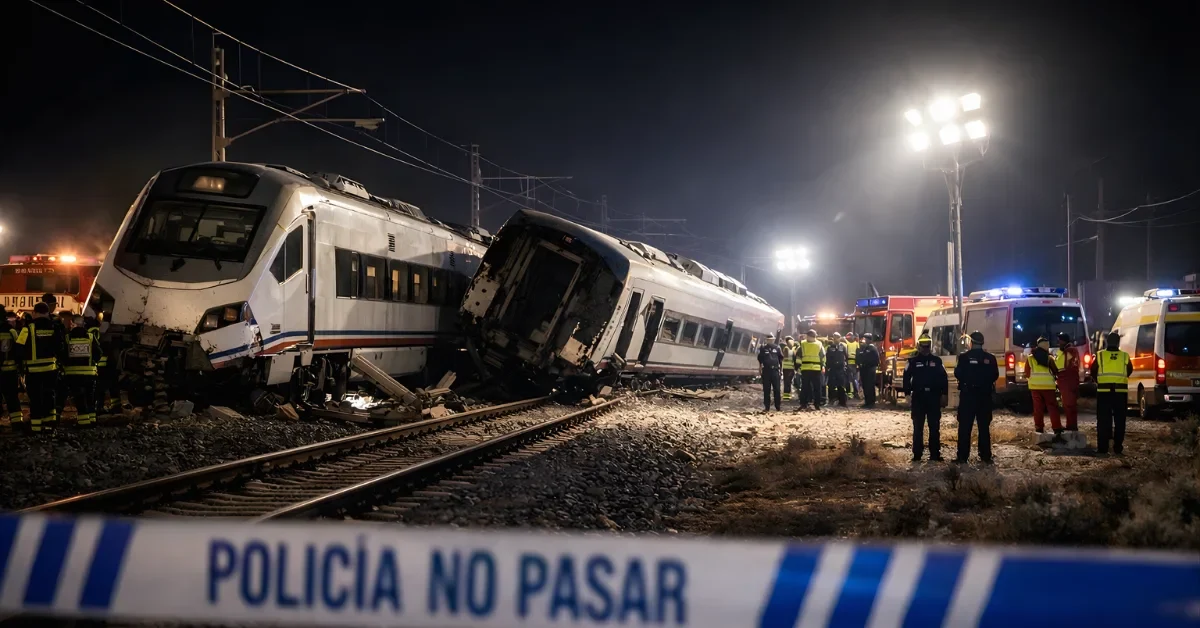
A deadly Spain high-speed train crash near Adamuz in Córdoba province has killed at least 39 people, according to multiple reports from Spanish officials and public broadcasters. The collision and derailments happened when a Malaga-to-Madrid train derailed and crossed onto an adjacent track, striking a Madrid-to-Huelva service, authorities and rail officials said.
Officials said the situation was “extremely unusual” and that a full investigation was underway, with early assessments leaving key questions unanswered. Rescue operations continued after the crash as emergency crews worked through twisted metal and damaged carriages to reach passengers.
What happened on the track
Spain’s rail infrastructure operator Adif said the accident occurred near Adamuz, close to the city of Córdoba, on the route linking Madrid and Andalusia. Adif’s account, echoed by Spanish officials, said a high-speed train traveling from Malaga toward Madrid derailed and moved onto the neighboring line, where it collided with an oncoming train traveling from Madrid to Huelva.
Several outlets described the derailment as involving the rear part of the Malaga-to-Madrid train, which then struck the front of the Madrid-to-Huelva train. Spain’s Transport Minister Óscar Puente said the front portion of the Renfe train took the brunt of the impact, and the first two carriages derailed and went down an embankment or slope. Reuters reported that Renfe’s CEO said there was about a 20‑second gap between the first derailment and the collision, which he said was too short for an automatic braking system to activate.
The crash was reported to have occurred on a straight section of track, which Puente and other officials highlighted as part of why the event appeared unusual. Puente also said the line had been renovated in May, and Reuters reported he cited a 700 million euro investment tied to the works.
Death toll and injuries
By early Monday, Spain’s Civil Guard had reported at least 39 deaths, and multiple international outlets carried the same figure. Some coverage described a death toll of “at least 40,” while other reports said “at least 39,” reflecting ongoing updates as the response continued.
Injuries and hospitalizations were also reported with differing figures as authorities assessed the scene. Andalusia’s regional president, Juanma Moreno, was cited as saying 75 passengers were admitted to hospitals, with 15 in critical condition. Reuters reported 122 people were injured, while other reports described at least 73 injured and still others said injuries exceeded 150.
Passenger totals also varied across official and media accounts. Reuters and the BBC reported about 400 people were on the two trains combined, while RTVE reported 317 people aboard the Iryo train and about 184 aboard the Renfe service, and AP cited 289 passengers on the Malaga-to-Madrid train.
Rescue scene and service disruption
Footage described by Reuters showed rescuers pulling passengers from mangled carriages lying on their sides under floodlights, with some people escaping through broken windows and others carried on stretchers. BBC reporting described a difficult rescue operation, saying the wreckage made it hard to reach survivors and recover victims. Córdoba fire chief Francisco Carmona told RTVE that rescuers sometimes had to move a deceased person to reach someone alive, describing the work as delicate.
Officials said the emergency response mobilized multiple services in Andalusia, and media reports described passengers trapped for hours as crews worked in darkness at the crash site. AP reported that the Spanish Red Cross set up a support center in Adamuz to assist emergency teams and people seeking information.
Rail disruption spread beyond the crash site as authorities halted key routes. Adif said high-speed services between Madrid and several Andalusian cities were suspended, and RTVE reported that high-speed travel between Madrid and Andalusia was halted and trains in transit were redirected. BBC reporting said the rail operator arranged areas at major stations for families of victims, including Madrid’s Atocha, as well as Seville, Córdoba, Malaga, and Huelva.
Investigation and unanswered questions
Spain’s Transport Minister Óscar Puente said the cause of the crash was not yet known, while describing the event as “extremely unusual” and “truly strange.” AP reported Puente estimated that determining the cause could take about a month. Reuters quoted Renfe’s CEO as saying human error was almost ruled out, suggesting investigators would need time to determine whether there was a malfunction in the rolling stock or infrastructure.
Reuters also reported that investigators found a damaged joint on the track at the crash site, citing a source familiar with the preliminary inquiry. The same Reuters report said derailed carriages collided with an approaching train, causing that second train to leave the rails and tumble down an embankment.
On equipment and maintenance, Reuters reported Puente said the Iryo train involved was under four years old and that the track had undergone a complete renovation in May. Reuters also reported that Iryo said the train’s last inspection took place on January 15.
Spain’s rail context
Several reports compared the crash to Spain’s worst rail disasters in recent history. CNN and AP described the incident as Spain’s deadliest since a 2013 derailment in Galicia, with CNN reporting 79 deaths and 144 injuries and AP describing about 80 deaths. The New York Times reported that Spain has the world’s second-longest high-speed rail network, behind China, citing the International Union of Railways.
