

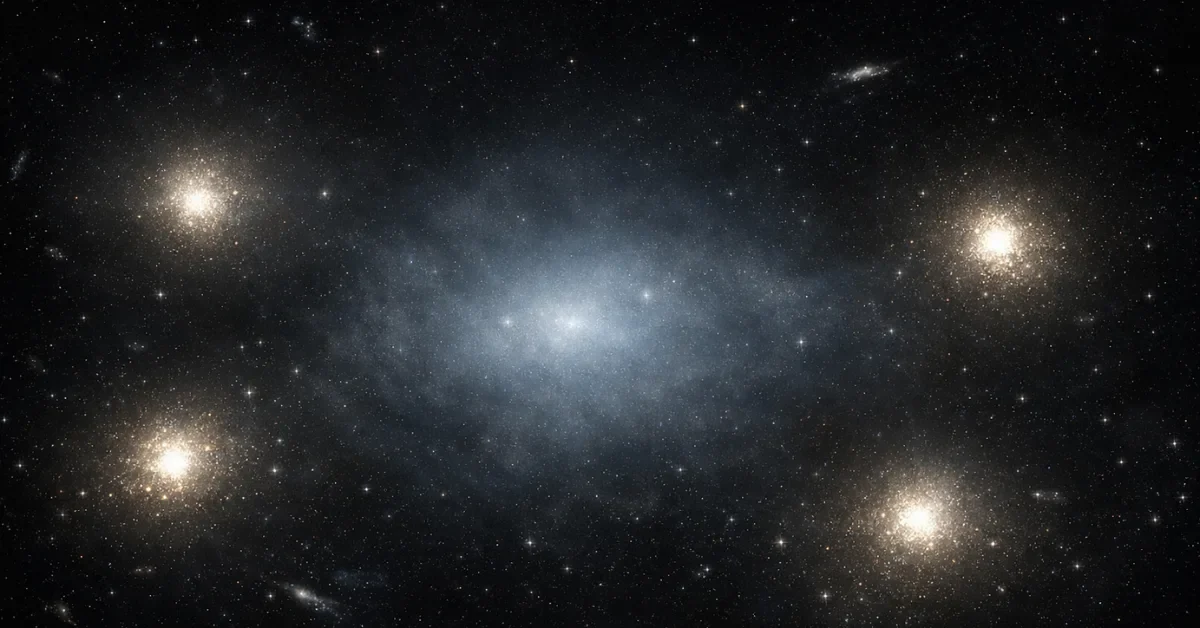
Astronomers have identified a rare, nearly invisible cosmic object known as dark matter galaxy CDG-2. Unlike standard galaxies that shine brightly across the universe with billions of visible stars, this faint entity is almost entirely composed of dark matter. Dark matter is an invisible substance that does not emit, absorb, or reflect electromagnetic radiation. Because it behaves differently than everyday matter made of protons, neutrons, and electrons, it is exceptionally difficult for scientists to study directly. However, its strong gravitational pull influences visible matter and light, allowing researchers to detect its presence indirectly.
The discovery of dark matter galaxy CDG-2 was achieved by combining observational data from three powerful observatories. Researchers utilized NASA’s Hubble Space Telescope, the European Space Agency’s Euclid space observatory, and Japan’s ground-based Subaru Telescope located in Hawaii. Together, these advanced instruments revealed a ghost-like structure that fundamentally challenges our understanding of how galaxies form and evolve.
Spotting an Invisible Target
Finding a dark galaxy requires innovative techniques. Most galaxies contain a standard mix of stars, gas, dust, and dark matter. In a typical galaxy, dark matter outweighs ordinary, visible matter by a ratio of roughly five to one. However, in CDG-2, a staggering 99 percent of its total mass is made up of dark matter.
Because the galaxy lacks a substantial stellar population, researchers had to look for secondary clues. Dayi (David) Li, a post-doctoral fellow in statistics and astrophysics at the University of Toronto in Canada, led the team. The researchers used advanced statistical methods and machine learning to sift through massive amounts of telescope data, searching specifically for tight groupings of globular clusters.
Globular clusters are compact, spherical star groups containing immense stellar density. They are held tightly together by gravity and are typically found orbiting normal galaxies in the galactic halo. While their origins and exact roles in galactic evolution remain somewhat unclear, finding them in an otherwise empty patch of space can indicate the presence of a hidden galaxy. During their search, Li’s team identified ten previously known low-surface-brightness galaxies alongside two new dark galaxy candidates.
The Hubble Space Telescope provided high-resolution imagery showing a close collection of four globular clusters. Subsequent analysis of data from Hubble and Euclid showed an almost identical morphology of diffuse light. Because the extremely faint glow appeared the same across different observatory surveys, the researchers concluded it was not an imaging artifact but strong evidence of an underlying dark galaxy.
“This is the first galaxy detected solely through its globular cluster population,” Li stated. “Under conservative assumptions, the four clusters represent the entire globular cluster population of CDG-2.”
The Survival of Globular Clusters
Despite its massive dark matter content, CDG-2 produces very little actual light. Preliminary analysis suggests the entire galaxy shines with the luminosity of approximately six million Sun-like stars. For comparison, a typical spiral galaxy like the Milky Way contains over 150 globular clusters, while this elusive dark object appears to host only four.
These four spherical star groups are crucial to the galaxy’s overall visibility. The researchers estimate that these clusters account for roughly 16 percent of the galaxy’s visible light content. The remainder of the galaxy features stars that are far too dim to resolve individually.
Astronomers theorize that CDG-2 once held enough normal matter, primarily hydrogen gas, to sustain normal star formation. However, gravitational interactions with neighboring galaxies likely stripped away this star-forming gas over time. The globular clusters survived this violent process because they are incredibly dense and gravitationally bound, allowing them to resist the powerful tidal forces that tore the rest of the visible material away.
Resolving Cosmic Distances
The newly identified dark galaxy resides within the Perseus galaxy cluster, a massive gathering of cosmic structures. However, reports differ slightly regarding its exact distance from Earth, depending on the publication.
According to Space.com, CDG-2 is located approximately 245 million light-years away. In contrast, according to NASA, the Space Telescope Science Institute, and ScienceAlert, the Perseus galaxy cluster where the object resides is located 300 million light-years away. While the exact distance figures vary across these sources, they all agree on the galaxy’s general location and characteristics.
Exploring the Deep Universe
The confirmation of CDG-2 immediately brings its companion candidate, CDG-1, back into the scientific spotlight. Researchers suggest that CDG-1 might be an even more extreme twin, potentially existing as a dark matter halo entirely lacking any stars outside of its globular clusters.
The team’s groundbreaking results were officially published in The Astrophysical Journal Letters. As deep sky surveys expand, finding these nearly invisible objects should become more frequent. Upcoming projects like NASA’s Nancy Grace Roman Space Telescope and the Vera C. Rubin Observatory will soon join Euclid in scanning the cosmos. By applying advanced statistical methods to these massive datasets, astronomers hope to uncover many more dark galaxies lurking in the universe.
