

Iran’s Supreme Leader Ayatollah Ali Khamenei issued a stark warning on Sunday, declaring that any military attack by the United States would escalate into a “regional war” across the Middle East. The statement represents the most direct threat from the 86-year-old leader as tensions mount over Tehran’s violent crackdown on nationwide protests and President Donald Trump’s military threats.
Rising Tensions Over Protest Crackdown
The confrontation follows weeks of unrest that began December 28, 2025, when demonstrations erupted over the collapse of Iran’s rial currency. What started as economic grievances quickly transformed into a direct challenge to Khamenei’s decades-long rule. The Iranian government responded with a brutal crackdown that has left thousands dead and tens of thousands detained.
The U.S.-based Human Rights Activists News Agency reports that Iranian authorities have detained more than 49,500 people and killed at least 6,713 individuals, the vast majority of them demonstrators. Iran’s government offers a significantly lower figure, reporting 3,117 deaths as of January 21, including 2,427 civilians and security forces, with the remainder labeled as “terrorists.” The death toll surpasses any other round of protest in Iran in decades and recalls the chaos of the 1979 Islamic Revolution.
President Trump has established two clear red lines for military action against Iran: the killing of peaceful protesters or the mass execution of those detained during the crackdown. The USS Abraham Lincoln aircraft carrier and associated American warships are currently positioned in the Arabian Sea, a deployment ordered by Trump following Tehran’s violent response to the demonstrations.
Khamenei’s Defiant Warning
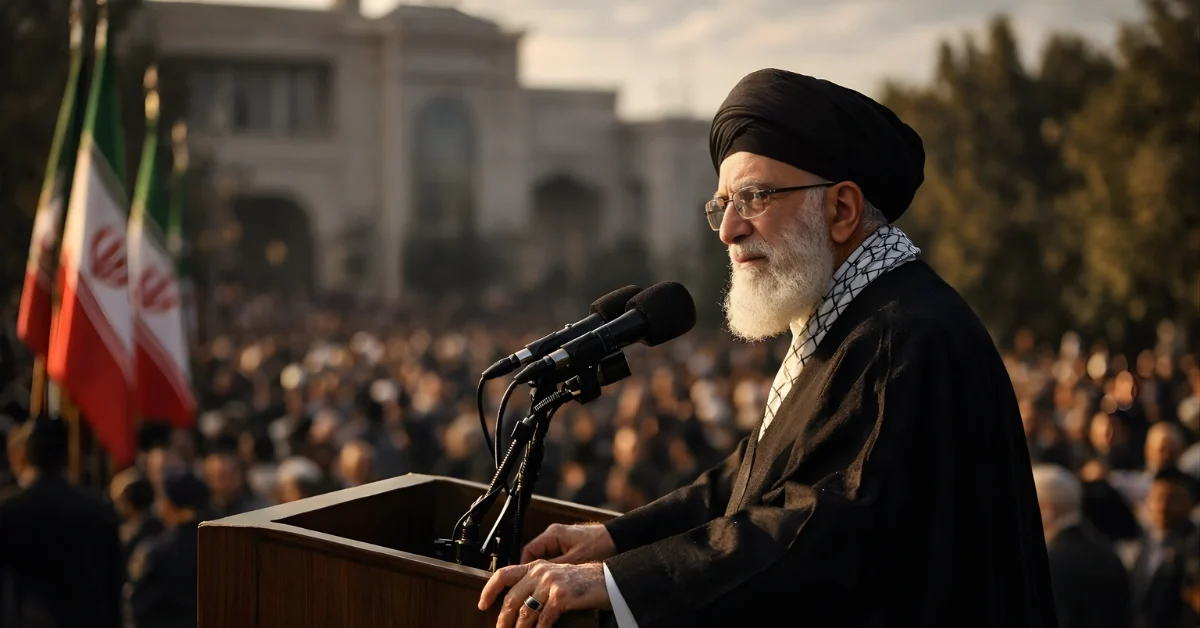
Speaking to a crowd at his compound in Tehran during commemorations of the country’s 1979 Islamic Revolution, Khamenei delivered an unambiguous message to Washington. “The Americans must be aware that if they wage a war this time, it will be a regional war,” he stated. He added that while Iran does not seek conflict, “if anyone shows greed and wants to attack or harass, the Iranian nation will deal a heavy blow to them.”
The supreme leader characterized the recent demonstrations as “a coup,” hardening the government’s position after previously acknowledging some protesters had legitimate economic grievances. “The recent sedition was similar to a coup. Of course, the coup was suppressed,” Khamenei said. He accused demonstrators of attacking police, government centers, Islamic Revolutionary Guard Corps facilities, banks, and mosques, and of burning copies of the Quran.
Military Maneuvers and Diplomatic Channels
Iran planned a live-fire military drill for Sunday and Monday in the strategically vital Strait of Hormuz, the narrow waterway through which approximately one-fifth of global oil trade passes. However, an unidentified Iranian official told Reuters that the Islamic Revolutionary Guard Corps naval forces have “no plan” to carry out live-fire exercises in the strait, contradicting an earlier report from U.S. Central Command. The U.S. military has warned against threatening American warships or aircraft during any exercises or disrupting commercial traffic through the critical passage.
Iranian Foreign Minister Abbas Araghchi reinforced Khamenei’s warning, stating that if the United States attacks Iran, the conflict will extend throughout the region and Iran will target all U.S. bases. The threats are widely seen as an attempt to deter American military action by raising the stakes of any potential confrontation.
Trump’s Response and Negotiation Hopes
President Trump, speaking to reporters at Mar-a-Lago, responded to Khamenei’s comments by saying, “Of course he is going to say that.” The president declined to say whether he had decided on military action against Iran, but referenced the formidable American naval presence in the region. “We have the biggest, most powerful ships in the world over there, very close couple of days,” Trump said. “And hopefully we’ll make a deal. We don’t make a deal, then we’ll find out whether or not he was right.”
Trump has repeatedly indicated that Iran wants to negotiate and has expressed interest in reaching a “satisfactory” deal to prevent Tehran from acquiring nuclear weapons. The president previously ordered strikes on three Iranian nuclear sites during Israel’s 12-day war with Iran in June 2025.
Regional Concerns and Reciprocal Designations
The escalating rhetoric has alarmed regional powers. Gulf states have reportedly warned Washington that Iran’s missile program remains capable of causing significant damage to American interests in the region. A Gulf assessment concluded that key elements of Iran’s missile program, including short-range ballistic missiles and their launchers, remain intact despite damage sustained during the June 2025 war. According to a former Iranian diplomat, the regime has doubled its missile production since the conflict and has deployed some launchers into mountainous regions to protect them from potential strikes.
Meanwhile, Iran’s parliament speaker Mohammad Bagher Qalibaf announced that the Islamic Republic now considers all European Union militaries to be terrorist organizations. The move came in response to the EU’s designation of Iran’s paramilitary Revolutionary Guard as a terrorist group over its role in the protest crackdown. Lawmakers at the session wore Revolutionary Guard uniforms and chanted “Death to America!” and “Death to Israel!”
The situation remains fluid as diplomatic efforts continue alongside military posturing. Qatari Prime Minister Sheikh Mohammad bin Abdulrahman al Thani met with Iranian officials in Tehran on January 31 to discuss decreasing regional tensions, while Egyptian President Abdel Fattah al Sisi spoke with Iranian President Masoud Pezeshkian about restarting negotiations between Iran and the United States.
