
By using this site, you agree to our Privacy Policy and Terms of Use.
Accept
VellaTimesVellaTimesVellaTimes
  • News
    NewsShow More
    A stressed university student looks at a laptop screen displaying a red digital cybersecurity warning in a dimly lit room.
    Canvas Cyberattack: Millions of Students Face Data Breach During Finals Week
    May 9, 2026
    Hyper-realistic news-style image of AI server racks and shipping crates inside a logistics warehouse, representing an investigation into chip shipments through Thailand.
    Nvidia Chips Smuggled to Alibaba Via Thailand Probe
    May 8, 2026
    The MV Hondius expedition cruise ship anchored in the Atlantic Ocean under overcast skies.
    Hantavirus Cruise Ship Outbreak: 3 Dead Off Cape Verde
    May 5, 2026
    A sleek quadruped robot dog and a humanoid robot operating inside a modern, highly automated industrial facility.
    Physical AI: Meta and China Lead Global Robotics Investment
    May 5, 2026
    A close-up view of a high-tech silicon wafer and modern microchips on a metallic surface inside a brightly lit semiconductor manufacturing facility.
    Apple Chip Manufacturing: Intel and Samsung Explored
    May 5, 2026
  • Technology
    TechnologyShow More
    A stressed university student looks at a laptop screen displaying a red digital cybersecurity warning in a dimly lit room.
    Canvas Cyberattack: Millions of Students Face Data Breach During Finals Week
    May 9, 2026
    Hyper-realistic news-style image of AI server racks and shipping crates inside a logistics warehouse, representing an investigation into chip shipments through Thailand.
    Nvidia Chips Smuggled to Alibaba Via Thailand Probe
    May 8, 2026
    A close-up view of a high-tech silicon wafer and modern microchips on a metallic surface inside a brightly lit semiconductor manufacturing facility.
    Apple Chip Manufacturing: Intel and Samsung Explored
    May 5, 2026
    The interior of a modern federal courthouse with sunlight streaming onto wooden benches.
    OpenAI Trial: Elon Musk Warns Execs Before Court Battle
    May 5, 2026
    A glowing digital medical tablet displaying artificial intelligence graphics in a modern hospital emergency room.
    AI Outperforms Doctors in Harvard Trial of Emergency Triage Diagnoses
    May 3, 2026
  • AI
    AIShow More
    A sleek quadruped robot dog and a humanoid robot operating inside a modern, highly automated industrial facility.
    Physical AI: Meta and China Lead Global Robotics Investment
    May 5, 2026
    A frustrated professional is looking at a laptop screen displaying a server error message in a modern office setting.
    ChatGPT Global Outage: OpenAI Investigates Access Issues
    May 5, 2026
    A sleek and modern stage at a corporate technology launch event with glowing digital displays.
    OpenAI GPT-5.5 Launch Party and the Goblin Problem
    May 3, 2026
    Hyper-realistic news-style image of a modern AI data center with server racks and a digital display labeled DeepSeek V4, shown in cool blue lighting.
    DeepSeek V4 launch puts Huawei AI chips in spotlight
    May 1, 2026
    News-style image of Elon Musk seated in a courtroom during a legal dispute involving OpenAI.
    Elon Musk OpenAI Trial Puts Nonprofit Mission on Trial
    May 1, 2026
  • Science
    ScienceShow More
    The MV Hondius expedition cruise ship anchored in the Atlantic Ocean under overcast skies.
    Hantavirus Cruise Ship Outbreak: 3 Dead Off Cape Verde
    May 5, 2026
    A glowing meteor streaks across a dark, star-filled night sky with a bright waning moon illuminating a remote natural landscape below.
    Eta Aquarid Meteor Shower 2026: How to Watch the Peak
    May 5, 2026
    A glowing quantum clock fragmenting into light particles against a dark cosmic background with swirling entangled atoms and spacetime waves, representing quantum physics breakthroughs in time and the universe.
    Quantum Physics Breakthroughs Reshaping How We Understand Time and the Universe
    May 3, 2026
    A glowing antimatter atom passing through a hexagonal graphene sheet and splitting into a quantum wave interference pattern in a high-tech laboratory setting.
    Scientists Observe Positronium Wave Behavior in Lab
    May 1, 2026
    The NASA Curiosity rover is using its robotic arm to drill into a red sandstone rock on the dusty surface of Mars.
    Mars Organic Molecules: Curiosity Rover Makes Historic Find
    May 1, 2026
  • World
    WorldShow More
    Allu Arjun Commitment to Ethical Brand Partnerships
    Exploring Allu Arjun’s Commitment to Ethical Brand Partnerships
    December 18, 2023
    Orry aka Orhan Awatramani
    Orhan Awatramani ‘Orry’ Biography, Lifestyle and Rise to Fame
    December 8, 2023
    Alia Bhatt Latest Deepake Video Victim
    Alia Bhatt becomes latest victim of Deepfake Videos, Obscene Video goes Viral
    November 28, 2023
    Napoleon Movie Review
    Napoleon Movie Review: A Historical Epic by Ridley Scott Reviewed
    November 25, 2023
  • Bookmarks
Search
Category
  • News
  • Technology
  • AI
  • Science
  • World
Company
  • About Us
  • Contact Us
  • Fact Checking Policy
  • Terms & Conditions
  • Privacy Policy
  • Copyright Policy
Resources
  • Home
  • Web Stories
  • Bookmarks
  • Interests
  • Disclaimer
  • Sitemap
© 2022 VellaTimes • All Rights Reserved.
Reading: Stanford Optical Cavity Arrays Unlock Million-Qubit Quantum Computers
Share
Notification Show More
Font ResizerAa
VellaTimesVellaTimes
Font ResizerAa
  • News
  • Technology
  • AI
  • Science
  • World
Search
  • Explore
    • News
    • Technology
    • AI
    • Science
    • World
  • Useful Links
    • About Us
    • Contact Us
    • Fact Checking Policy
    • Terms & Conditions
    • Privacy Policy
    • Copyright Policy
  • Home
  • Web Stories
  • Bookmarks
  • Interests
  • Disclaimer
  • Sitemap
© 2022 VellaTimes • All Rights Reserved.
News

Stanford Optical Cavity Arrays Unlock Million-Qubit Quantum Computers

Nisha Pradhan
Last updated: 03/02/2026
Nisha Pradhan
Share
5 Min Read
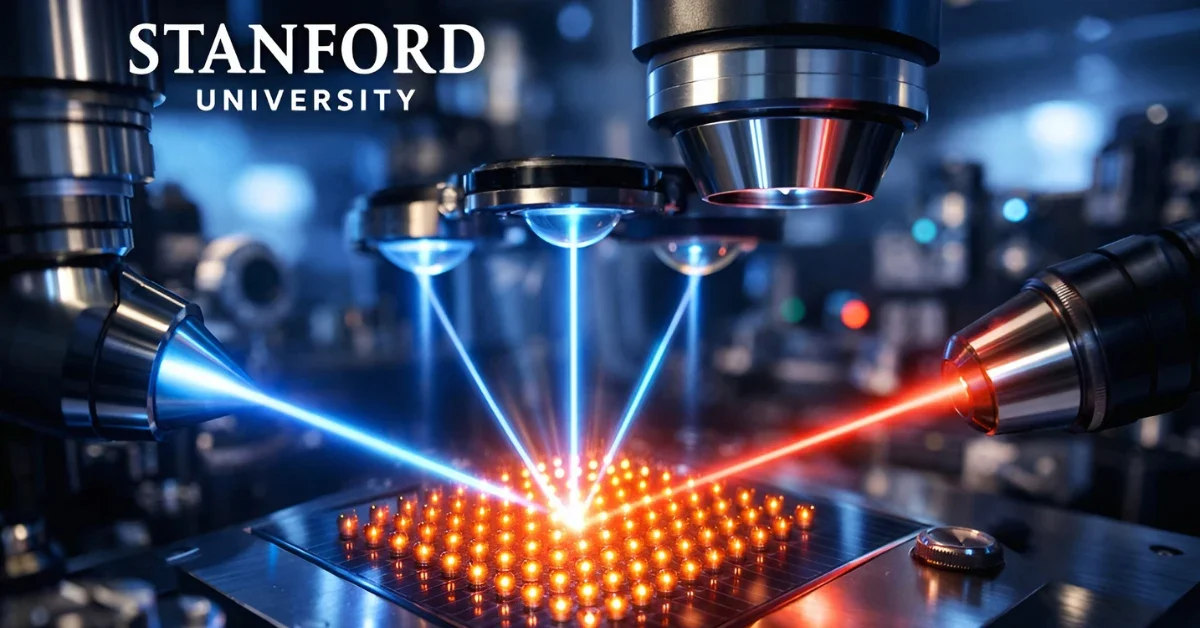
Stanford lab optical cavity array system interfacing light with atom qubits for quantum computing advancement.

Stanford physicists have introduced a novel optical cavity array system that speeds up qubit readout in quantum computers. This breakthrough tackles a key scaling challenge by linking each atom qubit to its own dedicated cavity for parallel light collection. A new study in Nature details a 40-cavity array with individual atoms and a prototype surpassing 500 cavities, pointing toward systems with millions of qubits.

Contents
Qubit Readout Challenge SolvedInnovative Cavity DesignScalability DemonstratedBroad Applications Ahead

The platform, called a cavity-array microscope, merges neutral-atom arrays with optical cavity quantum electrodynamics. It enables fast, non-destructive measurement of single atoms across a two-dimensional setup. Researchers demonstrated parallel readout on millisecond timescales, including via a fiber array for networking tests.

Qubit Readout Challenge Solved

Quantum computers rely on qubits from atom quantum states, which can hold zero, one, or both values simultaneously. This superposition promises to slash computation times for tough problems from millennia to hours. Yet reading qubit states quickly has proven tricky.

Atoms emit photons slowly and scatter them everywhere. Past efforts paired whole atom arrays with one shared cavity mode, limiting addressability and growth. The Stanford design changes that. Each atom now sits in its own cavity, achieving strong light-matter coupling without nanophotonics.

Jonathan Simon, senior author and associate professor of physics and applied physics at Stanford, explained the issue clearly. Atoms fail to emit light fast enough at scale, and it spreads in all directions. Optical cavities direct that light efficiently, and this setup gives every atom its personal cavity.

Innovative Cavity Design

Optical cavities trap light between reflective surfaces, bouncing it repeatedly for stronger atom interactions. The team added microlenses inside each cavity. These focus beams tightly on single atoms at micrometer scales, matching optical tweezer spacings.

The macro-scale resonator spans about 34 centimeters. An microlens array stabilizes beams and demagnifies them at the atom plane. This yields peak cooperativity above unity, with low crosstalk under 1% between neighboring modes.

Atoms stay distant from dielectric surfaces, easing engineering. The result: homogeneous coupling across the array. Adam Shaw, first author and Stanford Science Fellow, described the shift. The architecture goes beyond basic mirrors, promising quicker distributed quantum machines with high data rates.

Scalability Demonstrated

The study showcased a working 40-mode array. A next-generation version boasts over 500 cavities and nearly ten times better finesse. Goals include tens of thousands of cavities soon.

This supports linking quantum processors into networks. Imagine quantum data centers where machines connect via cavity interfaces, forming supercomputers. Fiber-coupled readout proves the modular approach works.

Simon likened classical computing to sequential searches. Quantum systems compare answer combos like noise-canceling headphones, boosting correct ones while damping errors.

Broad Applications Ahead

Millions of qubits will outpace top supercomputers. Fields like materials design, chemical synthesis for drugs, and cryptography stand to gain. Cavity arrays also boost biosensing and microscopy for medical advances.

In astronomy, they could sharpen optical telescopes to spot exoplanets directly. Shaw sees single-particle light control reshaping how we view the world.

Co-authors include David Schuster from Stanford, plus experts from Stony Brook University, University of Chicago, Harvard University, and Montana State University. Doctoral students Anna Soper, Danial Shadmany, and Da-Yeon Koh contributed from Stanford.

Support came from the National Science Foundation, Air Force Office of Scientific Research, Army Research Office, Hertz Foundation, and U.S. Department of Energy. Some researchers consult for Atom Computing and hold stock options there. Shadmany, Jaffe, Schuster, Simon, and Stony Brook’s Aishwarya Kumar share a patent on the resonator geometry.

This platform unlocks many-cavity quantum electrodynamics. It pioneers large-scale quantum networks with atom arrays, blending high-fidelity logic from arrays and strong coupling from cavities.

The work promises hybrid atom-photon systems for faster measurements and engineered Hamiltonians. Engineering hurdles linger, but the foundation feels solid for quantum leaps forward.

TAGGED: atom qubits, Nature study, quantum computing, quantum networks, Stanford University
Share This Article
Facebook Twitter Whatsapp Whatsapp Telegram Copy Link
By Nisha Pradhan
I am a passionate content creator with a deep love for travel, music, and food. Using my unique blend of these interests, I genuinely enjoy crafting high-quality travel, lifestyle, and entertainment-related news content.
Leave a comment

Leave a Reply Cancel reply

Your email address will not be published. Required fields are marked *


Most Read

AI Governance Frameworks Shape the Future of Tech in 2026

March 10, 2026

World Governments Summit 2026: AI Dominates Agenda at Largest-Ever Gathering in Dubai

February 6, 2026

Gemini-Powered Siri: Apple Updates and New Mac App

April 19, 2026

H5N1 Bird Flu Threat: Viral Mutations and Rising Mammal Infections

April 15, 2026

Infosys AI Revenue Hits 5.5% as Tech Giant Ramps Up Enterprise Work

February 18, 2026

Windows 11 Update: Microsoft Cuts AI Bloat to Boost Speed

March 22, 2026

Related News

A stressed university student looks at a laptop screen displaying a red digital cybersecurity warning in a dimly lit room.
News

Canvas Cyberattack: Millions of Students Face Data Breach During Finals Week

Rakesh Paul Rakesh Paul May 9, 2026
Hyper-realistic news-style image of AI server racks and shipping crates inside a logistics warehouse, representing an investigation into chip shipments through Thailand.
News

Nvidia Chips Smuggled to Alibaba Via Thailand Probe

Rakesh Paul Rakesh Paul May 8, 2026
The MV Hondius expedition cruise ship anchored in the Atlantic Ocean under overcast skies.
News

Hantavirus Cruise Ship Outbreak: 3 Dead Off Cape Verde

Nisha Pradhan Nisha Pradhan May 5, 2026

About Us

VellaTimesVellaTimesVellaTimes

VellaTimes is a leading news portal that covers the latest trending news in technology, lifestyle, entertainment, automobiles, travel, and sports.

Explore

  • News
  • Technology
  • AI
  • Science
  • World

Useful Links

  • About Us
  • Contact Us
  • Fact Checking Policy
  • Terms & Conditions
  • Privacy Policy
  • Copyright Policy

Subscribe Us

Subscribe to our newsletter for the Latest News and Top Stories!

© 2022 VellaTimes • All Rights Reserved.
  • Home
  • Web Stories
  • Bookmarks
  • Interests
  • Disclaimer
  • Sitemap
adbanner
AdBlocker Detected
Our site is an advertising supported site. Please whitelist us to support our work.
Okay, I'll Whitelist