

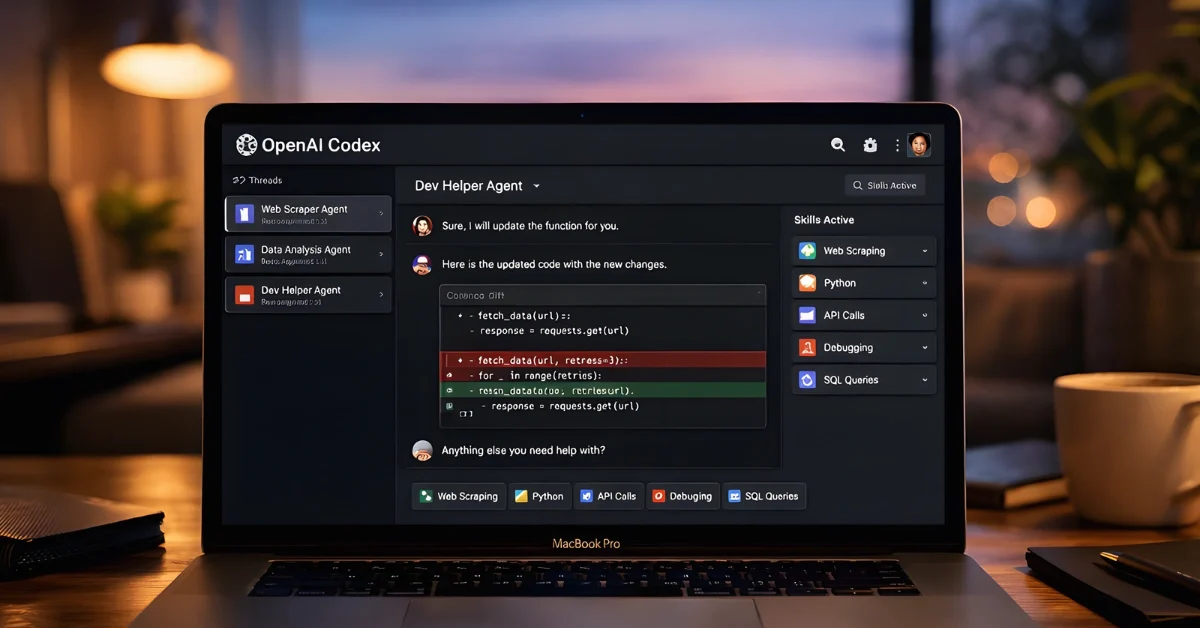
OpenAI has rolled out the Codex app exclusively for macOS users. This new desktop tool helps developers handle multiple AI agents at the same time, speeding up complex software projects.
The app arrived on February 2, 2026, right as competition heats up in AI-assisted coding. Developers can now oversee agents working side by side on tasks that stretch over hours or days. OpenAI positions it as a command center that transforms how teams build and maintain software.
Streamlining Multi-Agent Workflows
Developers often juggle several AI agents for different parts of a project. The Codex app organizes these into separate threads grouped by projects. Users switch between tasks without dropping context, review code changes in real time, and even tweak diffs manually.
Support for worktrees keeps things smooth. Each agent operates on its own copy of the code repository, avoiding clashes. This setup lets teams test ideas freely before merging into the main branch.
The tool syncs seamlessly with existing setups. It pulls in session history and configurations from the Codex command-line interface and IDE extensions, making the switch effortless.
Extending Capabilities with Skills
Codex goes beyond basic code writing. Skills let agents tackle broader jobs like pulling data, solving problems, or creating content. These packages combine instructions, resources, and scripts tailored to specific needs.
OpenAI shares a starter library of skills. One pulls designs from Figma and turns them into matching UI code. Another handles project tracking in Linear, sorting bugs and managing workloads. Deployment skills push apps to platforms like Cloudflare, Netlify, or Vercel.
Image creation stands out too. Powered by GPT Image, agents generate visuals for websites or games. Document skills manage PDFs, spreadsheets, and Word files with polished formats.
Users build custom skills in the app. These work across the CLI, IDE, or app, and teams share them via repositories.
Automations and Personalized Interactions
Background automations add efficiency. Set them to run on schedules, blending instructions with skills. Results wait in a review queue for quick check-ins.
OpenAI teams use them for daily chores like bug triage or summarizing failures. One even creates new skills automatically.
Agent personalities adapt to user style. Choose terse and direct or chatty and supportive—no impact on power, just better fit.
Security Built from the Ground Up
Safety comes first. The app runs agents in open-source sandboxing, like the CLI version. Agents stick to their folder or branch, use cached searches, and seek permission for network access. Teams set rules for auto-approvals on trusted commands.
Stepping Up Against Rivals
OpenAI aims to close the gap with leaders like Anthropic’s Claude Code. That tool hit $1 billion in annualized revenue within six months of launch. Observers note coding tools boost developer speed, though they don’t replace humans yet.
Benchmarks show OpenAI’s GPT-5.2-Codex leading TerminalBench for command-line tasks. It holds strong on SWE-bench for bug fixes, trading blows with rivals from Gemini and Claude.
CEO Sam Altman stresses the edge. “If you really want to do sophisticated work on something complex, 5.2 is the strongest model by far,” he said on a press call. He highlighted flexible interfaces unlocking that power. Altman also noted agents’ endless drive: “The models just don’t run out of dopamine.”
From a blank slate, agents build advanced software in hours, limited only by idea input speed.
Broad Access and Rapid Growth
The app launches for ChatGPT Plus, Pro, Business, Enterprise, and Edu users. Log in with your subscription—no extra cost, though credits top up if needed.
Free and Go tiers get temporary access. Paid plans see doubled rate limits across all Codex spots: app, CLI, IDE, cloud.
Usage has surged. Since GPT-5.2-Codex debuted mid-December 2025, overall activity doubled. Over a million developers tapped it last month.
OpenAI plans Windows support, faster models, refined multi-agent flows, and cloud automations. The focus stays on code-driven control, expanding to knowledge work.
This launch signals AI coding’s shift to agent teams. Developers gain tools matching frontier models’ smarts, easing oversight at scale.
