

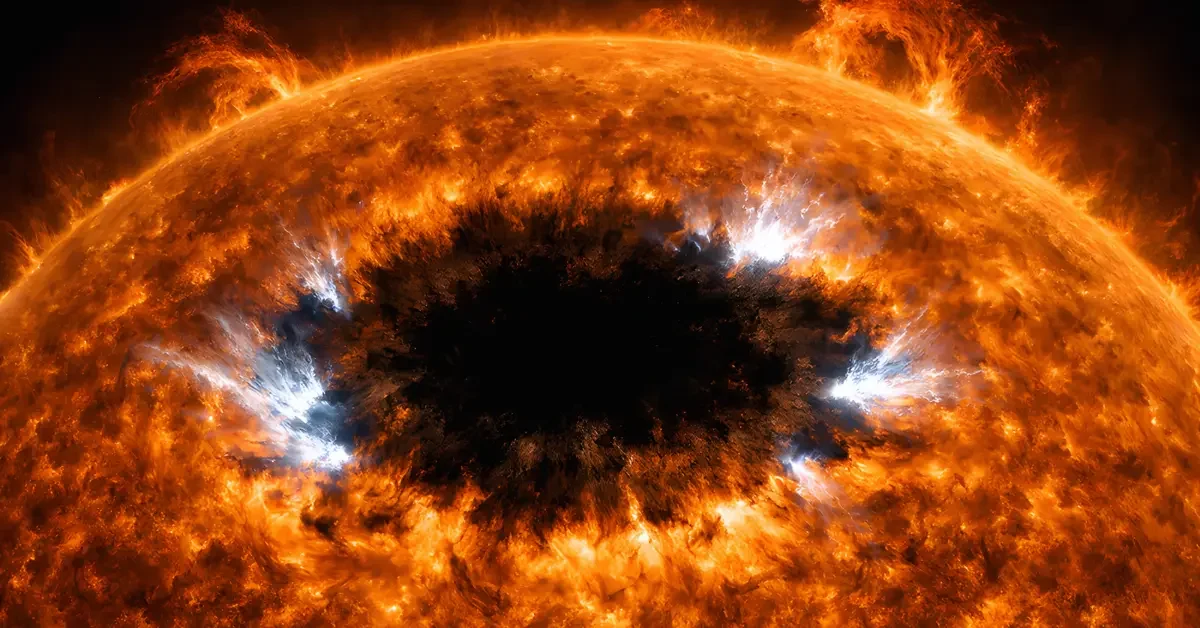
The sun has erupted in an extraordinary barrage of solar activity, with a volatile new sunspot firing off 27 powerful flares in just 24 hours, including the strongest outburst in more than a year. The massive sunspot, designated region 4366, has grown rapidly since appearing several days ago and is now roughly half the size of the infamous Carrington Event sunspot that triggered history’s most destructive geomagnetic storm in 1859.
The flurry of activity began late on February 1 and continued into February 2, with sunspot 4366 unleashing at least 21 M-class flares and five X-class flares. X-class flares rank as the most powerful explosions the sun can produce, with each letter category representing a tenfold increase in energy over the previous. The most intense eruption, an X8.1 flare, peaked at 6:57 p.m. EST on February 1, making it the strongest solar flare recorded since October 2024 and the third-largest flare of Solar Cycle 25.
Radio Blackouts Sweep Across Pacific
The X8.1 flare immediately triggered strong R3 radio blackouts across large portions of Earth’s sunlit hemisphere, disrupting high-frequency communications for aviation, maritime operators, and amateur radio users. The burst of extreme ultraviolet and X-ray radiation ionized Earth’s upper atmosphere, causing prolonged signal absorption below 20 MHz. Reports of communication disruptions came from across the eastern Pacific, affecting areas near Australia and New Zealand.
Less than an hour after the X8.1 eruption, AR4366 fired again with a powerful X2.9 flare at 12:42 a.m. UTC on February 2, hammering nearly the same sector of Earth’s atmosphere and reinforcing the ongoing radio impacts. The region also produced additional X-class flares measuring X1.5, X2.8, and X1.7 within the same volatile 24-hour window.
Aurora Forecast for February 5
Scientists are monitoring the sunspot closely for coronal mass ejections, or CMEs, that often accompany such powerful flares. Early analysis from NOAA’s Space Weather Prediction Center suggests that a CME likely launched in connection with the X8.1 eruption could deliver a possible glancing blow to Earth late on February 5. This raises hopes for elevated geomagnetic activity and potentially vibrant northern lights, though forecasters caution that much depends on the CME’s speed, direction, and magnetic orientation.
If the glancing impact materializes as predicted around 23 UTC on February 5, charged solar particles could race toward Earth’s magnetic poles, producing bright auroras. The prediction carries moderate confidence until coronagraph-based geometry confirms the exact trajectory. Current estimates suggest Kp levels of 3 to 4, indicating mostly active-to-unsettled geomagnetic conditions.
More Explosions Expected
Space weather forecasters emphasize that sunspot 4366 remains far from finished. The region has exploded in area while maintaining a highly complex magnetic configuration classified as beta-gamma-delta, a state prone to violent eruptions. Spaceweather.com described the region as a “solar flare factory,” warning that its rapid growth and magnetic complexity make additional eruptions highly likely.
NOAA forecasters anticipate continued moderate-to-high activity from AR4366, assigning a 75 percent probability of more M-class flares and a 25 percent chance of additional X-class events over the next 24 to 48 hours. The sunspot continues to rotate into a more Earth-facing position, increasing the odds that future eruptions could launch CMEs more directly toward our planet.
Solar Maximum Intensifies
The dramatic surge in activity arrives as solar scientists confirm that solar maximum is well underway. The sun’s magnetic activity peaks every 11 years during this phase, bringing increased frequency and intensity of solar flares and CMEs. NASA has warned that violent space weather could remain elevated through 2026, potentially producing rare and widespread auroral displays similar to those observed in May 2024, when a monster CME pushed the northern lights as far south as Florida.
Intense solar storms can also produce adverse consequences beyond beautiful sky shows. Radio blackouts, GPS disruptions, and damage to satellites and spacecraft all represent potential hazards during periods of heightened solar activity. The strongest flare of 2025 was an X5.1-class eruption recorded in November, a mark that sunspot 4366 has already surpassed with its X8.1 outburst.
Sunspot watchers around the globe will be tracking AR4366 in the coming days as this behemoth region, nearly ten times wider than Earth, continues its march across the solar disk.
