

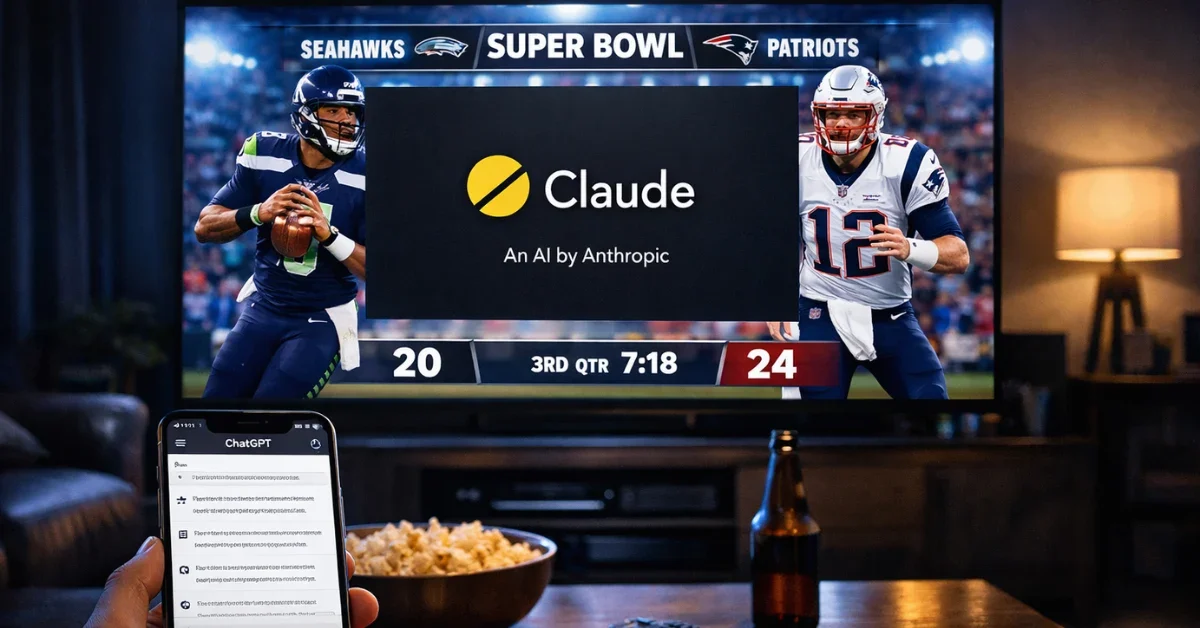
Anthropic took the burgeoning rivalry between artificial intelligence giants to the largest possible stage this week, airing multi-million dollar Super Bowl commercials that directly targeted OpenAI’s decision to introduce advertisements into ChatGPT. The high-profile campaign, which aired during Super Bowl LX on Sunday, positioned Anthropic’s Claude chatbot as the premium, ad-free alternative in an industry increasingly divided over how to monetize digital assistants. While millions of viewers watched the Seattle Seahawks face off against the New Patriots, Anthropic used the event to launch a series of commercials with titles like “Betrayal” and “Treachery” that mocked the intrusion of sponsored content in AI conversations.
The move signals a shift in the AI agent war from technical benchmarks to a battle for consumer trust and brand identity. By spending an estimated $8 million to $10 million for a single 30-second spot, Anthropic is banking on the idea that users will find advertisements in AI interfaces distracting or even deceptive. This aggressive marketing strategy comes just as OpenAI begins the rollout of its own ad-supported tier for ChatGPT, marking one of the most significant public confrontations between leading AI firms since the technology became mainstream.
High-Stakes Commercials Mock Sponsored Content
Anthropic’s Super Bowl spots relied on humor and awkward scenarios to illustrate the potential pitfalls of mixing advertisements with personal AI assistance. In one 30-second commercial, a young man performing pull-ups in a public park asks a burly onlooker for advice on how to get a six-pack. The bystander responds in a stiff, mechanical tone, offering a customized fitness regimen before suddenly pivoting into a sales pitch for shoe inserts designed to help “short kings stand tall.” The ad ends with the tagline, “Ads are to AI but not Claude,” driving home the message that Anthropic intends to keep its platform free from commercial interruptions.
Another commercial in the series featured a man seeking relationship advice from an older woman to help him communicate better with his mother. After beginning with helpful guidance, the character—acting as a personified chatbot—abruptly shifts into an advertisement for a niche dating site connecting younger men with older women. These advertisements are designed to tap into growing consumer anxiety regarding privacy and the potential for AI to become as cluttered with ads as social media and search engines.
OpenAI Begins Testing Ads in ChatGPT
The timing of the campaign follows OpenAI’s official confirmation that it has started testing advertisements within its ChatGPT platform. The testing phase is currently limited to adult users in the United States who are on the “Free” and the newly introduced “Go” subscription tiers. OpenAI has stated that these advertisements will appear at the bottom of the chat window and will be selected based on the topic of the current conversation or past interactions. For example, a user researching recipes might see a sponsored link for a meal kit or grocery delivery service.
OpenAI executives have defended the move as a necessary step to keep the chatbot accessible to a global audience. The company noted that ads help fund the massive compute requirements needed to maintain and improve the intelligence of its models. Despite the inclusion of ads, OpenAI has emphasized that user privacy remains a priority and that chat history is not shared directly with advertisers. Furthermore, the company claims that its subscription-based tiers—Plus, Pro, and Enterprise—will remain entirely ad-free for the foreseeable future.
Rapid Growth and the Hundred Billion Dollar Goal
While Anthropic focuses on “trash talk” regarding advertising, OpenAI CEO Sam Altman is touting a period of reaccelerated growth for the company. In a recent internal communication, Altman informed employees that ChatGPT has returned to over 10% monthly growth and has surpassed 800 million weekly active users. This growth spurt is a critical metric as OpenAI reportedly nears the finalization of a historic $100 billion funding round. This investment is rumored to be aimed at building out massive infrastructure, including the “Stargate” supercomputer project, which would represent one of the largest capital injections in the history of the technology sector.
OpenAI also utilized the Super Bowl stage, though with a different focus. Rather than attacking rivals, OpenAI ran advertisements for its coding software, Codex, positioning itself as the essential tool for developers and professional users. The split in strategies reveals two very different paths for the industry: Anthropic is positioning itself as the “clean” consumer-focused agent, while OpenAI is pushing for massive scale and infrastructure dominance supported by a diverse revenue model that includes both high-end subscriptions and mass-market advertising.
The Future of the AI Agent War
Industry experts suggest that this year’s Super Bowl may be remembered as the moment the AI industry entered its “cola wars” era. With only a small percentage of Americans currently believing that AI will have a positive impact on the country, both companies are using high-profile television spots to normalize the technology and encourage daily use. Anthropic is leveraging its campaign to highlight Claude’s focus on safety and a distraction-free user experience, while OpenAI is leaning into its massive user base and multi-modal capabilities.
As the year 2026 progresses, the competition is expected to intensify further. OpenAI has already hinted at an updated chat model to be released within the coming weeks, while Anthropic continues to refine its premium coding and reasoning tools. For users, the choice may soon come down to whether they prefer a free, ad-supported experience that rivals the reach of Google and Meta, or a focused, ad-free environment that prioritizes a direct relationship between the user and the AI agent.
