

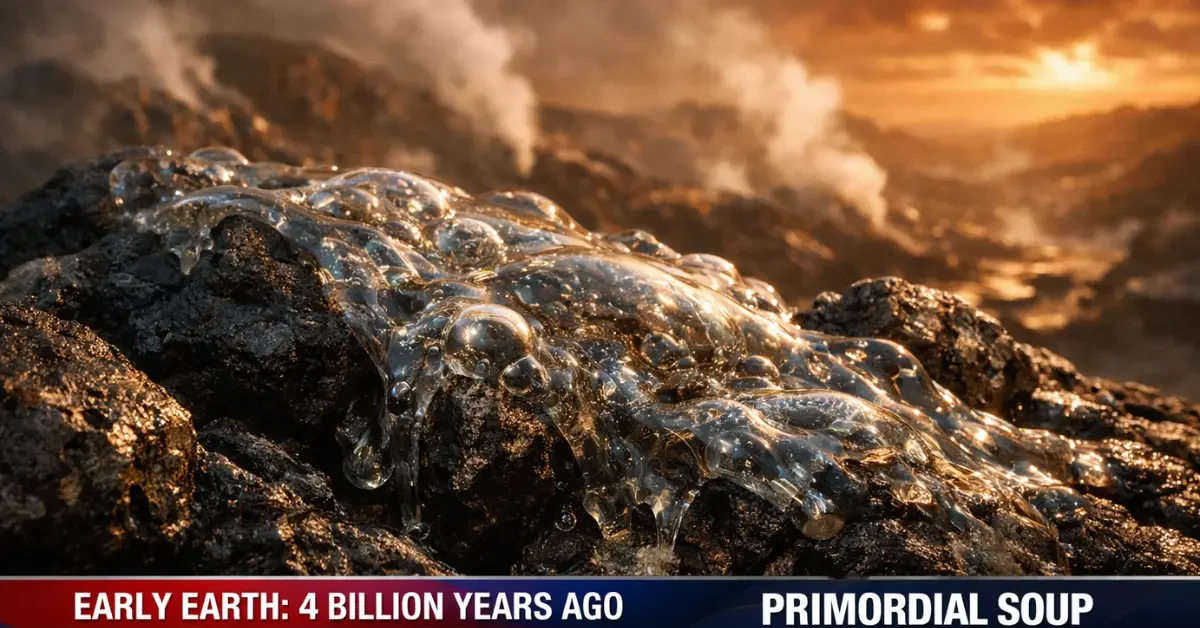
Scientific researchers have recently uncovered a groundbreaking theory suggesting that life on Earth did not begin in a vast open ocean but rather within sticky, jelly-like substances on rock surfaces. This new “primordial goo” theory challenges the long-standing “primordial soup” model by demonstrating how semi-solid gels could have acted as the perfect nursery for the first biological building blocks to form and thrive.
The discovery, led by experts including Dr. Terence Kee from the University of Leeds, shifts the focus from free-floating molecules in water to “prebiotic gels” that formed on mineral surfaces. These hydrogels provided a unique environment that solved several major hurdles in the early stages of life’s evolution. By concentrating essential chemical ingredients and protecting them from the harsh conditions of early Earth, these sticky structures may have been the missing link between simple chemistry and the very first living cells.
Solving the Concentration Problem
For decades, scientists have struggled to explain how the chemical ingredients of life—like amino acids and nucleotides—ever met each other in the massive oceans of the ancient Earth. In a liquid “soup,” these molecules would likely have drifted too far apart to react and form complex structures. This is known as the dilution problem. However, the study of prebiotic gels offers a simple and elegant solution to this mystery.
Sticky gels act like chemical traps, gathering and holding organic molecules in a small, confined space. Because the gel is semi-solid, it prevents these vital ingredients from washing away, essentially forcing them to interact. This high concentration of materials allowed for more frequent and complex chemical reactions, paving the way for the creation of larger molecules like RNA and proteins that eventually became the foundation of all life.
The Protective Cradle of Prebiotic Gels
Early Earth was a violent and unstable place, characterized by intense ultraviolet radiation, extreme temperature swings, and volcanic activity. In an open water environment, fragile precursor molecules would have been easily destroyed before they could evolve. The researchers found that hydrogels served as a protective shield, buffering these delicate chemical structures against environmental stress.
These gels are not just passive containers; they are active environments that stabilize the molecules inside them. By providing a consistent and shielded habitat, the gels allowed chemical evolution to persist over long periods. This stability was crucial for the transition from random chemical mixtures to organized systems that could eventually replicate themselves. The sticky nature of these gels also allowed them to adhere to rocks near hydrothermal vents or tide pools, where energy was abundant but conditions were otherwise chaotic.
Energy Transfer and Metabolism
One of the most significant findings in this research is how gels facilitate energy movement. For life to begin, it needed a way to harness and use energy, a process known as metabolism. The study suggests that these prebiotic gels were excellent at conducting the energy required to drive chemical reactions forward. By interacting with minerals like phosphorus found on rock surfaces, the gels could facilitate the exchange of electrons and the formation of energy-rich bonds.
Phosphorus is a key component of DNA and ATP, the energy currency of cells, but it is often difficult to incorporate into biological systems in a watery environment. The researchers discovered that when phosphorus minerals interact with organic materials to form a gel, the phosphorus becomes much more accessible. This interaction creates a “cradle” where metabolic-like processes could start occurring even before a formal cell membrane had ever developed.
Rethinking the Evolution of the First Cells
Before this discovery, many scientists believed that a protective cell membrane had to be one of the very first things to evolve to keep life’s ingredients together. The “sticky goo” theory suggests that the gel itself acted as a primitive version of a cell wall. In this scenario, life did not need to wait for the complex evolution of fatty membranes to begin organizing. Instead, the physical properties of the gel provided the necessary boundaries and structure.
As these chemical systems within the gels became more advanced, they eventually developed the ability to create their own oily membranes. This allowed them to break away from their “sticky” rock nurseries and become independent, free-swimming cells. This new timeline suggests that the “gel phase” of life was a long and essential chapter in Earth’s history that occurred long before the first traditional fossils were ever formed.
Implications for Life Beyond Earth
The shift from a “soup” to a “goo” model has major implications for how we search for life on other planets. If life starts in sticky gels on rock surfaces rather than deep oceans, astrobiologists may need to change where they look for signs of past or present biology. This discovery suggests that mineral-rich environments on Mars or the icy moons of Jupiter and Saturn could be prime locations for finding similar prebiotic structures.
By understanding the specific types of rocks and minerals that help form these life-giving gels, NASA and other space agencies can better target their missions. The study emphasizes that life is a product of its environment, and the “sticky beginnings” found on Earth might be a universal blueprint for how life emerges across the cosmos. This research provides a new lens through which we can view the transition from a dead, rocky world to a planet teeming with biological diversity.
