
By using this site, you agree to our Privacy Policy and Terms of Use.
Accept
VellaTimesVellaTimesVellaTimes
  • News
    NewsShow More
    A researcher in a lab holding a transparent microfluidic chip that contains engineered blood vessels with complex branching paths and red fluid.
    Engineered blood vessels lead to new vascular disease treatments
    February 12, 2026
    A professional team of insurance experts in a high-tech 2026 office environment using holographic AI data displays to manage agentic systems.
    Agentic AI in Insurance: How Tech Is Reshaping the Industry
    February 12, 2026
    A person holding a smartphone displaying the new TikTok Local Feed tab in a busy city environment with restaurants and shops in the background.
    TikTok Local Feed Launches in U.S. Using Precise Location
    February 12, 2026
    A smartphone displaying a red security warning icon against a high-tech digital background, illustrating a critical Android security warning.
    Android security warning: Over a billion phones now at risk
    February 12, 2026
    President Donald Trump and Prime Minister Benjamin Netanyahu seated in the Oval Office for a serious discussion during their February 2026 meeting.
    Trump Netanyahu Iran talks end with no definitive nuclear deal
    February 12, 2026
  • Technology
    TechnologyShow More
    A person holding a smartphone displaying the new TikTok Local Feed tab in a busy city environment with restaurants and shops in the background.
    TikTok Local Feed Launches in U.S. Using Precise Location
    February 12, 2026
    A smartphone displaying a red security warning icon against a high-tech digital background, illustrating a critical Android security warning.
    Android security warning: Over a billion phones now at risk
    February 12, 2026
    The exterior of the United Kingdom Supreme Court building in London, representing the site of the landmark ruling on AI patents.
    UK Supreme Court Ruling on AI Patents Set to Boost Innovation
    February 12, 2026
    The charred ruins of a residential house in Bohodukhiv, Kharkiv, following a Russian drone strike, with debris and a child's toy in the foreground.
    Russian Drone Strike Kharkiv Kills Father and 3 Children
    February 12, 2026
    A high-tech semiconductor foundry with a robotic arm handling a silicon wafer, representing the partnership for AI chip manufacturing.
    ByteDance Samsung AI Chip Production Partnership
    February 12, 2026
  • AI
    AIShow More
    A professional team of insurance experts in a high-tech 2026 office environment using holographic AI data displays to manage agentic systems.
    Agentic AI in Insurance: How Tech Is Reshaping the Industry
    February 12, 2026
    The Barclays headquarters building in London at sunset with a digital overlay of financial growth charts and an AI symbol, representing the bank's 2026 financial success and technological shift.
    Barclays Annual Profit 2026: Bank Plans £15B Payout and AI Shift
    February 12, 2026
    Military personnel in a high-tech command centre working on a unified digital platform for the UK Ministry of Defence.
    UK Ministry of Defence Selects Red Hat to Scale AI and Cloud
    February 12, 2026
    A high-tech semiconductor cleanroom showing a detailed memory chip in the foreground with technicians inspecting silicon wafers in the background under blue clinical lighting.
    Memory chip demand projected to stay strong through 2027
    February 11, 2026
    A professional banking office setting showing a computer screen with financial data and an AI interface, representing Goldman Sachs' integration of Anthropic's Claude.
    Goldman Sachs Anthropic AI Agents Automate Banking
    February 11, 2026
  • Science
    ScienceShow More
    A researcher in a lab holding a transparent microfluidic chip that contains engineered blood vessels with complex branching paths and red fluid.
    Engineered blood vessels lead to new vascular disease treatments
    February 12, 2026
    A professional medical injector pen and a medication vial on a sterile white surface in a laboratory setting.
    GLP-1 weight loss drugs: FDA crackdown and global guidelines
    February 12, 2026
    A NASA sounding rocket launches into a night sky filled with green northern lights over a snowy landscape in Alaska
    NASA Auroral CT Scan Rocket Missions Launch From Alaska
    February 11, 2026
    A medical professional in a white coat observing a hazy cloud of chemical irritants on a city street at dusk while reviewing lung diagrams on a tablet.
    Tear Gas Health Effects: Risks and Long-term Impact
    February 11, 2026
    A doctor showing an adult patient a medical diagram of an appendix on a tablet during a consultation about antibiotic treatment.
    Antibiotics for Appendicitis: Long-Term Data Support Treatment Choice
    February 11, 2026
  • World
    WorldShow More
    President Donald Trump and Prime Minister Benjamin Netanyahu seated in the Oval Office for a serious discussion during their February 2026 meeting.
    Trump Netanyahu Iran talks end with no definitive nuclear deal
    February 12, 2026
    A wide-angle, hyper-realistic photo of El Paso International Airport at sunrise, showing the control tower and parked airplanes as flight operations resume following a security closure.
    El Paso Airspace Closure Ends After Ten Days of Alerts
    February 12, 2026
    RCMP vehicles with flashing lights parked behind police tape at Tumbler Ridge Secondary School following a mass shooting incident.
    Tumbler Ridge School Shooting: 9 Confirmed Dead in BC
    February 12, 2026
    A wide news-style shot of the Gaza skyline in February 2026 showing smoke rising from military strikes behind damaged buildings at sunset.
    Gaza Military Strikes Intensify as Trump and Netanyahu Prepare for High-Stakes Meeting
    February 11, 2026
    An aerial view of the nearly completed Gordie Howe International Bridge at sunset, showing its tall towers and cables connecting Detroit and Windsor.
    Trump Threatens to Block Gordie Howe International Bridge
    February 11, 2026
  • Bookmarks
Search
Category
  • News
  • Technology
  • AI
  • Science
  • World
Company
  • About Us
  • Contact Us
  • Fact Checking Policy
  • Terms & Conditions
  • Privacy Policy
  • Copyright Policy
Resources
  • Home
  • Web Stories
  • Bookmarks
  • Interests
  • Disclaimer
  • Sitemap
© 2022 VellaTimes • All Rights Reserved.
Reading: Life’s Origins in Sticky Gels Spark New Science Theory
Share
Notification Show More
Font ResizerAa
VellaTimesVellaTimes
Font ResizerAa
  • News
  • Technology
  • AI
  • Science
  • World
Search
  • Explore
    • News
    • Technology
    • AI
    • Science
    • World
  • Useful Links
    • About Us
    • Contact Us
    • Fact Checking Policy
    • Terms & Conditions
    • Privacy Policy
    • Copyright Policy
  • Home
  • Web Stories
  • Bookmarks
  • Interests
  • Disclaimer
  • Sitemap
© 2022 VellaTimes • All Rights Reserved.
News

Life’s Origins in Sticky Gels Spark New Science Theory

Nisha Pradhan
Last updated: 12/02/2026
Nisha Pradhan
Share
7 Min Read
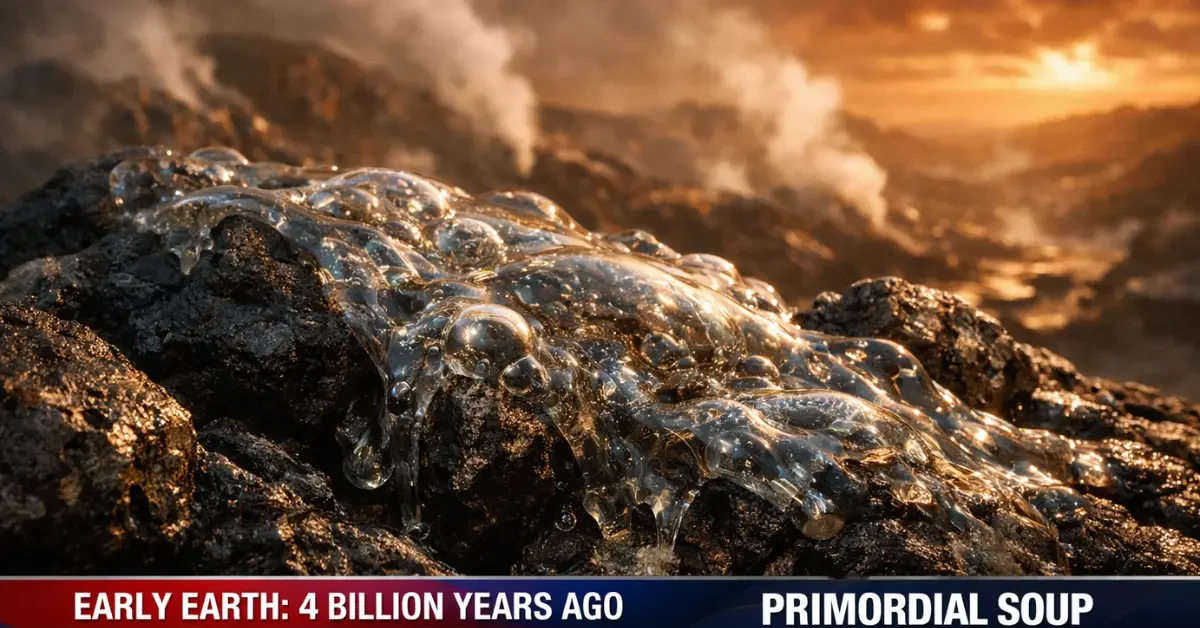
Hyper-realistic depiction of translucent prebiotic gels clinging to dark volcanic rocks on the ancient Earth's surface during the origin of life.

Scientific researchers have recently uncovered a groundbreaking theory suggesting that life on Earth did not begin in a vast open ocean but rather within sticky, jelly-like substances on rock surfaces. This new “primordial goo” theory challenges the long-standing “primordial soup” model by demonstrating how semi-solid gels could have acted as the perfect nursery for the first biological building blocks to form and thrive.

Contents
Solving the Concentration ProblemThe Protective Cradle of Prebiotic GelsRethinking the Evolution of the First CellsImplications for Life Beyond Earth

The discovery, led by experts including Dr. Terence Kee from the University of Leeds, shifts the focus from free-floating molecules in water to “prebiotic gels” that formed on mineral surfaces. These hydrogels provided a unique environment that solved several major hurdles in the early stages of life’s evolution. By concentrating essential chemical ingredients and protecting them from the harsh conditions of early Earth, these sticky structures may have been the missing link between simple chemistry and the very first living cells.

Solving the Concentration Problem

For decades, scientists have struggled to explain how the chemical ingredients of life—like amino acids and nucleotides—ever met each other in the massive oceans of the ancient Earth. In a liquid “soup,” these molecules would likely have drifted too far apart to react and form complex structures. This is known as the dilution problem. However, the study of prebiotic gels offers a simple and elegant solution to this mystery.

Sticky gels act like chemical traps, gathering and holding organic molecules in a small, confined space. Because the gel is semi-solid, it prevents these vital ingredients from washing away, essentially forcing them to interact. This high concentration of materials allowed for more frequent and complex chemical reactions, paving the way for the creation of larger molecules like RNA and proteins that eventually became the foundation of all life.

The Protective Cradle of Prebiotic Gels

Early Earth was a violent and unstable place, characterized by intense ultraviolet radiation, extreme temperature swings, and volcanic activity. In an open water environment, fragile precursor molecules would have been easily destroyed before they could evolve. The researchers found that hydrogels served as a protective shield, buffering these delicate chemical structures against environmental stress.

These gels are not just passive containers; they are active environments that stabilize the molecules inside them. By providing a consistent and shielded habitat, the gels allowed chemical evolution to persist over long periods. This stability was crucial for the transition from random chemical mixtures to organized systems that could eventually replicate themselves. The sticky nature of these gels also allowed them to adhere to rocks near hydrothermal vents or tide pools, where energy was abundant but conditions were otherwise chaotic.

Energy Transfer and Metabolism

One of the most significant findings in this research is how gels facilitate energy movement. For life to begin, it needed a way to harness and use energy, a process known as metabolism. The study suggests that these prebiotic gels were excellent at conducting the energy required to drive chemical reactions forward. By interacting with minerals like phosphorus found on rock surfaces, the gels could facilitate the exchange of electrons and the formation of energy-rich bonds.

Phosphorus is a key component of DNA and ATP, the energy currency of cells, but it is often difficult to incorporate into biological systems in a watery environment. The researchers discovered that when phosphorus minerals interact with organic materials to form a gel, the phosphorus becomes much more accessible. This interaction creates a “cradle” where metabolic-like processes could start occurring even before a formal cell membrane had ever developed.

Rethinking the Evolution of the First Cells

Before this discovery, many scientists believed that a protective cell membrane had to be one of the very first things to evolve to keep life’s ingredients together. The “sticky goo” theory suggests that the gel itself acted as a primitive version of a cell wall. In this scenario, life did not need to wait for the complex evolution of fatty membranes to begin organizing. Instead, the physical properties of the gel provided the necessary boundaries and structure.

As these chemical systems within the gels became more advanced, they eventually developed the ability to create their own oily membranes. This allowed them to break away from their “sticky” rock nurseries and become independent, free-swimming cells. This new timeline suggests that the “gel phase” of life was a long and essential chapter in Earth’s history that occurred long before the first traditional fossils were ever formed.

Implications for Life Beyond Earth

The shift from a “soup” to a “goo” model has major implications for how we search for life on other planets. If life starts in sticky gels on rock surfaces rather than deep oceans, astrobiologists may need to change where they look for signs of past or present biology. This discovery suggests that mineral-rich environments on Mars or the icy moons of Jupiter and Saturn could be prime locations for finding similar prebiotic structures.

By understanding the specific types of rocks and minerals that help form these life-giving gels, NASA and other space agencies can better target their missions. The study emphasizes that life is a product of its environment, and the “sticky beginnings” found on Earth might be a universal blueprint for how life emerges across the cosmos. This research provides a new lens through which we can view the transition from a dead, rocky world to a planet teeming with biological diversity.

TAGGED: astrobiology, chemical evolution, evolutionary biology, hydrogels, origin of life, prebiotic gels, primordial goo, Terence Kee, University of Leeds
Share This Article
Facebook Twitter Whatsapp Whatsapp Telegram Copy Link
By Nisha Pradhan
I am a passionate content creator with a deep love for travel, music, and food. Using my unique blend of these interests, I genuinely enjoy crafting high-quality travel, lifestyle, and entertainment-related news content.
Leave a comment

Leave a Reply Cancel reply

Your email address will not be published. Required fields are marked *


Most Read

Iran protests: Khamenei blames Trump, US and Israel

January 18, 2026

Amazon in Talks to Invest Up to $50 Billion in OpenAI

February 1, 2026

El Paso Airspace Closure Ends After Ten Days of Alerts

February 12, 2026

Artemis II rollout: NASA moves moon rocket to Pad 39B

January 17, 2026

GitHub Launches Agent HQ: Integrate Claude and Codex into Your Workflow

February 8, 2026

Iran protests internet blackout widens as toll disputed

January 11, 2026

Related News

A researcher in a lab holding a transparent microfluidic chip that contains engineered blood vessels with complex branching paths and red fluid.
News

Engineered blood vessels lead to new vascular disease treatments

Nisha Pradhan Nisha Pradhan February 12, 2026
A professional team of insurance experts in a high-tech 2026 office environment using holographic AI data displays to manage agentic systems.
News

Agentic AI in Insurance: How Tech Is Reshaping the Industry

Sameer Katoch Sameer Katoch February 12, 2026
A person holding a smartphone displaying the new TikTok Local Feed tab in a busy city environment with restaurants and shops in the background.
News

TikTok Local Feed Launches in U.S. Using Precise Location

Rakesh Paul Rakesh Paul February 12, 2026

About Us

VellaTimesVellaTimesVellaTimes

VellaTimes is a leading news portal that covers the latest trending news in technology, lifestyle, entertainment, automobiles, travel, and sports.

Explore

  • News
  • Technology
  • AI
  • Science
  • World

Useful Links

  • About Us
  • Contact Us
  • Fact Checking Policy
  • Terms & Conditions
  • Privacy Policy
  • Copyright Policy

Subscribe Us

Subscribe to our newsletter for the Latest News and Top Stories!

© 2022 VellaTimes • All Rights Reserved.
  • Home
  • Web Stories
  • Bookmarks
  • Interests
  • Disclaimer
  • Sitemap
adbanner
AdBlocker Detected
Our site is an advertising supported site. Please whitelist us to support our work.
Okay, I'll Whitelist