

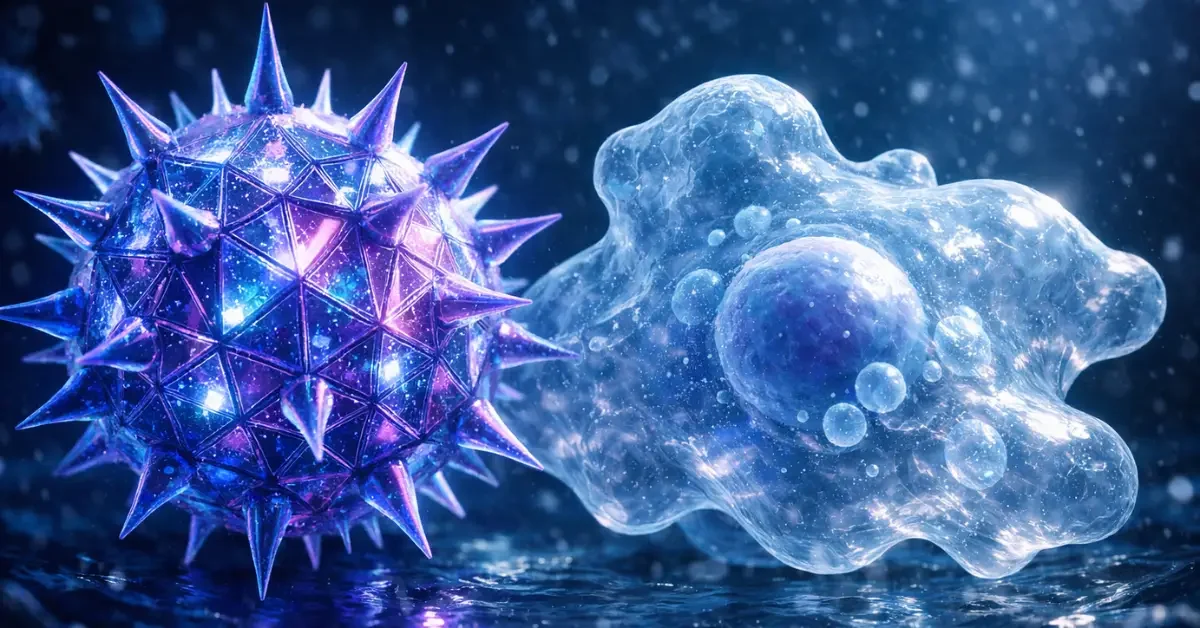
The story of life on Earth may have a surprising microscopic architect. Following a recent giant virus discovery in Japan, scientists are gaining new insights into how the first complex cells evolved. Found in the pond waters of Lake Ushiku in Ibaraki Prefecture, this newly identified microscopic particle is challenging traditional views of biology and the tree of life.
Named ushikuvirus, the organism was isolated by a research team led by Professor Masaharu Takemura at the Tokyo University of Science and collaborators from the National Institute of Natural Sciences. The virus infects single-celled amoebae and possesses a set of highly unusual physical and genetic traits. By studying how it interacts with its host, researchers believe they may be closer to understanding the origin of the cell nucleus itself.
The Unique Traits of Ushikuvirus
The ushikuvirus targets a specific type of amoeba known as Vermamoeba vermiformis. When it infects a host, it triggers a dramatic physical transformation. Scientists observed that infected amoeba cells swell to approximately twice their normal size. Despite this massive physical change, the virus keeps its host alive for up to six days, allowing for a slow and steady replication cycle.
Under an electron microscope, researchers discovered that the virus features a spiky protein shell, or capsid, measuring roughly 250 nanometers across. Some of these spikes feature unique capped tips and thin fiber-like extensions that likely help the virus latch onto its amoeba targets.
Genetically, ushikuvirus is incredibly complex. Sequencing revealed a genome containing at least 666,605 DNA letters and 784 predicted genes. More than half of these genes have no close match in any existing scientific databases. Surprisingly, the virus also carries histones, which are special proteins normally used by complex cells to package DNA into tight coils.
Rewriting the Rules of Viral Replication
When it comes to making copies of itself, ushikuvirus behaves differently than its closest microscopic relatives. Closely related giant DNA viruses, such as clandestinovirus and members of the Mamonoviridae family, typically reproduce while leaving the host cell’s nucleus intact. They use the undisturbed nucleus as a safe zone to replicate.
Ushikuvirus, however, takes a more destructive approach. During its replication cycle, it actively breaks down the nuclear membrane—the thin protective layer surrounding the host’s DNA. The virus then constructs a temporary “virus factory” inside the cell to assemble new viral particles.
Once the new viruses are fully built, they do not violently tear the host cell open to escape. Instead, they exit the amoeba steadily by pushing through the cell surface in small bubbles. This precise, extended release mechanism highlights a highly adapted infection cycle that maximizes the virus’s chances of survival.
Shaping the Evolution of Complex Life
The unusual behaviors of this new organism provide strong support for the “viral eukaryogenesis” theory. First proposed in 2001 by Professor Takemura and Dr. Philip Bell, this hypothesis suggests that the nucleus of complex eukaryotic cells originally evolved from a giant DNA virus.
According to the theory, an ancient virus infected a primitive single-celled organism billions of years ago. Rather than killing the host, the virus established a permanent residence inside the cell, eventually absorbing cellular genes and evolving into the modern cell nucleus.
Because ushikuvirus bridges the gap between viruses that preserve the host nucleus and those that destroy it, scientists view it as a living puzzle piece. While it cannot fully replay the events of ancient cellular history, it offers a tangible example of how viruses might have exerted lasting control over early cells, fundamentally shaping the trajectory of complex life on Earth.
Potential Medical Applications
Beyond evolutionary biology, studying amoeba-infecting giant viruses carries real-world potential for modern healthcare. While the researchers note that ushikuvirus does not target humans, it is highly effective at neutralizing specific amoebae.
Certain free-living amoebae, such as Acanthamoeba, can cause severe and sometimes fatal human illnesses, including amoebic encephalitis. By mapping exactly how ushikuvirus enters, hijacks, and eventually neutralizes its host, scientists hope to uncover new strategies to fight amoebic infections in humans.
The findings, recently published in the Journal of Virology, emphasize that giant viruses are far more than simple microscopic threats. They are complex biological agents that continue to rewrite the rules of life, offering a unique window into both our distant evolutionary past and future medical treatments.
