

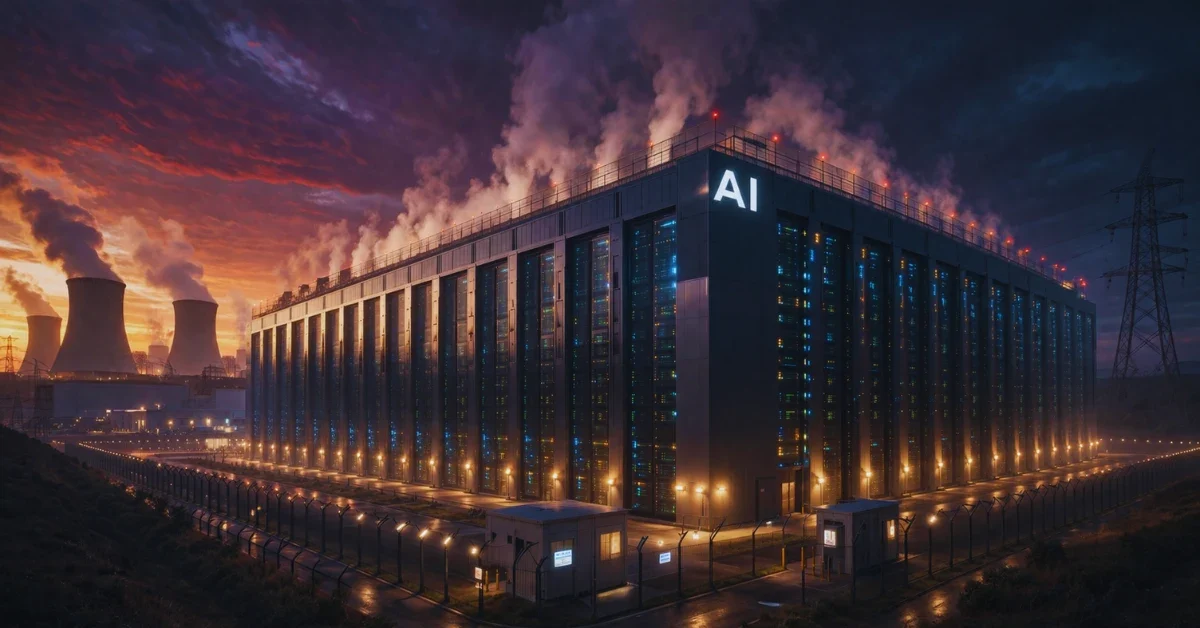
The rapid expansion of artificial intelligence is physically changing the environment, creating localized heat zones that affect millions of people. As tech giants build massive facilities to power their digital services, new research shows that AI data centers are warming the surrounding land, consuming vast amounts of water, and heavily relying on fossil fuels. This growing environmental footprint has triggered severe legislative proposals, including a push to freeze all new construction in the United States.
The Rise of Data Heat Islands
A recent study by researchers at the University of Cambridge highlights a phenomenon known as the “data heat island effect.” Analyzing two decades of satellite temperature data and over 6,000 facilities, scientists discovered a sharp temperature jump that coincides with the start of data center operations. On average, the land surface temperature around these facilities rises by about 2 degrees Celsius. In extreme cases, local temperatures can surge by as much as 9.1 degrees Celsius.
These heat bubbles do not stay confined to the immediate property line. Elevated temperatures can be felt up to 10 kilometers away, with a measurable 1-degree Celsius increase extending out to 4.5 kilometers. This local climate shift affects more than 340 million people globally. The warming pattern is consistent worldwide, with unexplained temperature spikes documented around major infrastructure hubs like the Bajio region in Mexico and Aragon in Spain.
The physical heat generated by computation places AI infrastructure in the same category as traditional industrial heat sources. Urban heat islands typically increase city temperatures by 4 to 6 degrees Celsius, and data centers are now proving to be a comparable localized climate force.
Massive Resource Consumption
Beyond releasing intense heat, AI data centers are enormous consumers of natural resources. The cooling systems required to prevent servers from overheating require millions of liters of water. Generating a simple 100-word AI prompt consumes about 519 milliliters of water, roughly the equivalent of a standard bottle. While that may seem small on an individual level, billions of prompts are processed globally every minute.
Medium-sized facilities can use roughly 110 million gallons of water annually for cooling, which equals the yearly consumption of about 1,000 households. Larger sites can consume up to 5 million gallons of water a day, rivaling the usage of a small town.
Powering these massive computing hubs also requires staggering amounts of electricity. AI workloads amplify energy demands, and much of this infrastructure still relies heavily on fossil fuels. If current trends continue unchecked, data centers could account for nearly half of the emissions allowed under current United States power sector climate targets.
Tech Giants Turn to Fossil Fuels
To meet their immense power needs, major technology companies are securing their own energy sources. Meta recently reached an agreement to fund the construction of seven new natural gas power plants. These new facilities will supply an additional 5.2 gigawatts of electricity to Meta’s Hyperion campus in Richland Parish, Louisiana.
Combined with previously approved infrastructure, the Louisiana campus will be powered by a total of 10 natural gas facilities delivering over 7 gigawatts of electricity. Approximately 5 gigawatts of this massive power draw will be dedicated strictly to computing workloads. The deal is structured so that Meta covers its full cost of service, a move projected to deliver more than $2 billion in savings to other consumers over 20 years. Meta also committed to help fund up to 2.5 gigawatts of renewable energy and explore future nuclear power development.
This agreement aligns with recent demands from President Donald Trump, who ordered technology companies to cover their own power costs to prevent residential electricity bills from spiking due to the data center boom.
Lawmakers Propose Construction Freeze
The staggering environmental and energy impacts of AI data centers have prompted swift political action. United States Senator Bernie Sanders and Representative Alexandria Ocasio-Cortez have introduced the Artificial Intelligence Data Center Moratorium Act. This legislation aims to halt all new data center construction across the country.
Under the proposed bill, the construction ban would remain in place until Congress passes federal legislation that limits environmental damage, protects workers, safeguards consumers, and defends civil rights. Lawmakers are specifically concerned about the immense electricity costs, the strain on potable water supplies, and the broader climate impact of the AI industry.
Local governments are already taking matters into their own hands. Since August 2025, various towns and counties in Missouri, Indiana, Georgia, and North Carolina have passed temporary bans on data center construction, and at least 11 other states are currently considering similar measures.
