

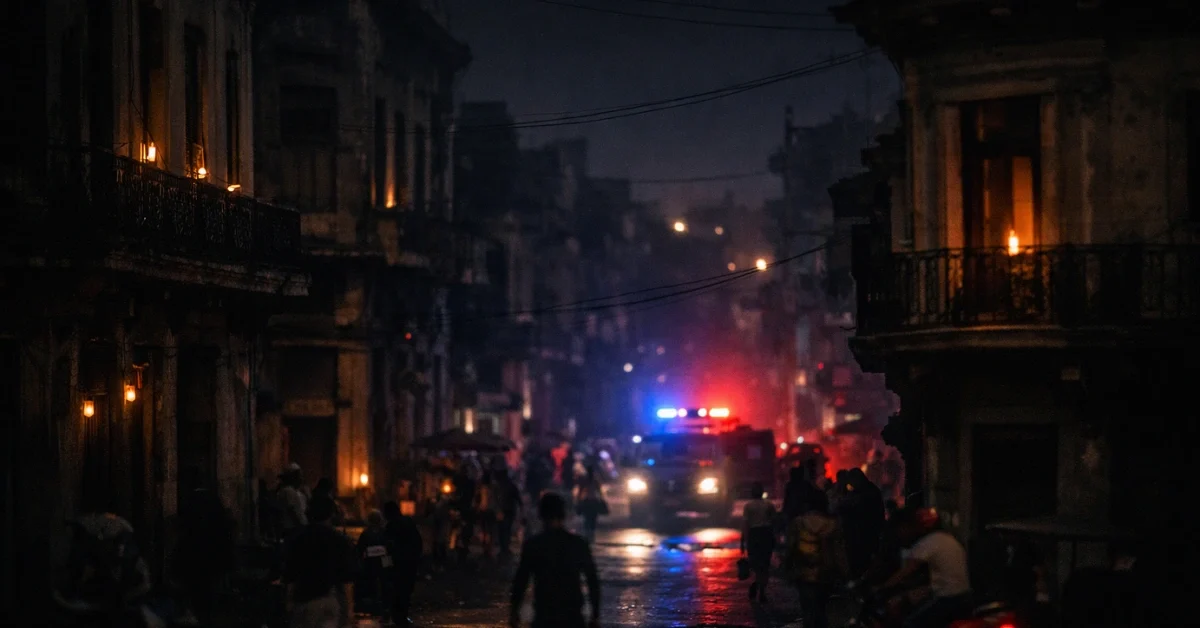
Cuba was plunged into a nationwide blackout on Monday, March 16, 2026, following the complete collapse of its national electric grid. The unprecedented power failure has left millions of residents in the dark, significantly deepening the island’s ongoing economic and energy crisis.
The Cuban Ministry of Energy and Mines announced a “total disconnection” of the electrical network on social media. The state grid operator, UNE, immediately launched an investigation to determine the exact causes of the collapse. Reporting organizations conflict regarding the exact number of people affected by the outage. According to international broadcasting networks, 9.6 million people are affected, while major news wires report around 10 million, and American public radio organizations estimate that approximately 11 million residents are currently without power.
The immediate consequences of the grid collapse have been severe. The massive blackout has forced the Cuban government to delay medical surgeries for tens of thousands of individuals. This nationwide failure follows a significant outage that struck the western region of the island just over a week ago, which had already left millions without electricity.
U.S. Sanctions and Severed Oil Supplies
The immediate trigger for the collapse traces back to a severe lack of fuel needed to run Cuba’s obsolete power generation system. The United States has aggressively tightened its trade embargo on the communist-led nation this year. In January 2026, U.S. operations led to the capture of Venezuelan President Nicolas Maduro, removing Cuba’s most important foreign benefactor. Following this event, the administration under U.S. President Donald Trump threw its support behind acting Venezuelan President Delcy Rodriguez and completely halted all Venezuelan oil shipments to Cuba.
To further restrict the island’s energy supply, President Trump threatened to impose heavy tariffs on any country that sells oil to Cuba. This direct warning targeted other key historical suppliers, including Mexico and Russia, effectively strangling the Caribbean nation’s already antiquated power grid.
A System Running on Fumes
Cuba has struggled to find alternative fuel sources. On Friday, Cuban President Miguel Diaz-Canel stated that the island has not received any oil deliveries for over three months. To cope, the nation has relied heavily on its thermoelectric plants, natural gas, and solar energy. While Cuba currently generates 40% of its own oil to produce electricity, this domestic output has proven entirely inadequate to meet the daily demands of its deteriorating electrical infrastructure.
Ship tracking data from LSEG confirms the stark reality of the blockade. Throughout the early months of 2026, Cuba received only two small vessels carrying imported fuel. In January, a tanker from Mexico discharged fuel at the port of Havana. In February, a second vessel from Jamaica delivered liquefied petroleum gas, commonly used as cooking gas. Meanwhile, Venezuela’s state-owned oil company, PDVSA, loaded a tanker with gasoline in February, but satellite monitoring shows the vessel has not left Venezuelan waters. Satellite imagery also confirms that no large fuel imports have entered through Cuba’s primary crude refining hubs in Matanzas or Moa, and the ports of Havana and Cienfuegos have seen no import activity for over a month.
Violent Protests and Civil Unrest
The combination of prolonged blackouts, soaring food prices, and widespread shortages of fuel and medicine has ignited intense frustration among citizens. Over the weekend, these harsh living conditions sparked rare and violent protests across the country. As dusk falls, residents in numerous cities have taken to banging pots and pans to express their dissent against the government.
In Morón, a city of approximately 70,000 people located near the northeastern coast, the unrest escalated dramatically. Hundreds of demonstrators confronted law enforcement outside a local precinct, chanting “Freedom, freedom.” The crowds then marched to the local headquarters of the ruling Communist Party, where they raided the offices and set office furniture on fire.
Diplomatic Talks and Policy Shifts
Faced with an increasingly unsustainable domestic situation, the Cuban government announced on Friday that negotiations with the United States have officially commenced. Cuban officials hope these discussions will help resolve the dire economic and energy crisis. Shortly after the talks began, Cuban Deputy Minister Oscar-Ol Fraga revealed a significant potential policy shift. He stated that the government intends to allow Cuban citizens living abroad, including those residing in the United States, to invest in and own private businesses within Cuba.
President Trump has publicly acknowledged the situation, suggesting that the Cuban regime is nearing a breaking point. Speaking to reporters aboard Air Force One on Sunday, he remarked that Cuba wants a deal, indicating that the U.S. will either reach an agreement or take whatever actions are necessary. Trump also previously indicated that regime change in Cuba remains a potential outcome, especially in the wake of the ongoing U.S.-Israeli conflict with Iran.
