

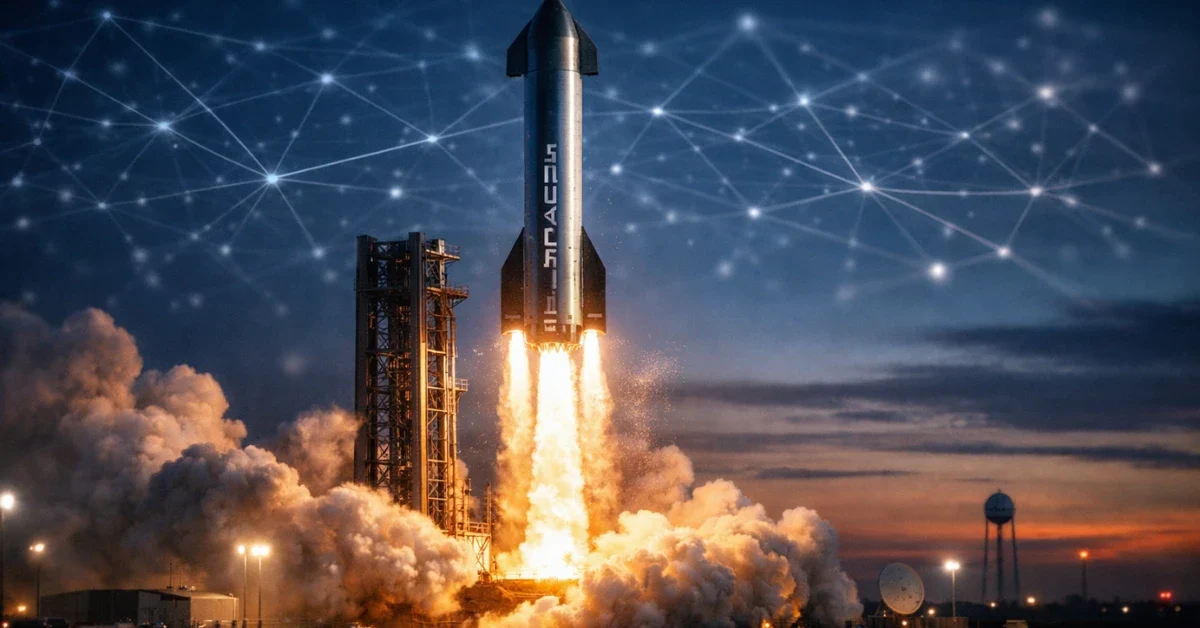
Elon Musk’s aerospace company is reportedly preparing to take a massive leap into the public markets. Industry analysts have confirmed that the long-awaited SpaceX IPO could begin taking shape as early as this month. The rocket startup is expected to submit a confidential filing with the U.S. Securities and Exchange Commission, setting the stage for a monumental public debut.
If the current timeline holds, the highly anticipated SpaceX IPO could arrive by June 2026. The offering is expected to target an unprecedented valuation exceeding $1.75 trillion. This move marks a major shift for the world’s most valuable aerospace entity as it transitions toward public ownership and seeks to raise billions in fresh capital.
Setting Up the Largest Public Offering in History
The planned public listing is poised to shatter global financial records, as SpaceX aims to raise up to $50 billion in primary capital through its initial offering. This ambitious target would comfortably surpass the current record holder, Saudi Aramco, which raised $29 billion during its historic market debut in 2019.
Choosing to file confidentially provides the aerospace giant with a significant strategic advantage. A private filing allows the company to submit its financial disclosures to the SEC and receive regulatory feedback out of the public eye. Management can then make necessary adjustments to the company prospectus before initiating a traditional public roadshow.
Financial analysts emphasize that this private review period is critical. The company must navigate complex disclosure requirements related to its recent corporate integrations and the inherent volatility surrounding its experimental rocket development programs. While the exact timeline remains fluid, prediction markets are already reacting to the news. Traders on Kalshi, a regulated U.S. prediction market, currently estimate a 47% probability that the company will officially announce its public listing before the start of June.
Merging Aerospace Dominance with Artificial Intelligence
A key driver of the massive $1.75 trillion target valuation is the company’s recent all-stock merger with xAI, the artificial intelligence venture also founded by Elon Musk. This strategic integration effectively combined the company’s massive orbital infrastructure with high-performance artificial intelligence computing capabilities.
Prior to the upcoming public offering, the combined entity was valued at $1.25 trillion. The company’s internal valuation has essentially more than doubled since July 2025, reflecting massive growth and market dominance. Today, the unified company controls over 95% of the domestic rocket launch market while holding more than $22 billion in active government contracts.
Starlink Emerges as a Global Telecommunications Utility
While the towering Falcon and Starship launch vehicles capture the most public attention, the underlying financial engine driving the upcoming public debut is Starlink. The satellite internet service has matured rapidly, transforming the overarching business model of the entire enterprise.
By the end of 2025, Starlink successfully reached 9.2 million active subscribers. This milestone represents a remarkable doubling of its global user base in just fifteen months. The internet business unit has become a financial powerhouse, generating more than $10 billion in revenue over the last year.
Market analysts from Quilty Space and Bloomberg project that this growth trajectory will only accelerate. Revenue forecasts for the satellite internet division in 2026 range between $15.9 billion and $24 billion. This highly profitable, software-like margin profile has fundamentally shifted the company’s identity. It is no longer viewed strictly as an industrial aerospace contractor, but rather as a highly lucrative global telecommunications utility.
Funding Next-Generation Space Infrastructure
Despite the immense revenue generated by its satellite internet division, the company requires massive capital infusions to fund its most ambitious projects. The decision to pursue public markets represents a clear shift in strategy for Elon Musk, who previously noted the heavy burdens of public ownership. In prior statements, the chief executive highlighted that the legal requirements and the intense pressure to deliver short-term results are very high for public companies.
However, the immense financial requirements of future aerospace projects have seemingly outweighed the benefits of remaining a private enterprise. The aerospace leader needs multi-billion dollar investments to support the development of lunar Starship variants. Additionally, the company is actively funding the creation of the “Golden Dome” missile defense layer, an endeavor requiring extraordinary capital resources.
Critical Upcoming Milestones
The coming weeks will be crucial as the company pursues a dual-track strategy of financial preparation and aerospace testing. Alongside the confidential SEC paperwork, the company is actively preparing to execute a major test launch of its next-generation Starship vehicle in late March.
A successful orbital mission for Starship is widely considered a mandatory step in the process. Proving the technical viability of the massive next-generation rocket will provide the validation needed to secure major institutional backing ahead of the June market debut. If the test launch succeeds and the regulatory filing proceeds smoothly, the company is perfectly positioned to make Wall Street history.
