

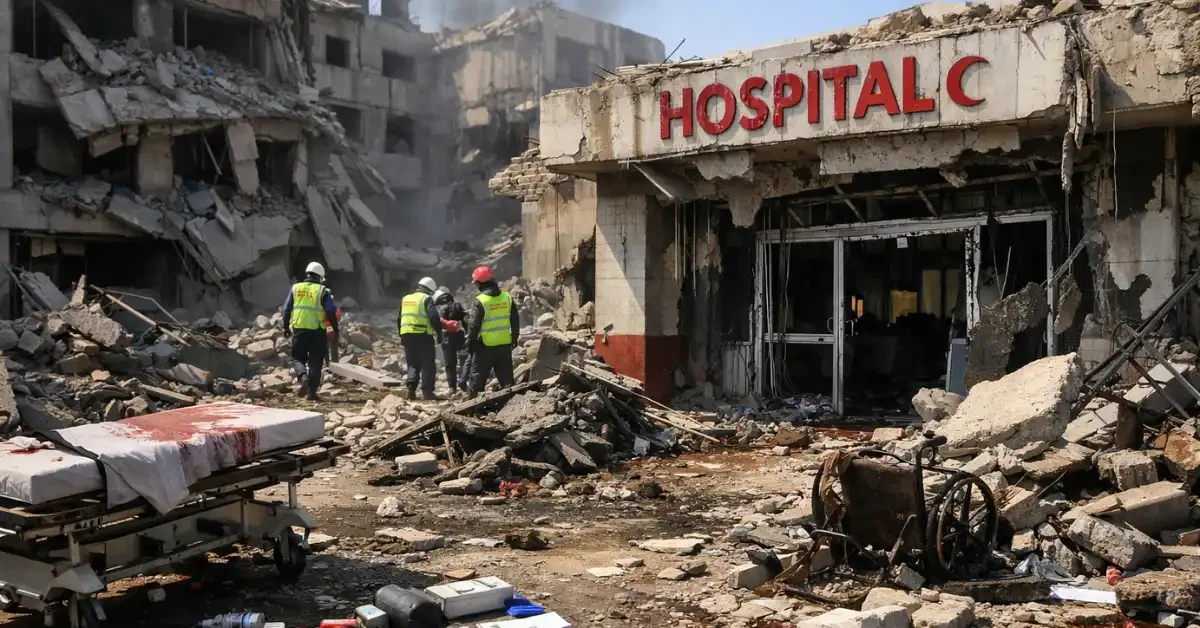
A devastating Sudan hospital strike in the East Darfur region has claimed the lives of at least 64 individuals, including 13 children and multiple medical professionals. The World Health Organization confirmed that the deadly assault, which occurred on a Friday night, targeted the Al-Daein Teaching Hospital. This critical healthcare facility has now been rendered completely non-functional, immediately cutting off vital medical services and emergency care for the surrounding community.
World Health Organization Director-General Tedros Adhanom Ghebreyesus shared the grim details of the attack on the social media platform X on Saturday. The tragic Sudan hospital strike also injured an additional 89 people, further highlighting the escalating dangers faced by civilians and healthcare workers in the ongoing war. This recent assault has brought renewed international condemnation from humanitarian groups as the nation’s severe crisis continues to deepen.
Casualties and Devastation at Al-Daein Teaching Hospital
The violent strike severely impacted critical areas of the Al-Daein Teaching Hospital, which serves as the primary medical center in the capital of East Darfur state. The hospital’s pediatric, maternity, and emergency departments sustained massive damage during the bombardment. The extensive destruction involved heavy weaponry that adversely affected not only the physical infrastructure but also crucial medical supplies and storage capacities necessary for saving lives.
The death toll reflects a devastating loss for both the local population and the medical community. Among the 64 confirmed fatalities were 13 children, multiple patients seeking urgent medical care, two female nurses, and one male doctor. Furthermore, of the 89 individuals who sustained wounds in the attack, eight were active healthcare staff members. The widespread damage has forced the entire hospital out of service, leaving vulnerable residents without access to essential healthcare in the midst of a broader conflict.
Conflicting Reports on the Origin of the Attack
The World Health Organization’s System for Attacks on Health formally verified the incident, officially categorizing it as an act of violence involving heavy weapons. However, the organization functions strictly as a monitoring and tracking body, not an investigative agency. As a result, the World Health Organization does not assign blame or identify the specific perpetrators behind such military strikes.
Meanwhile, independent groups have offered specific claims regarding the source of the bombardment. The Emergency Lawyers, a Sudanese rights organization dedicated to documenting war-related atrocities, stated that an army-operated drone was responsible for striking the teaching hospital. The ongoing civil war pits the national Sudanese army against the paramilitary Rapid Support Forces. Currently, the Rapid Support Forces maintain dominance over the expansive western Darfur region, while the national military controls the eastern, central, and northern territories of the country.
A Growing Toll on Healthcare Infrastructure
Medical facilities and their personnel have consistently been among the targets since the armed conflict first ignited in mid-April 2023. Following this most recent tragedy, the total number of fatalities directly linked to assaults on healthcare infrastructure during the nearly three-year war has now surpassed 2,000.
According to the World Health Organization’s tracking system, officials have verified 2,036 deaths resulting from 213 separate attacks on medical establishments. The United Nations humanitarian office in Sudan expressed deep dismay over the Friday night attack, noting that hospitals remain frequent targets despite repeated international condemnation.
Prior to this specific event, United Nations statistics from December indicated that over 1,800 individuals, including 173 health workers, had already lost their lives in similar incidents. The violence has not slowed in the new year. Before this latest strike, 12 attacks on healthcare had already been documented this year alone, resulting in 178 fatalities and 237 injuries.
The Broader Humanitarian Crisis
The relentless warfare between the Sudanese army and the Rapid Support Forces has triggered what the United Nations describes as the most severe man-made humanitarian and displacement crisis globally. The ongoing violence has resulted in tens of thousands of civilian and military casualties nationwide, devastating communities across multiple regions.
The conflict has also created a massive displacement emergency, although humanitarian reports vary slightly on the exact scale of the crisis. According to The Guardian, the war has displaced more than 11 million individuals from their homes. In contrast, Al Jazeera reports that over 12 million people have been forced to flee. Despite this discrepancy, both news outlets confirm that a staggering 33 million people in the country are currently in urgent need of humanitarian assistance to survive.
