

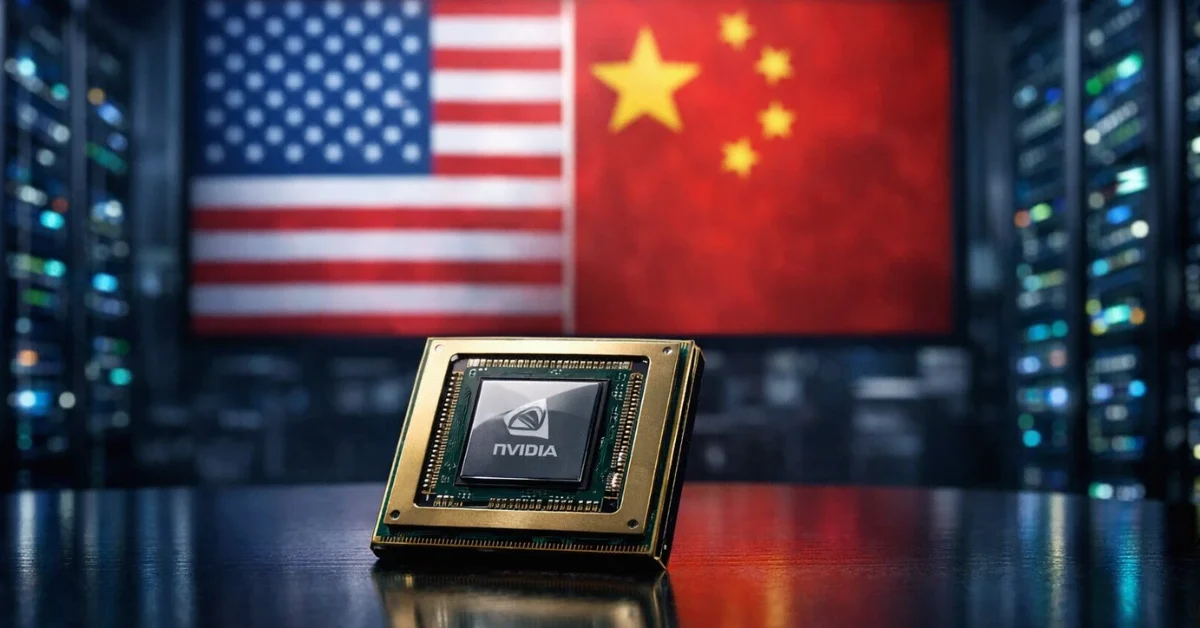
Nvidia just posted its biggest quarter ever, but a looming question is casting a shadow over the celebration: will China ever allow the company’s H200 chips across its border?
The Santa Clara-based chipmaker reported revenues of $68.12 billion for its fourth fiscal quarter of 2026, with profits reaching $42.96 billion. For the full fiscal year, Nvidia turned a staggering $120 billion profit on revenues of $215.93 billion — numbers that would have seemed impossible just a few years ago. Yet the company’s inability to crack the Chinese market remains a thorn in its side, even as demand from hyperscale customers surges worldwide.
H200 Licence Granted, But Revenue Still at Zero
The Trump administration reversed an earlier export ban in early December, allowing Nvidia to sell its H200 accelerators to Chinese customers — with a catch. The licence comes with conditions: shipments must be inspected in the United States and are subject to a 25 percent duty.
Despite that partial green light from Washington, Nvidia’s CFO Colette Kress told investors on the company’s earnings call that not a single dollar has been booked from H200 sales in China. “While small amounts of H200 products for China-based customers were approved by the US Government, we have yet to generate any revenue, and we do not know whether any imports will be allowed into China,” Kress said.
The problem is that Beijing has its own say on the matter. China has not formally approved imports of the H200, leaving Nvidia stuck in a diplomatic no-man’s-land between two governments. Notably, Nvidia’s first-quarter revenue forecast — which projects approximately $78 billion in sales — does not include a single cent of Chinese data centre revenue.
A $50 Billion Market Just Out of Reach
CEO Jensen Huang has previously described China’s AI chip market as potentially worth around $50 billion in the coming years. That makes the current standoff particularly painful for Nvidia shareholders and executives alike.
A political tug-of-war between Washington and Beijing has long disrupted Nvidia’s ability to sell its most powerful processors in China. The United States restricts exports of top-tier chips on national security grounds, and China’s government has been actively steering its largest tech firms toward domestic alternatives.
Bloomberg News reported in January that Chinese officials had signalled to major tech companies, including Alibaba, that they could begin preparing H200 orders — suggesting Beijing was edging toward formal approval. But as of Nvidia’s February 25 earnings call, that approval had still not arrived.
Chinese Rivals Are Gaining Ground
While Nvidia waits, its domestic competitors in China are not standing still. Companies such as Huawei Technologies, Cambricon Technologies, Moore Threads Technology, and recently listed MetaX Integrated Circuits Shanghai have been racing to fill the void left by export restrictions. Several of these firms have recently completed initial public offerings, raising fresh capital to meet surging domestic AI demand.
Kress did not downplay the threat. Chinese chipmakers, she warned, “have the potential to disrupt the structure of the global AI industry over the long term.” She argued that for the United States to maintain its leadership in artificial intelligence, it needs to remain the platform of choice for developers globally — including those in China.
Her comments echoed concerns previously raised by AMD and major US tech partners such as Microsoft, CoreWeave, and OpenAI.
Data Centre Business Dominates Nvidia’s Growth
China headaches aside, Nvidia’s core business is firing on all cylinders. The company’s data centre segment brought in $62.3 billion in Q4 alone, accounting for more than 90 percent of total revenues. By contrast, its gaming, professional visualisation, and automotive divisions generated $3.7 billion, $1.3 billion, and $604 million, respectively — increasingly marginal compared to the data centre juggernaut.
Looking ahead to Q1 of fiscal 2027, Nvidia expects roughly 90 percent year-over-year revenue growth, driven by massive capital commitments from hyperscale customers. Meta, Google, Amazon, and Microsoft are collectively expected to invest around $635 billion in data centre and AI infrastructure this calendar year alone.
What Comes Next
The path forward for Nvidia in China hinges on decisions made not in boardrooms, but in government offices in both Beijing and Washington. Until China formally clears H200 imports, Nvidia’s multi-billion-dollar opportunity in the world’s largest semiconductor market remains frozen — a blank line in an otherwise record-breaking earnings report.
