

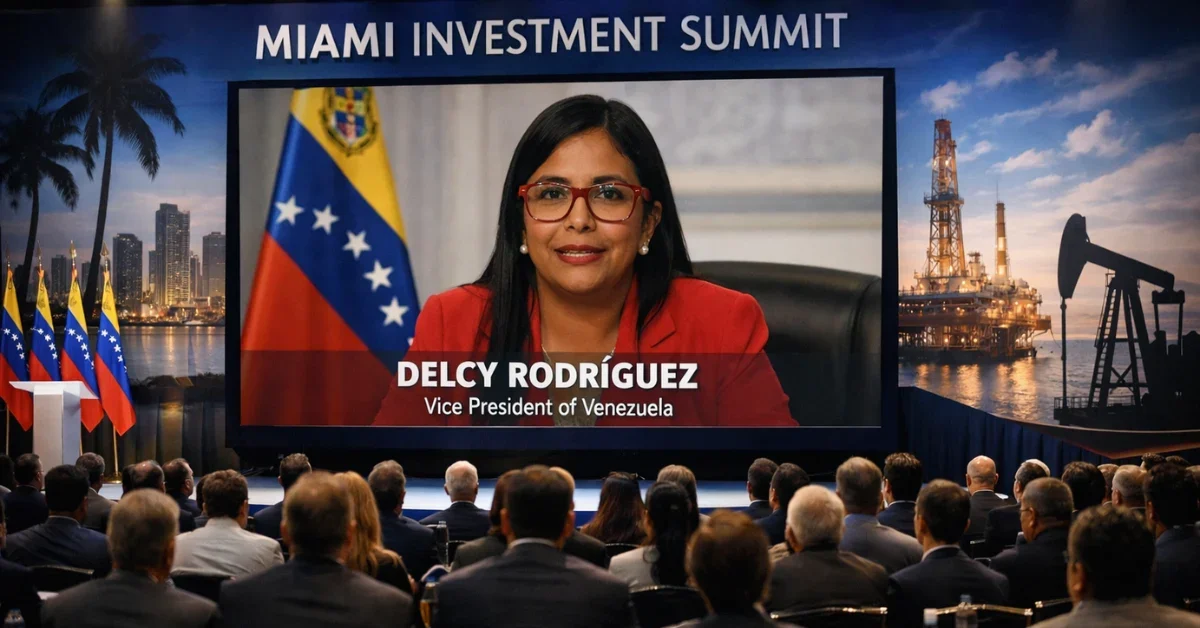
Venezuela put its oil investment drive in front of international business leaders this week as acting President Delcy Rodríguez used a Miami summit appearance to argue that the country is changing its legal and policy framework to attract foreign capital. Speaking by video to the FII PRIORITY conference, Rodríguez said Venezuela is working to give investors clearer guarantees, more flexibility, and a more predictable business climate, with the oil sector at the center of that effort.
The Venezuela oil investment message was aimed at a room filled with U.S., Saudi, and Latin American investors, according to reports on the event. Rodríguez said her government is advancing reforms designed to strengthen legal certainty and reassure companies that their investments can be protected and generate returns even amid political changes.
Legal guarantees
Rodríguez said the investment environment must offer security so companies know that, regardless of political alternation or restrictions, Venezuela has laws that allow serious returns on investment. She described the country as being in a stabilization process that includes reforms meant to support a productive environment and attract capital into different parts of the economy.
In her remarks, she tied that argument directly to the energy business, saying the already enacted hydrocarbon law and other measures under discussion are meant to improve conditions for investors. She also said those legal changes are being designed to affect not only hydrocarbons, but also construction, banking, insurance, mining, and manufacturing.
Rodríguez told the Miami audience that Venezuela wants to make visible what an industry and economy with greater freedom in the exercise of its sovereign powers could look like. She added that the government is incorporating alternative dispute-resolution mechanisms, including national and international arbitration, as part of the legal framework for investors.
Hydrocarbon overhaul
A central part of the pitch focused on Venezuela’s new Hydrocarbon Law. Rodríguez said the law creates mechanisms for private-sector control over production and commercialization, introduces more flexible fiscal arrangements, and establishes alternative conflict-resolution processes such as international arbitration.
According to venezuelanalysis.com, the law was approved in late January by the National Assembly and allows the executive branch to reduce taxes and royalties at its discretion. The same report said the reform expands private corporate control over the industry compared with the framework that had been in place under the 2001 Hydrocarbon Law and later changes.
Rodríguez also said 64 percent of the price of a barrel is open to negotiation with investors through lower royalties and taxes as well as dividends. She framed those measures as part of a broader effort to create “flexibility,” “guarantees,” and “security” for companies considering entry into Venezuela’s energy and resource sectors.
Beyond oil, Rodríguez highlighted the country’s natural gas, gold, and other mineral resources as part of the larger investment opportunity. She said she has met with representatives of 120 multinational corporations since January, presenting the reforms as an invitation for investors to take part.
Diplomatic opening
The Miami appearance also came alongside signs of a diplomatic opening between Caracas and Washington. Rodríguez said a high-level meeting between diplomatic delegations from Venezuela and the United States was expected this week to strengthen diplomatic, political, and geopolitical dialogue between the two countries.
She separately announced the imminent departure of a Venezuelan diplomatic mission to Washington led by Félix Plasencia, who is slated to become ambassador to the United States, according to venezuelanalysis.com. Rodríguez said that delegation would manage what she called a new stage of diplomatic relations and dialogue between the two countries.
At the summit, Rodríguez also referred to U.S. President Donald Trump, saying both governments are now willing to build a constructive bilateral diplomatic agenda that benefits both sides. She coupled that message with an appeal for stronger regional economic integration and for the removal of unilateral sanctions on Venezuela, arguing that current U.S. Treasury licenses hurt investor confidence.
Summit focus
The FII PRIORITY event in Miami is backed by Saudi Arabia’s sovereign investment apparatus and brings together executives, investors, analysts, and political leaders. El País reported that more than 1,000 investors, chief executives, and political figures were taking part in the gathering, whose program this year was titled “Capital in Motion.”
Rodríguez used that platform to present Venezuela as a country looking for outside capital and a reset in how global investors view its economy. Her message was consistent across the event: new laws, broader flexibility, and stronger legal protections are meant to make Venezuela’s oil sector more appealing to foreign companies watching for opportunities in the region.
