

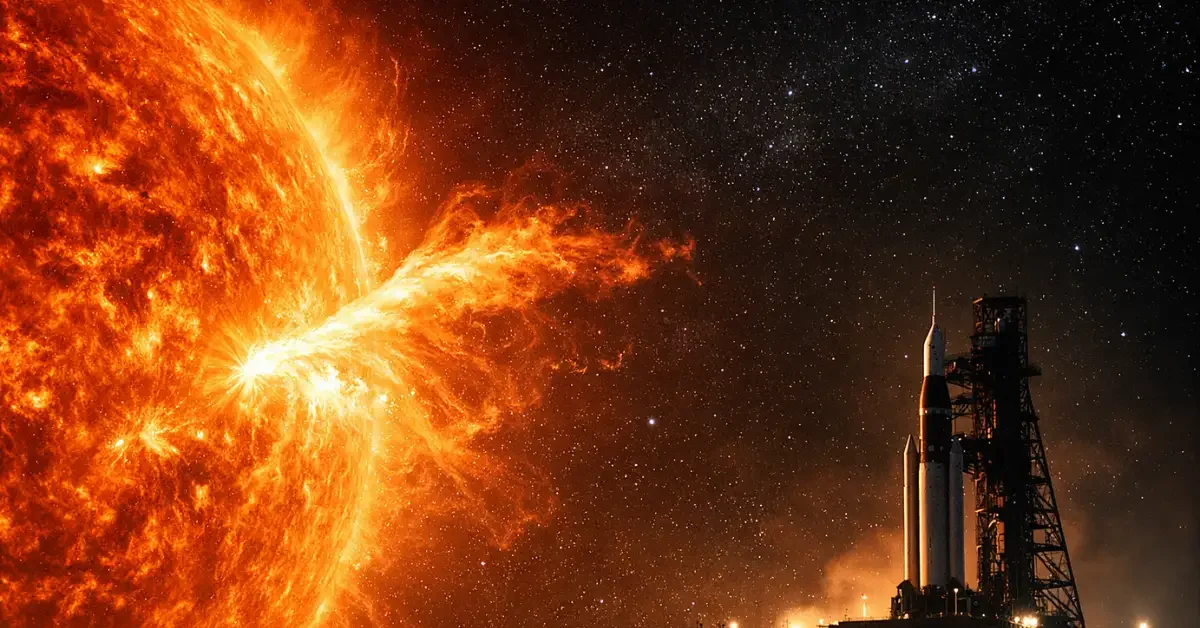
An intense surge of solar energy has caught the eye of space weather experts, occurring merely days before a highly anticipated spaceflight. The sun recently emitted a powerful X1.4 solar flare, which caused a temporary loss of radio signals across regions in Asia and Australia.
This dramatic space weather event quickly sparked conversations about potential risks to NASA’s Artemis II launch. Scheduled to lift off on April 1, 2026, this historic mission represents humanity’s first crewed journey back to the moon since 1972. Although the timing of the solar eruption initially raised eyebrows, aerospace officials remain confident as pre-flight preparations continue.
Anatomy of the Solar Eruption
The intense burst of solar energy erupted late in the evening at 11:19 p.m. EDT on March 29, continuing into the early hours of March 30. NASA’s Solar Dynamics Observatory captured the event, which scientists quickly categorized as an X-class flare. This specific designation is reserved for the most severe category of solar storms.
This burst of energy emerged from a magnetically complex cluster of sunspots known as active region 4405. Because this area is gradually turning to face Earth, any ongoing eruptions could directly influence our planet over the next several days.
Flares of this magnitude release incredible amounts of radiation, which can easily disrupt satellites and communication grids. Following this specific X1.4 solar flare, monitors confirmed a short-lived radio blackout over parts of Asia and Australia. Experts note that this level of signal disruption is completely expected for an eruption of this size.
In addition to the flare, the sun expelled a coronal mass ejection. Frequently referred to as a CME, this event is essentially a giant cloud of charged solar particles hurled into space. When directed at Earth, these particles can collide with the planet’s magnetic field, triggering geomagnetic storms that occasionally impact power systems and satellites.
Space Weather and the Artemis II Launch
With the Artemis II launch slated for 6:24 p.m. EDT on April 1, this sudden solar activity prompted an immediate assessment by space agency leaders. The upcoming mission will send four astronauts on a 10-day trip around the moon, meaning crew safety is the ultimate priority.
Addressing reporters at the Kennedy Space Center, Amit Kshatriya stated that the coronal mass ejection tied to the recent flare is not projected to create any significant problems for the mission. He emphasized that the team is not tracking any hazards that would require delaying or canceling the launch.
Officials managing the mission have analyzed recent space weather updates and resolved to move forward with the countdown. Current conditions remain well within acceptable safety margins, and forecasts predict a high probability of favorable weather at the launch site.
Still, space weather experts are carefully watching the volatile solar conditions. Solar physicist Tamitha Skov warned that NASA must pay close attention to radio bursts. These bursts can severely disrupt high-frequency and very-high-frequency radio signals, which are critical for satellite communications during launch operations and early orbit maneuvers.
Radiation Risks and Astronaut Safety
Aerospace engineers never treat severe solar activity lightly. Radiation exposure is one of the most significant dangers for astronauts traveling outside the protective bubble of Earth’s atmosphere. This threat becomes especially serious during lunar missions, where the natural shielding provided by Earth’s magnetic field is greatly diminished.
To help mitigate these hazards, the Artemis II mission includes an essential, built-in safety drill. During their journey, the astronauts will practice assembling a dedicated radiation shelter inside their spacecraft. This specially designed zone provides the crew with extra shielding if radiation levels spike unexpectedly during a severe solar storm.
Geomagnetic Storms and Auroras
While NASA remains focused on its lunar goals, experts on Earth are actively tracking the incoming solar particles. The recent coronal mass ejection has an Earth-directed component that could soon deliver a glancing blow to our planet.
In response, the National Oceanic and Atmospheric Administration’s Space Weather Prediction Center has activated a moderate geomagnetic storm watch. This G2-level alert is scheduled for March 31, with milder G1 storm conditions possible on March 30 and April 1.
Should the coronal mass ejection graze Earth’s magnetic field, it could spark geomagnetic storms that push auroras much further south than they typically appear. Based on NOAA’s projections, a favorable alignment of space weather conditions could make these colorful light displays visible in states like Washington, Wisconsin, and New York.
