

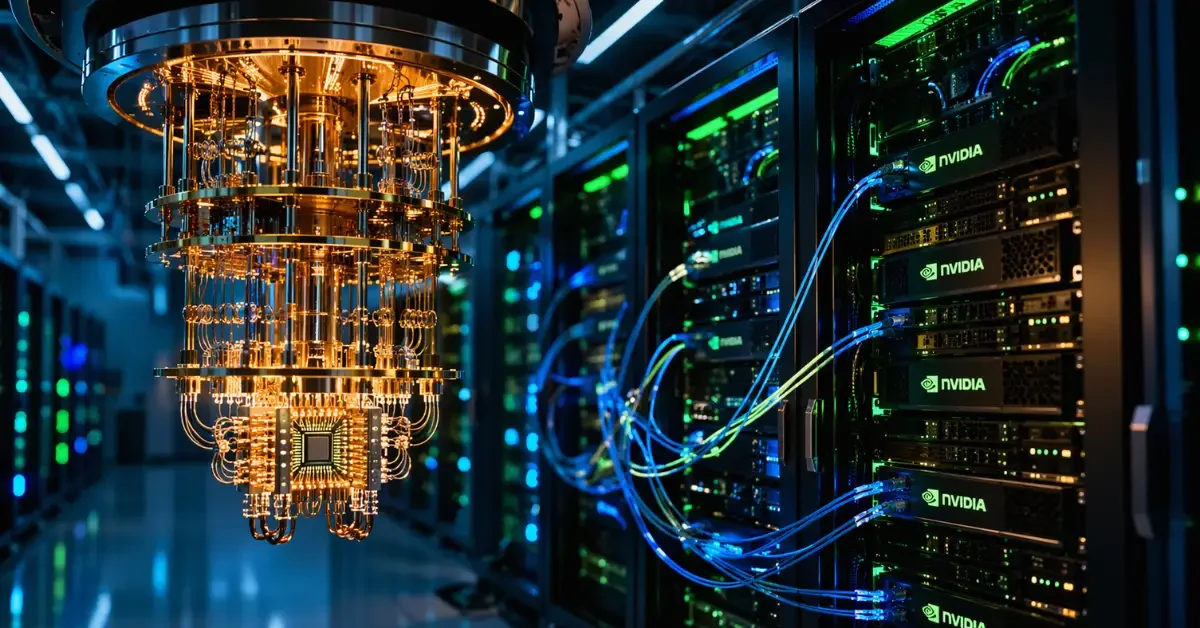
Nvidia has officially launched Ising, a groundbreaking family of open-source quantum AI models designed to tackle the most significant bottlenecks in quantum computing. The announcement, timed to coincide with World Quantum Day on Tuesday, introduced a suite of tools aimed at overcoming processor calibration and error-correction challenges. By addressing these fundamental issues, Nvidia aims to accelerate the development of fault-tolerant quantum systems, sparking a major rally in quantum computing stocks globally.
Instead of competing with generative text models like ChatGPT, Google Gemini, or Anthropic’s Claude, the Nvidia Ising AI models serve a completely different purpose. Rather than predicting the next word in a sentence, Ising acts as an operating system for the next generation of supercomputers by predicting and fixing errors in fragile quantum bits, or qubits, in real time.
Transforming the Quantum Computing Landscape
Building a practical quantum computer requires overcoming severe hardware limitations, primarily because qubits are highly sensitive and prone to errors. According to Sam Stanwyck, Nvidia’s director of quantum product, qubits are inherently noisy, and this noise represents the primary bottleneck preventing today’s quantum hardware from running useful applications.
To solve this, the Ising family, named after the Lenz-Ising model of ferromagnetism, leverages artificial intelligence to manage complex physical systems. Nvidia founder and CEO Jensen Huang stated that AI is essential for making quantum computing practical. He noted that with Ising, AI effectively becomes the control plane and operating system for quantum machines, helping to transform fragile qubits into scalable, reliable systems powered by both quantum and graphics processing units.
The initial rollout of the Ising family features two primary model domains: Ising Calibration and Ising Decoding.
Ising Calibration
Ising Calibration is a vision-language model designed to interpret and react to measurements from quantum processors. This model enables AI agents to automate the continuous calibration of quantum systems. According to Nvidia, this innovation can drastically reduce the time required to set up a quantum computer, cutting the process down from several days to just a few hours.
Ising Decoding
Ising Decoding consists of two variants of a three-dimensional convolutional neural network model focused on real-time quantum error correction. One variant prioritizes speed, while the other is optimized for maximum accuracy. Nvidia reports that these decoding models deliver up to two and a half times faster performance and three times higher accuracy compared to current open-source industry standards.
Quantum Computing Stocks Rally on the News
The financial markets reacted swiftly to Tuesday’s announcement, sending quantum computing stocks soaring as investors digested the implications of the new AI integration. Nvidia’s own shares experienced a 2.8 percent increase following the unveiling.
Smaller companies focused exclusively on quantum technology saw even more dramatic gains. Shares of Xanadu Quantum Technologies surged by 28 percent. IonQ and D-Wave Quantum both experienced a 13 percent spike, while Rigetti Computing shares rose by 9 percent.
The momentum extended to Asian software and information-technology markets. In South Korea, cybersecurity and software firms such as Axgate Co. and ICTK Co. briefly hit their daily trading limits of 30 percent. In China and Japan, companies including GuoChuang Software Co., QuantumCTek Co., and Fixstars Corp. each recorded gains of at least 8 percent.
Market analysts at Bernstein highlighted the long-term significance of these developments, noting to clients that quantum processor units are poised to become the next essential co-processor in data centers. While central processing units will handle general tasks and graphics processing units will manage highly parallel workloads like AI, quantum processors will tackle complex problems that remain too costly or difficult for classical computers.
A New Ecosystem for Developers and Researchers
Nvidia is positioning the Ising AI models as the top layer of its broader quantum computing portfolio. The models seamlessly integrate with the company’s existing infrastructure, including the CUDA-Q platform for hybrid quantum-classical workloads and the NVQLink hardware interconnect designed for real-time control and error correction.
To support developers, Nvidia released a comprehensive cookbook of quantum computing workflows, training data, and microservices. This allows researchers to fine-tune the open-source models for specific hardware architectures while running them locally to protect proprietary data.
Early adoption of the Ising models is already underway across major research institutions and enterprises. Organizations currently deploying Ising Decoding include Cornell University, Sandia National Laboratories, IQM Quantum Computers, Infleqtion, EdenCode, SEEQC, and the University of Chicago, among others. Dr. Tal David, CEO of Quantum Art, praised the advancement, stating that Nvidia Ising perfectly demonstrates the power of hybrid quantum-classical computing at the forefront of the industry today.
