

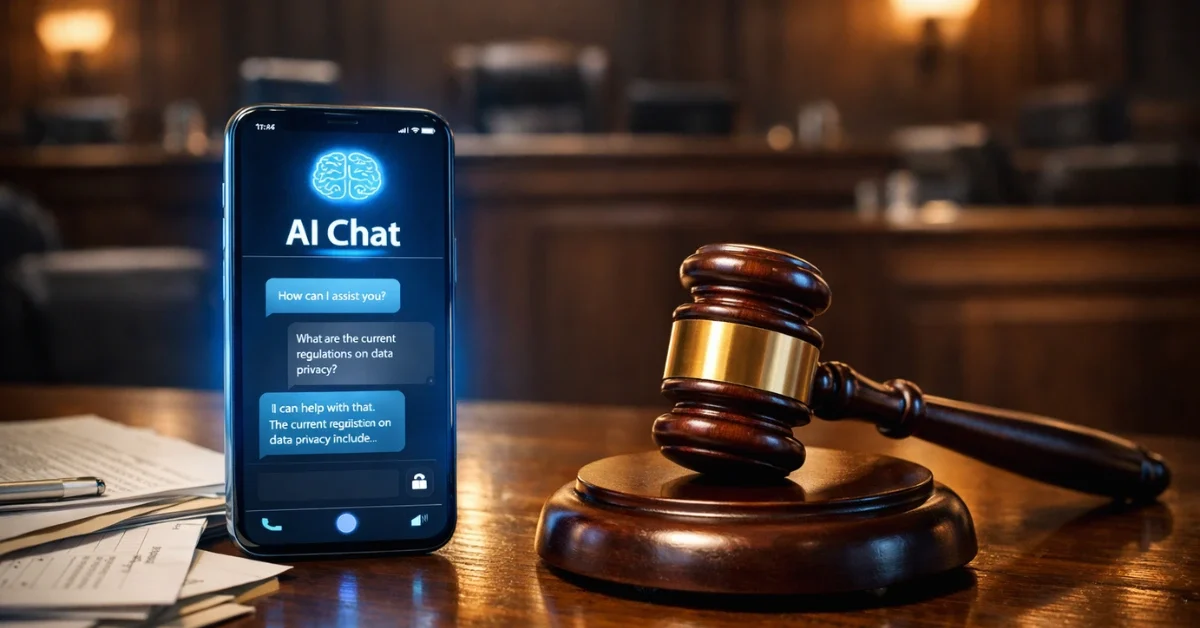
Artificial intelligence is rapidly changing the legal landscape, and federal courts are stepping in to set boundaries. Recent legal decisions reveal that sharing sensitive case information with AI chatbots can destroy attorney-client privilege. At the same time, companies are beginning to sue AI developers directly after being forced to defend against fake, AI-generated legal documents.
These early rulings show that the justice system is treating AI not just as a novel tech tool, but as a disruptive third party. For lawyers and clients, understanding these new rules is essential to protect confidential information and avoid costly mistakes.
Chatbots Can Break Attorney-Client Privilege
In a major decision in February 2026, the United States District Court for the Southern District of New York established that AI chatbots are not a secure vault for legal secrets. Judge Jed S. Rakoff ruled in a criminal fraud case, United States v. Heppner, that conversations between a defendant and an AI bot are not protected by attorney-client privilege.
Defendant Bradley Heppner used the AI assistant Claude to analyze his case. He claimed he used the bot strictly to prepare information for a meeting with his human attorney. However, the court found that his chats failed all three requirements for attorney-client privilege. Because he used a consumer-level large language model that trains on user prompts, the judge treated the AI like a human third party.
The court noted that if a person discusses legal plans with a friend over drinks and leaves notes behind, those notes are not privileged. Similarly, Heppner foolishly waived his confidentiality rights by sharing details with an unsecure chatbot. When Heppner was arrested, law enforcement lawfully seized the electronic records of his AI conversations, and the prosecution was allowed to use them against him.
A Narrow Exception for Self-Represented Litigants
While the Heppner case set a strict standard for represented clients, another federal case took a different approach for individuals acting without a lawyer. In Warner v. Gilbarco, Inc., the court ruled that an unrepresented litigant’s chats with an AI did qualify as protected work product.
Because the litigant was acting as her own attorney, the AI chats represented her mental impressions formed in anticipation of litigation. The judge determined that simply storing this work product in an AI system did not automatically waive protection. The key factor was that the information was not shared in a way that was reasonably likely to reach the opposing side. Therefore, the court viewed the AI use as an administrative function rather than a disclosure to an adversary.
Companies Are Now Suing AI Developers
As courts navigate confidentiality, they are also facing the fallout of AI generating fake legal work. In March 2026, Nippon Life Insurance Company of America filed a federal lawsuit against OpenAI in Illinois. This case highlights the severe financial damage caused when AI tools act like unlicensed lawyers.
The dispute began after Nippon settled a claim with a former employee, Graciela Dela Torre. Dela Torre later suspected that her settlement contained errors. Her human lawyers told her the settlement was final and explained the legal reality of a dismissal with prejudice. Unhappy with this answer, she turned to ChatGPT.
According to the complaint, ChatGPT told Dela Torre that her former lawyers were “gaslighting” her. The AI then generated legal pleadings filled with fictitious citations and encouraged her to file them to reopen the settled case. Nippon claims it was forced to spend $300,000 defending against these bogus, AI-generated court filings. Now, Nippon is suing the creators of ChatGPT to recover those costs.
The Problem With AI Disclaimers
The Nippon lawsuit raises a critical question regarding whether AI companies can avoid liability just by telling users to consult a real lawyer. Normally, courts can punish human attorneys for filing bad-faith lawsuits. However, holding an AI developer accountable for a user’s filings is a new frontier.
Nippon’s lawsuit argues that software developers can be held liable for tortious interference if they knowingly design and market tools that facilitate unlawful conduct. The situation is being compared to Tesla’s legal troubles over its autonomous driving software, where the company faced liability because it knew its safety warnings were largely ineffective.
AI models like Claude offer specific legal plugins for contract review and litigation support. Even though these tools include disclaimers stating that outputs should be reviewed by licensed attorneys, critics argue these warnings are not enough. If an AI acts in a way that would be illegal for a human and causes foreseeable harm, tech companies may struggle to convince a jury that a simple disclaimer shields them from responsibility.
What This Means for the Legal Profession
Legal experts warn that this genie is not going back into the bottle. Lawyers must now actively protect their clients from the risks of using consumer large language models like ChatGPT, Grok, and Claude.
Attorneys are being advised to include strict AI warnings in their client retention agreements. Clients need to understand that consumer AI systems are not closed or secure. Feeding case details into an AI to review lawyer communications is essentially leaking confidential information onto the internet.
As the boundaries of the legal practice shift, the justice system will continue to be pushed to define responsibility. For now, the message from the courts is clear: AI is not your lawyer, and treating it like one comes with severe legal consequences.
